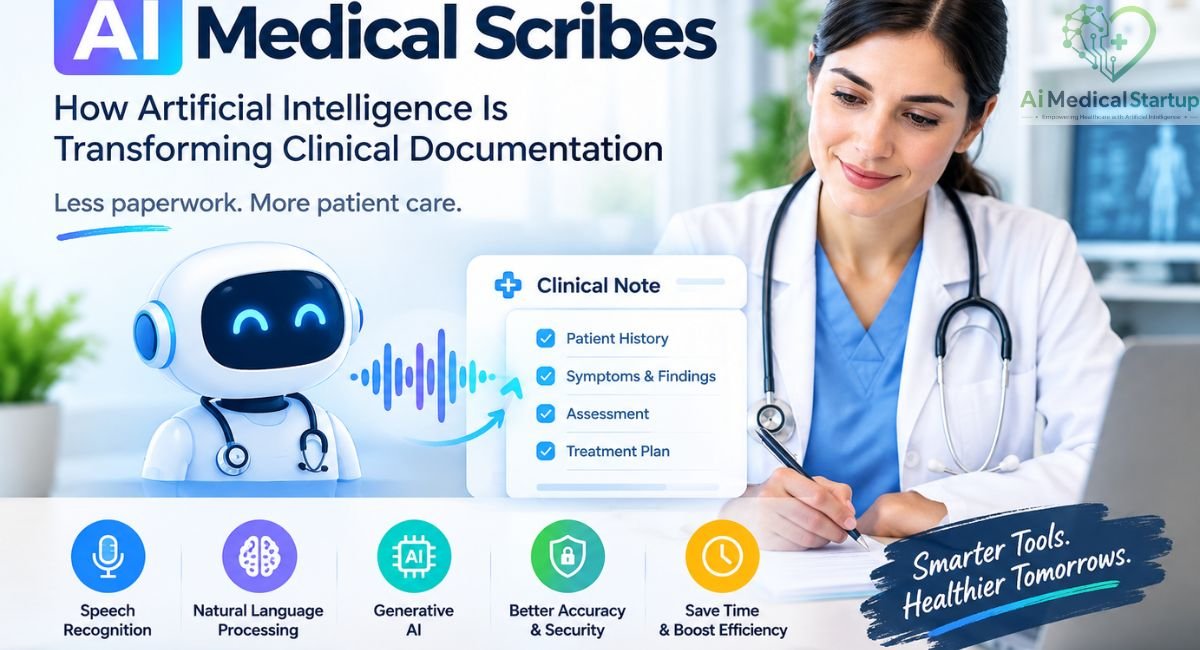
AI Medical Scribes

AI Medical Scribes: How AI Is Transforming Clinical Documentation
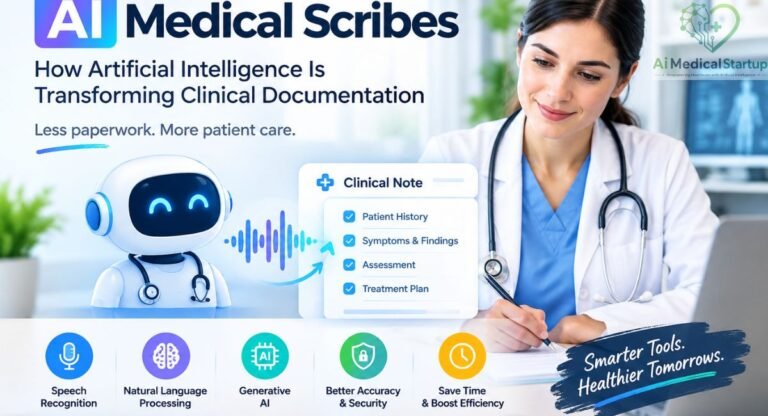
Clinical documentation can take almost as much energy as the patient visit itself. Physicians often spend hours reviewing notes, updating records, and completing administrative tasks after seeing patients. That is where AI Medical Scribes are changing the workflow. These intelligent systems can listen to clinician-patient conversations, understand relevant medical information, and turn spoken discussions into structured clinical notes. By combining artificial intelligence in healthcare, speech recognition, natural language processing, and generative AI, they can reduce repetitive documentation work while keeping clinicians involved in the final review.
For busy practices, this technology offers a practical way to streamline documentation without removing the human judgment that healthcare requires. However, AI-generated notes are not automatically perfect. Accuracy, privacy, security, EHR integration, and clinician oversight all matter. In this guide, you will learn how AI medical scribes work, what benefits they offer, how safe and accurate they are, what they cost, and what healthcare organizations should consider before adopting them.
What Is an AI Medical Scribe?
An AI medical scribe is software designed to assist with clinical documentation by processing information from a patient encounter and generating draft notes. Unlike ordinary transcription software, modern systems can interpret conversational context, identify clinically relevant details, and organize information into familiar medical formats. The goal is not merely to produce words, but to make documentation more useful.
Traditional medical scribes provide similar support through human observation and medical note-taking. An AI scribe attempts to automate parts of that process using speech recognition, natural language processing, and generative AI. Depending on the product, it may support real-time transcription, note generation, EHR workflows, or other documentation tasks. However, capabilities vary considerably between vendors.
What Does a Traditional Medical Scribe Do?
A traditional medical scribe typically documents patient encounters on behalf of a clinician, recording relevant medical history, examination findings, assessments, treatment plans, and other information for the electronic health record. The scribe may work beside the clinician or remotely. This arrangement reduces some clerical tasks, allowing the clinician to devote more attention to the patient.
Human scribes can also understand conversational nuance and ask for clarification when appropriate, although their performance naturally depends on training and experience. They may help organize patient charts, document medical test results, and support the broader physician workflow. Their presence, however, introduces staffing, training, scheduling, and scalability considerations that software handles differently.
How Is an AI Scribe Different from a Human Scribe?
The biggest difference is how the documentation work gets performed. An AI system can record patient-doctor interactions, process speech, and generate clinical notes without another person sitting in the room. A human scribe brings judgment and situational awareness, while an AI scribe brings automation, scalability, and rapid processing.
That distinction does not mean AI is automatically better. A systematic review found that AI scribes generally show promising efficiency benefits, yet documentation quality varies and clinicians continue to raise concerns about reliability. In practice, the strongest model is often human oversight paired with intelligent automation rather than blind dependence on either approach.
Who Can Use AI Medical Scribes?
Healthcare professionals across many outpatient settings can potentially use AI scribes, including physicians, doctors, nurse practitioners, physician assistants, and some other clinicians. Primary care, specialty clinics, urgent care, telehealth, and other environments may benefit when encounters generate substantial documentation. The exact suitability depends on workflow, specialty, patient population, and software capabilities.
For example, a family physician may use an AI scribe to organize routine follow-up documentation, while a specialist may need highly specific structured templates and terminology. A clinician providing virtual care may have different technical requirements from someone delivering in-person care. The important question is not whether AI can produce a note, but whether it produces the right note reliably.
How Do AI Medical Scribes Work?
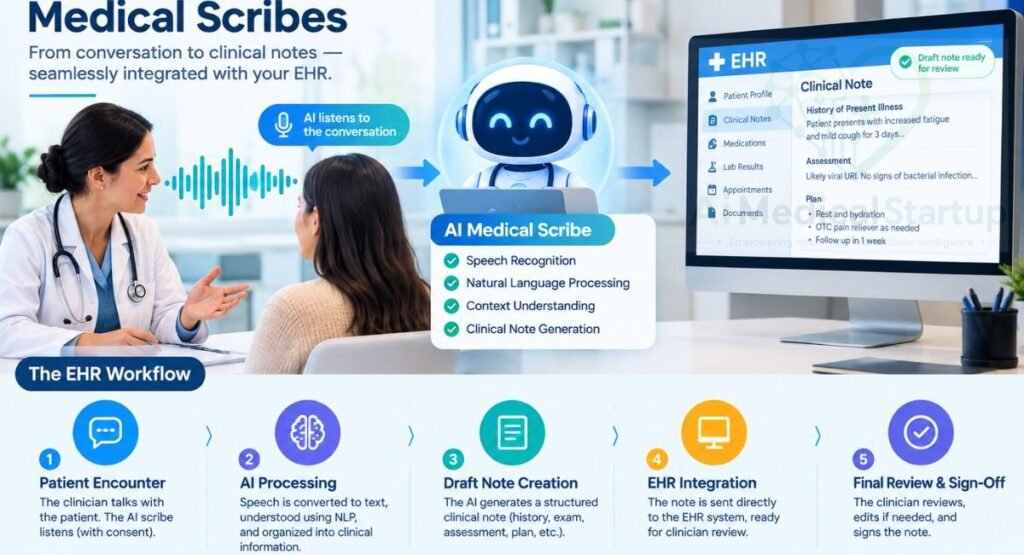
The modern AI scribe workflow usually resembles a relay race: audio enters first, language processing interprets it, generative AI organizes the information, and the clinician finishes the final leg. The system may document clinical sessions, identify relevant statements, and prepare a draft without requiring the clinician to type throughout the consultation.
Underneath that simple experience sits a chain of technologies. Voice recognition converts speech into machine-readable text, while natural language processing helps identify meaning and relationships. Generative models can then transform that information into organized medical notes. The clinician reviews the result before it becomes part of the official record.
Capturing the Patient-Clinician Conversation
Many modern systems use ambient listening to record conversations during appointments rather than requiring the clinician to dictate every sentence manually. The software captures relevant dialogue through a supported device or application and processes the audio according to its technical and privacy design. This can make automated note-taking feel less intrusive than constant typing.
However, recording a clinical encounter creates responsibilities that cannot be waved away with clever software. Organizations need appropriate policies for patient consent, device security, access, retention, and disclosure. Patients should understand when technology participates in documentation, while clinicians should know exactly where the captured information goes and how long it remains available.
Speech Recognition and Natural Language Processing
The first technical hurdle is understanding human speech, which is rarely neat. Speech recognition must handle accents, interruptions, medical terminology, background noise, incomplete sentences, and people speaking over one another. Natural language processing then helps identify what those words mean within the context of the encounter.
This matters because healthcare language is packed with abbreviations and subtle distinctions. “No chest pain” has a very different meaning from “chest pain,” while medication names can sound surprisingly similar. Better AI technology therefore needs more than accurate transcription; it must preserve context so the resulting documentation does not distort information that could influence clinical decisions.
Turning Conversations into Clinical Notes
A raw transcript is rarely what a clinician wants to read. Instead, modern systems can summarize patient interactions, separate relevant information from conversational clutter, and create medical notes in a selected format. Depending on the platform, the system may organize symptoms, history, findings, assessment, and plans into a familiar clinical structure.
This process is where generative AI becomes particularly useful—and particularly risky. A fluent model can produce beautifully organized documentation while still misunderstanding a detail. For that reason, AI-powered clinical documentation should be treated as draft assistance rather than autonomous medical judgment. The smoother the note looks, the more important careful verification becomes.
Physician Review and Approval
The final safeguard is remarkably simple: a qualified clinician reads the draft before approving it. During this stage, the physician should check medications, allergies, diagnoses, symptoms, examination findings, assessment, and treatment plans. This review protects both the patient record and the clinician from quietly accepting an AI-generated mistake.
Human review also preserves accountability. AI can capture relevant information and organize it, but it cannot assume professional responsibility for the care provided. Research reviews continue to identify omissions and occasional clinically significant inaccuracies, reinforcing why clinician verification remains central to safe implementation.
What Types of Clinical Notes Can AI Scribes Create?
The usefulness of an AI medical scribe depends partly on what documentation it can produce. A basic tool might generate a general encounter summary, while a sophisticated platform can create specialty-specific formats, support customizable notes, and fit existing documentation preferences. The exact options differ by vendor and should be tested before adoption.
For clinicians, the practical advantage comes from reducing reconstruction work. Instead of starting with a blank screen after the patient leaves, the clinician receives an organized draft that can be corrected, expanded, and signed. That distinction turns clinical documentation from a blank-page exercise into a review process.
SOAP Notes
SOAP documentation organizes an encounter into Subjective, Objective, Assessment, and Plan sections. An AI system can potentially sort conversational information into these categories, helping clinicians use structured documentation templates rather than manually rebuilding the encounter afterward.
The challenge is knowing where information belongs and whether it was actually established during the visit. A sophisticated system should distinguish patient-reported symptoms from clinician observations and avoid inventing objective findings. Consequently, clinicians should review each section rather than assuming the structure guarantees documentation accuracy.
Progress Notes
Progress notes describe how a patient’s condition is changing over time and what the clinician plans to do next. AI can assist by organizing current symptoms, treatment responses, relevant history, and updated plans into a readable note.
For chronic-care settings, this can be particularly helpful because encounters often involve repeated information mixed with subtle changes. The system should highlight what changed rather than merely recycling old language. Clinicians still need to confirm that the note accurately reflects the current encounter and does not carry forward outdated information.
Patient History and Examination Notes
AI systems can assist with documentation of patient history and examination-related information discussed during the encounter. They may identify symptoms, duration, relevant history, medications, and other details while the clinician concentrates on the interaction.
Yet AI cannot physically examine a patient unless another validated technology supplies that information. A conversational scribe can document what the clinician says or enters; it should not manufacture an examination finding simply because a typical template expects one. This distinction is fundamental to safe medical documentation.
Referral and Follow-Up Documentation
Referral and follow-up documentation can involve several moving pieces, including the reason for referral, relevant findings, previous treatment, current concerns, and next steps. AI tools may organize these details into a more coherent draft when the information is available during the encounter.
The real benefit comes when documentation remains connected to the patient’s broader care journey. A well-structured note can help another clinician understand why the referral occurred and what has already been considered. That supports continuity without pretending that automated text alone guarantees better care.
Other Clinical Documentation
Depending on the platform, AI tools may support patient instructions, discharge-related documentation, specialty templates, coding assistance, or other administrative outputs. Some systems also offer pre-charting, allowing information available before the encounter to be organized ahead of time.
These capabilities should be treated as product-specific rather than universal. One AI scribe software package may excel at ambulatory notes while another emphasizes EHR integration or specialty workflows. Before purchasing, practices should test the exact documentation they generate most frequently instead of judging a platform from a polished demonstration.
What Are the Benefits of Using an AI Medical Scribe?
The strongest argument for AI medical scribes is not that they make medicine effortless. It is that they can remove repetitive documentation work from an already crowded clinical day. Reviews of AI-driven documentation systems report promising improvements in efficiency and task burden, while also emphasizing variability in quality and the need for continued validation.
That distinction matters because healthcare is not a factory where every task can be automated safely. The value of an AI scribe appears when it reduces friction without introducing new clinical risks. When implemented thoughtfully, it can support clinical workflow, reduce repetitive typing, and give clinicians more mental space for the human side of medicine.
Saves Physicians Time
Time is often the most visible benefit. By reduce charting time and helping clinicians spend less time charting, AI documentation tools can shift some work from manual composition toward review and editing. That can be valuable when clinicians routinely finish charts after scheduled appointments.
The size of the benefit varies. A 2026 emergency-department study involving 198,178 encounters found ambient AI scribes were associated with a modest reduction in adjusted median attending documentation time, while human scribes showed a larger reduction; clinical productivity did not differ between groups.
Reduces Administrative Burden
Documentation rarely exists in isolation. It sits inside a larger collection of forms, coding tasks, messages, orders, and other administrative work. When software can reduce administrative workload, clinicians may have fewer repetitive steps competing for attention.
Still, AI does not erase administrative work by itself. Someone must review the generated note, resolve errors, complete required fields, and perform tasks the software does not support. The better goal is to reduce administrative burden without simply moving the burden somewhere else.
Helps Reduce Physician Burnout
Documentation burden has become closely associated with clinician stress and physician burnout, making automation an attractive intervention. Some implementation studies report improvements in clinician wellness, although the evidence is not consistent enough to claim that AI scribes independently solve burnout.
That nuance matters for healthcare worker mental health. If a tool saves twenty minutes of charting but creates ten minutes of corrections, the net gain is smaller than the marketing headline suggests. A successful system should make the whole workflow lighter, not simply replace one tedious task with another.
Improves Clinical Workflow
Good documentation technology should fit the way clinicians already work rather than forcing them through an awkward maze. AI can improve clinical workflow when capture, note generation, review, and EHR completion happen with minimal friction.
Implementation studies have found efficiency improvements across many settings, but adoption and performance vary. A practice should therefore measure actual workflow outcomes instead of assuming that installing software automatically makes clinical operations more efficient.
Allows Physicians to Focus More on Patients
One of the most appealing benefits is simple: clinicians may spend less time staring at the screen. Some studies report better patient-clinician interaction and greater clinician attention after ambient documentation tools are introduced.
This can strengthen direct patient attention without requiring a dramatic change to the appointment itself. Instead of typing every sentence, a physician can listen, observe facial expressions, ask follow-up questions, and explain treatment. The technology should support the physician-patient relationship, not become another barrier between two people.
Supports More Consistent Documentation
Templates can create a predictable framework for documentation, particularly in busy practices where clinicians use different writing habits. AI can customize clinical notes around preferred structures and help standardize recurring documentation patterns.
Consistency, however, should never be confused with correctness. A perfectly formatted error is still an error. Practices should monitor whether AI-generated notes are complete, clinically appropriate, and faithful to the encounter before deciding that standardized output represents improved quality.
How Do AI Medical Scribes Benefit Patients?
Patients may never think about documentation until they notice the clinician looking at the screen instead of them. That makes the patient-facing value of healthcare AI surprisingly tangible. If documentation assistance allows the clinician to maintain better attention, the technology can improve the interaction without becoming the focus of the visit.
Research on AI-powered voice documentation has generally found promising effects on patient-centered interaction and efficiency, although safety findings remain less certain. The patient benefit therefore depends on implementation, accuracy, transparency, and whether the clinician remains fully engaged.
More Face-to-Face Attention During Visits
A clinician who does not need to type constantly may have more opportunities for eye contact, active listening, and natural conversation. Studies of ambient documentation have reported improved patient-clinician interaction in some settings.
That can improve patient interaction in small but meaningful ways. Imagine explaining a worrying symptom while the clinician is looking at you rather than rapidly entering information into an EHR. The technology disappears into the background, which is exactly where good documentation assistance belongs.
Potentially Faster Documentation and Follow-Up
AI-generated drafts can help clinicians finish documentation sooner, potentially supporting more timely follow-up. A completed note can also make information easier to review when another clinician needs to understand what happened during an earlier encounter.
However, it would be misleading to promise that AI will automatically shorten appointment times or eliminate wait times. Real-world studies show mixed effects, and some emergency-department research has found technical and workflow barriers. (PubMed) Efficiency depends on the entire system, not one software feature.
Better Continuity of Care
Clear documentation can act like a clinical breadcrumb trail. When patients see different clinicians over time, well-organized notes help the next professional understand symptoms, prior decisions, medications, and follow-up plans.
AI can assist with that organization, but continuity still depends on human judgment. If a generated note omits a crucial detail, its polished appearance may create false confidence. Clinicians should therefore verify important information before relying on it for subsequent clinical decisions.
Improving the Overall Patient Experience
A better patient experience comes from more than faster paperwork. Patients want to feel heard, respected, and understood. If AI reduces screen distraction while preserving accurate documentation, it can contribute to that experience.
Transparency matters too. Patients may reasonably ask whether they are being recorded, how their information is handled, and whether someone reviews the generated note. A straightforward explanation can prevent the technology from feeling like a hidden observer in an already sensitive conversation.
Are AI Medical Scribes Accurate and Reliable?
Accuracy is where enthusiasm needs a seatbelt. Modern AI scribes can generate remarkably fluent clinical notes, but fluency is not proof of factual correctness. A 2025 systematic review found strong potential for efficiency while noting variability in documentation quality and continuing concerns about reliability and validity.
More recent reviews paint a similar picture. AI scribes can reduce documentation burden, yet researchers have identified omissions and occasional clinically significant hallucinations. In healthcare, one missing medication or misunderstood symptom can matter far more than several perfectly written sentences.
How Accurate Are AI-Generated Clinical Notes?
There is no single accuracy percentage that applies to every AI scribe. Performance depends on the underlying model, audio quality, clinical specialty, encounter complexity, documentation format, and evaluation method.
A tool that performs well during routine primary-care visits may behave differently during a complicated consultation with multiple speakers and specialized terminology. This is why healthcare organizations should assess reporting accuracy using representative encounters rather than relying solely on vendor demonstrations or generic benchmark claims.
Why Human Review Still Matters
Human review is the safety net between an AI-generated draft and an official patient record. The clinician can compare the note with the encounter, correct errors, remove irrelevant material, and ensure that the assessment and plan accurately reflect professional judgment.
This review should not become a ceremonial signature. If clinicians routinely approve notes without reading them, automation can create a dangerous illusion of reliability. The safest workflow treats AI output as assistance that requires active verification before it enters the permanent record.
Common Documentation Errors
AI-generated documentation can contain omissions, incorrect wording, wrong speaker attribution, misunderstood medication names, or statements that sound reasonable but were never actually made. These problems are especially concerning when the resulting note appears polished.
Researchers have specifically reported documentation omissions and occasional clinically significant hallucinations in ambient AI systems. That is why human error is not the only risk worth considering. AI introduces its own error patterns, and clinicians need workflows designed to catch them.
Factors That Can Affect AI Scribe Accuracy
Audio quality, room noise, accents, rapid speech, overlapping conversations, multiple speakers, medical terminology, and unusual clinical scenarios can all influence performance. Emergency departments can be especially demanding because their environments are noisy and unpredictable. A 2026 review identified environmental noise, fragmented workflows, EHR integration, and clinician distrust among reported challenges.
Language diversity deserves particular attention. A system may perform differently across accents, dialects, and languages, making real-world validation essential. Practices should test representative encounters instead of assuming that a strong demonstration in one setting guarantees reliable performance everywhere.
How Clinicians Can Verify AI-Generated Notes
Verification works best as a repeatable habit rather than a vague instruction to “check the note.” Clinicians should compare the draft against the actual encounter, paying particular attention to medications, allergies, diagnoses, symptoms, examination findings, assessment, and treatment plans.
High-risk information deserves especially careful review. If an AI-generated note changes the meaning of a symptom or introduces a medication that was never discussed, the clinician needs to correct it before signing. That simple discipline protects documentation accuracy and keeps clinical responsibility where it belongs.
Are AI Medical Scribes Safe and HIPAA Compliant?
Calling an AI scribe “HIPAA compliant” requires more care than placing a badge on a website. In the United States, HIPAA obligations depend on the roles of the organizations involved and how protected health information is handled. HHS explains that covered entities using business associates generally need written agreements that establish appropriate protections.
For UK and EU organizations, the privacy landscape is broader. Health information is highly sensitive personal data, and organizations must consider applicable data-protection requirements alongside healthcare-specific rules. The European Commission also highlights the importance of trustworthy, secure health-data use as AI becomes more embedded in healthcare.
How AI Scribes Handle Patient Data
An AI scribe may touch patient information at several points: audio capture, data transmission, processing, temporary storage, note generation, EHR transfer, and deletion. Understanding that lifecycle is more useful than simply asking whether a product is “secure.”
Healthcare organizations should know where information is processed, who can access it, how long it remains stored, whether subcontractors receive it, and whether it is used for model training. These questions help determine whether the technology actually fits the organization’s healthcare compliance requirements.
HIPAA and Data Privacy Considerations
Under HIPAA, covered entities and business associates have obligations concerning protected health information. HHS states that business associate arrangements must establish permitted uses and disclosures and require appropriate safeguards.
That means a practice should not accept a generic “HIPAA-ready” statement as sufficient evidence. Ask about the Business Associate Agreement, permitted data use, subcontractors, retention, breach procedures, access controls, and deletion. For EU organizations, the analysis should also consider GDPR obligations and applicable national requirements.
Data Encryption and Security
Strong data security should extend across the entire information lifecycle. Healthcare organizations should examine encryption during transmission and storage, authentication, role-based access, audit logging, credential management, breach response, and retention controls.
The important point is that security is a system, not a single checkbox. Even excellent encryption cannot compensate for weak passwords, excessive access privileges, poor vendor governance, or careless device management. Secure processing requires technology, policies, people, and continuous monitoring working together.
Patient Consent and Transparency
Patients deserve to know when technology participates in their clinical encounter. The exact legal requirement for consent can vary according to jurisdiction, organizational policy, and how the system operates, so practices should obtain appropriate legal and compliance guidance rather than relying on a universal rule.
A simple explanation can go a long way: the tool assists with documentation, the clinician reviews the result, and the information is handled according to established privacy controls. That transparency helps preserve trust while supporting patient consent and informed participation.
Questions Healthcare Organizations Should Ask Vendors
| Question | Why it matters |
| Where is patient data processed? | Establishes the relevant data environment and jurisdiction. |
| How long is audio retained? | Determines exposure after documentation is created. |
| Is audio deleted automatically? | Clarifies the lifecycle of sensitive recordings. |
| Will data train models? | Reveals secondary data-use practices. |
| Is a BAA available? | Important for applicable US healthcare arrangements. |
| What subcontractors are involved? | Identifies third-party data exposure. |
| How is data encrypted? | Helps assess technical safeguards. |
| What happens after contract termination? | Clarifies deletion or return of healthcare data. |
What Should You Look for in an AI Medical Scribe?
Choosing an AI scribe should feel more like evaluating a clinical colleague than buying another office application. You need evidence that it works in your environment, supports your documentation requirements, protects patient information, and fits the way clinicians actually practice.
The best product on paper may be the wrong choice in your clinic. AI scribe software should be judged through realistic testing, measurable outcomes, security review, and clinician feedback. A flashy interface cannot compensate for unreliable notes or an awkward EHR workflow.
Accuracy and Clinical Quality
Accuracy should sit near the top of every evaluation. Ask vendors how they measure quality, what error rates they observe, and how their systems perform across specialties and difficult encounters.
Then conduct your own assessment. Review representative encounters and measure omissions, corrections, note completeness, and clinician trust. A system that generates shorter notes but requires extensive editing may save less time than expected.
EHR Integration
An AI scribe that produces an excellent note but forces clinicians to copy and paste everything may create another administrative bottleneck. Strong EHR integration should minimize unnecessary steps between generation, review, and final documentation.
Check whether the product supports your specific EHR environment, authentication process, templates, note insertion, and organizational permissions. Integration should be tested in the real workflow because a feature listed on a sales page may behave differently during everyday clinical use.
Specialty Support
Medicine is not one documentation problem. A dermatologist, cardiologist, psychiatrist, emergency physician, and family doctor may need very different structures and terminology.
A strong system should support medical specialties relevant to your organization and allow appropriate customization. During testing, use real specialty scenarios rather than generic sample encounters. This reveals whether the AI understands the language and documentation patterns clinicians actually use.
Privacy and Security
Privacy should be evaluated before deployment, not after the first patient asks a difficult question. Review encryption, authentication, retention, access control, subprocessors, data residency, breach procedures, and relevant contractual protections.
For US practices, examine HIPAA compliance and applicable contractual requirements. For UK and EU organizations, consider GDPR and relevant local rules. The goal is to protect patient information throughout its lifecycle rather than merely securing the application interface.
Customizable Clinical Templates
Clinicians rarely agree on one perfect note format. Some prefer highly structured templates, while others rely on free-form notes and narrative detail. Good AI tools should accommodate legitimate differences without creating unnecessary complexity.
Look for custom prompts, specialty templates, formatting controls, and physician preferences. Customization can turn generic automation into something that genuinely supports the clinician. Still, every customization should preserve clinical clarity and should not encourage unnecessary documentation simply because the software can generate it.
Ease of Use
An AI tool should reduce friction, not become another application clinicians dread opening. The workflow should make recording, pausing, reviewing, editing, and finalizing documentation straightforward.
A useful AI scribe app may also support a mobile app or browser-based workflow, depending on the clinical environment. Test the software during a busy day, not just during a quiet demonstration. Real-world usability often reveals problems that a polished product tour hides.
Multilingual and Accent Support
Language performance deserves serious attention in diverse healthcare environments. Voice recognition can behave differently across accents, dialects, languages, speech rates, and background conditions.
If your organization serves multilingual populations, ask for evidence rather than accepting a long language list. Test common clinical conversations with representative speakers and evaluate both transcription quality and the accuracy of the resulting documentation.
Pricing and Scalability
Price should be considered alongside value rather than viewed in isolation. A low-cost product that requires substantial manual correction may be more expensive in practice than a higher-priced system that reliably reduces documentation time.
Consider provider numbers, encounter volume, storage, support, integrations, implementation costs, and contract terms. A genuinely cost-effective system should improve the overall workflow enough to justify its total cost of ownership.
Vendor Support and Reliability
Clinical software needs dependable support because downtime and workflow failures can quickly become operational problems. Evaluate on-boarding, technical assistance, training, uptime information, incident communication, product updates, and escalation procedures.
Vendor transparency matters too. Ask how the company handles model changes, significant errors, security incidents, and customer feedback. A healthcare technology partner should communicate clearly when its product changes rather than leaving clinicians to discover new behavior themselves.
How to Implement an AI Medical Scribe in Your Practice
Successful AI implementation is less about installing software and more about redesigning a small piece of clinical work. A 2025 systematic review found promising efficiency and clinician-wellness outcomes but also highlighted variable adoption, performance limitations, and gaps in evaluation.
That is why a thoughtful rollout beats a dramatic launch. Start small, establish measurable goals, involve clinicians, protect patient data, and monitor what actually happens. A careful pilot program can reveal whether the tool improves the workflow before an organization commits to widespread deployment.
Identify Your Documentation Needs
Begin by mapping the current workflow. Where do clinicians lose time? Which notes take longest? How much documentation occurs after hours? Which specialties have the greatest burden? These answers create a baseline against which the technology can be judged.
This stage is also where you should assess documentation needs and define success metrics. Possible measures include note completion time, correction rates, clinician satisfaction, patient feedback, after-hours charting, and adoption. Without baseline data, “improvement” becomes little more than a feeling.
Choose the Right AI Scribe
Once needs are clear, evaluate products against those requirements rather than starting with the most famous brand. Compare accuracy, privacy, specialty support, EHR integration, usability, pricing, and vendor support.
A strong selection process includes clinicians, IT, privacy, security, compliance, and operational leadership. Each group sees different risks. The physician notices note quality; IT notices integration; privacy teams examine data handling; administrators consider scalability and cost.
Connect the Tool With Your EHR
EHR integration is where many promising ideas meet the real world. The organization should test authentication, permissions, templates, note transfer, data flow, and failure handling before clinicians rely on the system.
The aim is to integrate with clinical workflows without forcing clinicians into duplicate documentation. If users must repeatedly move information between disconnected systems, the technology may simply relocate administrative work rather than eliminate it.
Train Physicians and Staff
Training should cover more than which button starts recording. Clinicians need to understand how the AI works, what it can miss, how to review generated notes, and what to do when something looks wrong.
Staff should also understand privacy procedures, patient communication, technical troubleshooting, and escalation pathways. The best clinical software cannot compensate for poor training. Adoption becomes much easier when users understand both the benefits and the limitations.
Establish Review and Quality-Control Processes
Every organization should establish a clear standard for reviewing AI-generated documentation before final approval. The process should identify high-risk fields and define what happens when a recurring error appears.
Periodic audits can reveal patterns that individual clinicians miss. If several users repeatedly correct medication names or missing examination details, that pattern may signal a product limitation or workflow problem. Quality control turns individual experiences into organizational learning.
Monitor Performance After Implementation
Implementation should not end when the software goes live. Track documentation time, correction rates, note quality, clinician satisfaction, patient feedback, adoption, technical failures, and privacy incidents over time.
A useful evaluation asks one simple question: Is the technology making clinical work genuinely better? If the answer is unclear, revisit the workflow. AI should earn its place through measurable value rather than staying because the organization already paid for it.
How Much Does an AI Medical Scribe Cost?
The price of an AI scribe can vary considerably because vendors use different models. Some charge per clinician, while others use usage-based pricing or enterprise agreements. Integration, customization, support, security reviews, and implementation can also affect the final bill.
Rather than asking only, “What does the software cost?” organizations should ask, “What will this workflow cost after implementation?” That broader calculation includes subscription fees, training, clinician review time, technical support, integration, and potential savings from reduced documentation work.
Factors That Affect AI Scribe Pricing
Provider count, encounter volume, specialty functionality, EHR integration, customization, support, storage, and contract length can all influence pricing. Enterprise organizations may negotiate different arrangements from individual clinicians.
The cheapest option is not automatically the most economical. If a product produces unreliable notes that require extensive correction, its apparent savings can evaporate quickly. Total cost should therefore include the administrative workflow around the software.
Subscription-Based Pricing
Subscription pricing commonly charges organizations according to users, seats, or plans. This model can make budgeting easier, particularly for smaller practices that want predictable expenses.
However, buyers should examine what the subscription actually includes. Storage limits, premium integrations, support tiers, specialty features, and implementation services may sit outside the headline price. Always evaluate the complete contract rather than the advertised monthly figure alone.
Per-Provider or Per-Encounter Pricing
Some platforms may structure costs around providers or usage. Per-provider pricing can be predictable for stable teams, while encounter-based pricing may appeal to organizations with variable volume.
The right model depends on how the service is used. A high-volume clinic should calculate annual spending under realistic encounter numbers rather than relying on an attractive low-volume example.
Additional Integration and Enterprise Costs
Large healthcare organizations may incur costs beyond the software license. These can include EHR integration, security assessments, customization, implementation support, training, contract review, and enterprise-level technical services.
These expenses are easy to overlook because they appear outside the product subscription. Yet they can materially affect the return on investment. Good planning includes them from the beginning rather than discovering them after deployment.
AI Scribe vs. Human Medical Scribe: Cost Considerations
Human scribes involve wages, benefits, recruitment, training, scheduling, supervision, and turnover. AI involves software, infrastructure, licensing, integration, and ongoing technical support. The two models therefore have fundamentally different cost structures.
A useful comparison should include productivity, documentation quality, clinician satisfaction, scalability, and oversight. Recent emergency-department evidence found both AI and human scribes associated with reduced documentation time, with human scribes showing a larger reduction in that particular study.
AI Medical Scribe vs. Human Medical Scribe
Neither approach wins every contest. Human medical scribes can understand context, adapt in real time, and interact naturally with clinicians. AI systems can operate at scale, generate drafts quickly, and avoid many staffing constraints. The better option depends heavily on the clinical environment and the organization’s priorities.
| Comparison factor | AI medical scribe | Human medical scribe |
| Availability | Software-based and highly scalable | Depends on staffing |
| Documentation | AI-generated draft | Human-created documentation |
| Contextual judgment | Limited and requires review | Human interpretation |
| Scalability | Generally high | Limited by recruitment |
| Cost structure | Software and usage costs | Labor and employment costs |
| EHR integration | Depends on vendor | Often workflow dependent |
| Patient interaction | No additional person required | Human scribe may be present |
| Oversight | Clinician review required | Clinician oversight still required |
| Privacy | Vendor and implementation dependent | Workforce and organizational controls |
| Best use | Scalable documentation assistance | Human-centered documentation support |
The practical lesson is straightforward: do not choose based on ideology. Choose based on evidence from your workflow. A complicated specialty practice with highly nuanced documentation may value human support, while a large ambulatory network may prioritize scalable AI technology.
What Are the Limitations and Risks of AI Medical Scribes?
Every useful technology has a shadow side, and AI scribes are no exception. Current evidence shows promise alongside meaningful concerns about omissions, inaccuracies, workflow integration, and implementation.
The safest attitude is neither fear nor hype. Think of an AI scribe like an extremely fast junior assistant: useful, tireless, and capable of producing polished work, but still capable of misunderstanding something important. That mindset encourages careful supervision without throwing away the productivity benefits.
Potential Documentation Errors
The most obvious risk is a documentation error. The system may omit a symptom, misunderstand a medication, assign a statement to the wrong speaker, or organize information incorrectly.
Even small mistakes can matter when documentation influences future care. Therefore, clinicians should prioritize review of clinically significant information rather than judging quality by how grammatical the note appears.
Hallucinated or Incorrect Information
Generative AI can sometimes produce information that sounds plausible but lacks support in the source conversation. In healthcare, this phenomenon deserves special attention because fluent language can make an invented detail look legitimate.
The solution is not to abandon the technology. It is to design workflows that reduce human error and AI error together. Source-grounded generation, clinician review, auditing, and clear escalation processes can reduce the chance that an unsupported statement becomes part of the official record.
Privacy and Data-Security Risks
An AI scribe may process highly sensitive health information, making data privacy a central concern. Risks can involve unauthorized access, excessive retention, third-party processing, insecure devices, or unclear secondary data use.
Organizations should examine the entire data lifecycle, including data storage, transmission, processing, deletion, and vendor access. A secure application is only one part of a secure clinical ecosystem.
Over-reliance on AI
Automation can create a subtle psychological trap: once people see consistently good output, they may become less vigilant. This is sometimes described as automation bias, where users place too much trust in automated recommendations or content.
Clinical documentation requires the opposite habit. Clinicians should remain intellectually engaged with the note and correct it when necessary. AI can assist the workflow, but it should never become the unquestioned authority.
Integration Challenges
A technically impressive product can still fail if it does not fit the clinical environment. Poor EHR integration, slow processing, unreliable connectivity, complicated interfaces, or fragmented workflows can frustrate clinicians.
Emergency-department research has identified integration and environmental challenges among the barriers to successful ambient AI adoption. That finding reinforces a simple rule: evaluate the technology inside the real workflow, not merely in a controlled demonstration.
Workflow and Staff Adoption Issues
People do not automatically embrace new technology because management approves it. Clinicians may worry about accuracy, privacy, workflow disruption, or the time required to learn another system.
Adoption improves when staff understand why the tool exists, how it affects their responsibilities, and how problems will be handled. Feedback should flow in both directions. A good AI implementation adapts to clinical reality instead of demanding that clinicians reshape everything around the software.
Why Clinician Oversight Is Essential
Clinician oversight is the final line between assistance and unsafe automation. The healthcare professional understands the patient, applies medical judgment, verifies the record, and remains responsible for the care provided.
This principle should appear throughout any AI documentation policy: AI assists; clinicians decide. When that boundary remains clear, AI can become a useful layer within healthcare rather than an unexamined substitute for professional judgment.
Best AI Medical Scribes to Consider
The market for AI documentation tools changes quickly, so any “best” list should be treated as a current comparison rather than a permanent ranking. Platforms worth researching include Doximity Scribe, Abridge, Nabla, Suki, Microsoft Dragon Copilot, and other established ambient documentation products.
Before choosing one, compare note quality, specialty support, EHR integration, security, languages, pricing, customization, and support. Product capabilities and pricing can change, so verify claims directly with official vendor documentation. A useful comparison should tell you which clinical problem each tool solves best, not simply which brand has the loudest marketing.
| Evaluation area | What to compare |
| Documentation quality | Accuracy, completeness, omissions, editing requirements |
| EHR integration | Supported systems and workflow depth |
| Specialties | Primary care and specialty coverage |
| Privacy | Data handling, retention, access controls |
| Compliance | Applicable HIPAA, GDPR, and organizational requirements |
| Customization | Templates, prompts, note formats |
| Languages | Supported languages, accents, dialects |
| Pricing | Subscription, usage, enterprise arrangements |
| Support | Training, onboarding, technical assistance |
| Scalability | Individual clinician through enterprise deployment |
FAQs About AI Medical Scribes
These questions capture the concerns clinicians and healthcare organizations commonly have before adopting documentation automation. The short answers below are designed to give you the practical takeaway first, while the main sections above provide deeper context.
What is an AI medical scribe?
An AI medical scribe is a software tool that uses technologies such as speech recognition and generative AI to assist with clinical documentation. It can process encounter information and generate clinical notes, but a qualified clinician should review the resulting documentation before finalizing it.
How does an AI medical scribe work?
An AI scribe typically captures or receives encounter information, converts speech into text, identifies clinically relevant content, and generates a structured draft. This is a form of AI-assisted medical documentation that moves from conversation to draft rather than requiring every sentence to be typed manually.
Are AI medical scribes HIPAA compliant?
Some products may be designed to support HIPAA-regulated environments, but “AI” itself is not synonymous with compliance. Organizations should evaluate the vendor, contracts, safeguards, data handling, and implementation. HHS states that covered entities using business associates need appropriate written arrangements and protections.
Can an AI scribe replace a human medical scribe?
An AI tool can replace traditional scribe tasks in some workflows, but that does not mean it replaces human judgment. AI can automate documentation work, while clinicians remain responsible for reviewing the record. Some practices may prefer AI, human scribes, or a combination depending on their needs.
How accurate are AI medical scribes?
Accuracy varies by platform, specialty, environment, encounter complexity, and evaluation method. Current research suggests promising documentation efficiency but also reports omissions and occasional inaccuracies. Clinicians should therefore review generated notes before signing them.
Can AI scribes integrate with EHR systems?
Many AI documentation platforms offer EHR integration, but the depth of integration varies. Some may insert drafts directly into supported workflows, while others require additional steps. Always verify compatibility with your specific EHR rather than assuming that “EHR integration” means a fully automated workflow.
How much does an AI medical scribe cost?
There is no universal price because vendors may use subscription, provider-based, usage-based, or enterprise pricing. Costs can also include implementation, integration, customization, training, and support. The most useful calculation is total cost of ownership rather than the advertised subscription alone.
Do patients need to consent to an AI scribe?
Consent requirements vary depending on jurisdiction, organizational policy, the technology, and how patient information is collected and processed. Practices should determine applicable legal requirements and communicate transparently with patients. Regardless of the legal minimum, clear communication can help maintain trust.
Can AI scribes work with different medical specialties?
Yes, many platforms are designed for multiple specialties, but performance can vary significantly. A tool that works well in primary care may need additional customization for cardiology, emergency medicine, surgery, psychiatry, or other complex specialties. Specialty-specific testing is therefore essential.
The Future of AI Medical Scribes in Healthcare
The next generation of AI medical scribes will likely move beyond simple note creation. Ambient systems are increasingly becoming part of a broader model of clinical intelligence, where AI can understand context, retrieve relevant information, assist with documentation, and support administrative workflows.
The direction is promising, but healthcare will demand stronger validation as these systems become more capable. Future progress will likely involve deeper EHR integration, better multilingual performance, specialty-specific models, multi-modal information, improved privacy controls, and more sophisticated evaluation standards. The European Commission likewise emphasizes trustworthy health-data infrastructure as AI becomes more integrated into healthcare.
Ambient Clinical Intelligence and the Next Generation of AI Scribes
Future systems may understand more than spoken words. They could combine conversation, structured EHR information, clinical context, and other authorized data sources to create richer documentation while reducing repetitive administrative work.
That evolution could make AI a more natural part of digital healthcare. Yet greater capability also increases the importance of governance. The more information an AI system can access and interpret, the more carefully healthcare organizations must control permissions, validation, transparency, and accountability.
AI-Assisted Medical Documentation Will Become More Context-Aware
The most useful systems will not simply transcribe what people say. They will understand which information matters, where it belongs in the note, and what requires clinician confirmation.
That means future automated clinical note generation may become more personalized and specialty-aware. A cardiologist, pediatrician, and family physician could each receive documentation shaped around their clinical context rather than a generic template.
The Future Is Human-AI Collaboration
The real opportunity is not to remove humans from documentation. It is to remove unnecessary friction from their work. AI can handle repetitive organization while healthcare professionals contribute judgment, empathy, interpretation, and accountability.
That division of labor could improve professional satisfaction, support work-life balance, and reduce some of the repetitive burden surrounding clinical care. The technology will succeed, however, only when accuracy, privacy, usability, and human oversight advance together.
Final Takeaway
AI is changing clinical documentation from a largely manual task into an increasingly collaborative human-machine workflow. The strongest systems can automate clinical documentation, organize conversations, create useful drafts, and reduce some of the administrative work that follows every patient encounter.
But the smartest way to adopt this technology is not to ask whether AI can replace clinicians or scribes. Ask whether it can reliably remove repetitive work while preserving accuracy, privacy, patient trust, and professional judgment. Current evidence suggests meaningful potential, but it also calls for cautious implementation, rigorous evaluation, and ongoing clinician oversight.
For healthcare organizations in the USA, UK, and EU, that balanced approach is likely to matter more than any flashy feature. The future of clinical documentation will not simply be about faster notes. It will be about creating better clinical workflows where technology handles the paperwork and people remain firmly in charge of care.
The article is intentionally balanced rather than promotional, because current evidence supports substantial potential but still identifies accuracy, omissions, implementation, privacy, and validation concerns. I also used current research and official regulatory sources so the healthcare claims are not built solely around vendor marketing.



Dr. Kanza Sarfraz, M.B.B.S., is a medical doctor and graduate of Allama Iqbal Medical College, Lahore. She brings nearly seven years of clinical experience across tertiary-care hospitals, medical headquarters, and healthcare facilities in both the public and private sectors. Her clinical experience provides a practical perspective on healthcare delivery, emerging medical technologies, and the evolving role of artificial intelligence in medicine.