AI in Healthcare

AI in Healthcare: Uses, Benefits, Risks & the Future of Medicine
Healthcare is entering a new era, and artificial intelligence in healthcare is becoming one of the core technologies driving that change. From analyzing medical images to assisting doctors with clinical documentation, AI is already influencing how healthcare professionals diagnose, monitor, and treat patients. Unlike traditional software, modern AI in healthcare can recognize patterns, analyze large amounts of medical data, and generate useful insights within seconds. This creates exciting opportunities for faster workflows, earlier disease detection, personalized care, and medical research.
However, the growing use of healthcare AI also raises important questions about accuracy, privacy, bias, safety, and accountability. As AI technologies become more common across hospitals, clinics, and digital health platforms, understanding their real capabilities and limitations matters more than ever. In this guide, you’ll explore the uses, benefits, risks, regulation, and the future of AI in healthcare, including whether AI could ever replace doctors.
Clinical Intelligence
Empowering healthcare professionals with advanced diagnostic tools and predictive analytics for 2026.
What Is Artificial Intelligence in Healthcare?
Artificial intelligence in healthcare refers to the use of computational systems that can analyze medical data, recognize patterns, generate predictions, produce content, or support decisions related to health and medicine. These systems can work with information such as medical images, laboratory results, electronic health records, clinical notes, genomic information, physiological measurements, and other patient data. In simple terms, AI allows computer technology to perform tasks that normally require some form of human cognitive ability.
The phrase AI in healthcare covers a very broad field. A machine-learning model that helps identify abnormalities on an X-ray is different from a generative AI assistant that summarizes clinical notes. Both are examples of medical artificial intelligence, but they solve different problems. The U.S. FDA describes AI-enabled medical devices as technologies that can support diagnosis, prognosis, risk assessment, and other medical functions, while WHO emphasizes that responsible deployment must remain safe, ethical, equitable, and people-centered.
Artificial Intelligence in Healthcare Definition
The simplest definition is this: artificial intelligence in healthcare uses computational models to analyze information and produce useful outputs for patient care, research, administration, or public health. Some systems predict outcomes. Others classify images, summarize information, detect patterns, or generate text. Their capabilities depend heavily on their training data, design, validation, and intended use.
What Does AI in Healthcare Mean?
AI in health care means applying AI methods to real healthcare problems. These problems can range from detecting cancer in medical images to predicting which patients may deteriorate, organizing clinical information, or helping researchers identify promising compounds. The important point is that AI is not one single technology. It is an umbrella term covering many AI technologies with different levels of complexity and risk.
AI in Healthcare vs Traditional Healthcare Technology
Traditional healthcare technology often stores, transmits, or displays information. An electronic health record, for example, helps clinicians document and retrieve patient information. An AI-enabled system can go further by analyzing that information and identifying patterns or generating predictions. The difference is similar to having a filing cabinet versus having an assistant who can rapidly examine thousands of files and identify connections.
Types of Artificial Intelligence Used in Healthcare
Modern AI applications include machine learning, deep learning, natural language processing, computer vision, generative models, and increasingly large language models. Machine learning identifies patterns from data, while deep learning uses layered neural networks for complex tasks. Generative models create new content, such as text or images. More recent multimodal AI systems can work across several forms of information at once.
| AI Technology | Common Healthcare Use | Typical Output |
|---|---|---|
| Machine learning | Risk prediction | Probability or score |
| Deep learning | Medical imaging | Classification or detection |
| Natural language processing | Clinical documentation | Extracted or summarized text |
| Generative AI | Documentation and research | Generated content |
| Computer vision | Radiology and pathology | Image-based findings |
| Multimodal AI | Complex clinical analysis | Combined interpretation |
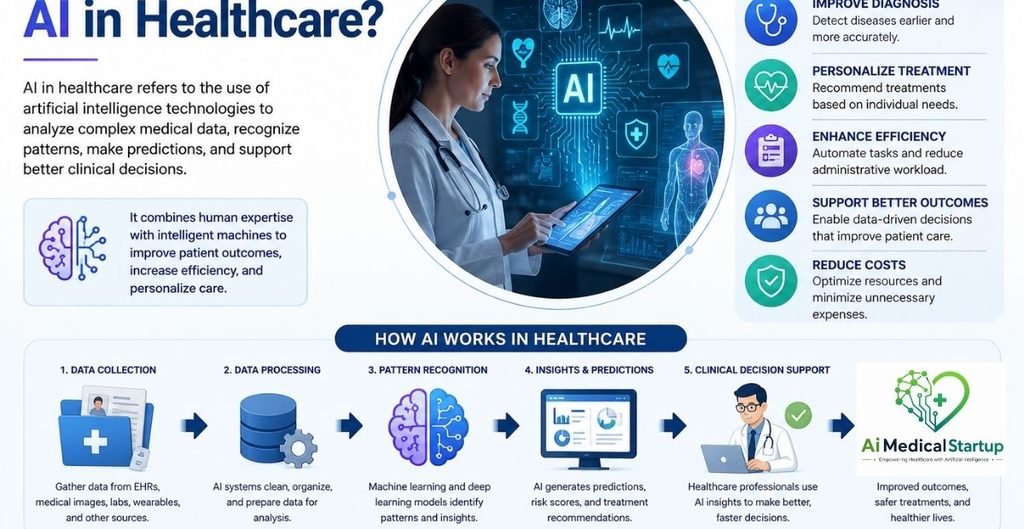
How Does AI Work in Healthcare?
At a basic level, an AI system receives data, processes it using a trained model, and produces an output. The output might be a prediction, classification, recommendation, summary, alert, or generated response. Clinicians interpret that output within the patient’s wider context. AI does not automatically understand every factor that a physician considers during clinical decision-making.
The quality of an AI result depends on much more than the algorithm itself. Data quality, population representation, model design, validation, workflow integration, and monitoring all matter. The FDA highlights challenges around limited training data, bias, uncertainty, performance evaluation, and post-market monitoring of AI-enabled medical devices. This is why a sophisticated model can still perform poorly when it encounters a population or environment that differs from the one used during development.
How AI Processes Healthcare Data
Healthcare produces enormous quantities of clinical data, including medical records, laboratory results, medical images, prescriptions, physiological measurements, and narrative notes. AI models can transform these different data sources into structured information. A model might recognize a pattern in thousands of images or extract relevant information from millions of clinical documents.
Machine Learning in Healthcare
Machine learning allows an algorithm to learn relationships within data rather than relying entirely on manually written rules. Researchers train models in supervised learning using examples with known outcomes. For example, researchers may train a model using labeled medical images. The model then learns patterns associated with particular findings and can later evaluate new images.
Deep Learning and Medical Pattern Recognition
Deep learning uses multi-layer neural networks to identify complex patterns. It has become particularly important in image-heavy areas such as radiology and pathology. A deep-learning model may learn subtle visual characteristics that are difficult to describe through simple rules. However, strong performance in one dataset does not guarantee equal performance in another healthcare environment.
Generative AI and Large Language Models in Healthcare
Generative AI can create text, images, summaries, or other content from learned patterns. Large language models are particularly relevant to documentation, research assistance, communication, and information retrieval. WHO has specifically highlighted the potential and governance challenges of large multimodal models in health, including their ability to process multiple forms of input and generate varied outputs.
From AI Output to Clinical Decision
An AI prediction is not automatically a medical decision. A clinician must consider symptoms, history, examination findings, patient preferences, available evidence, and uncertainty. This is why human oversight and clinical oversight remain essential. FDA guidance on machine-learning-enabled medical devices also emphasizes evaluating the performance of the human-AI team rather than viewing the technology in isolation.
How Do We Use AI in Healthcare?
The practical uses of AI in healthcare now stretch across diagnosis, imaging, documentation, research, monitoring, administration, and personalized care. Some applications are relatively low risk, such as helping organize information. Others can influence clinical decisions and therefore require much stronger clinical validation, governance, and regulatory scrutiny.
The most important distinction is between AI that assists a professional and AI that directly influences a high-stakes medical decision. A system that summarizes a consultation is not equivalent to one that interprets a scan or recommends a treatment. The potential value may be substantial in both cases, but the safety requirements are very different.
AI for Medical Diagnosis and Disease Detection
AI can analyze clinical information and identify patterns associated with disease. In some settings, models support medical diagnosis by highlighting findings that deserve attention. This can be particularly useful when clinicians face large workloads or large volumes of diagnostic information. AI may also contribute to early detection, screening, and risk prediction.
We should not treat diagnostic AI as an infallible oracle. A model can produce false positives and false negatives. Its performance may also change when the patient population, equipment, clinical workflow, or disease prevalence changes. The FDA identifies early disease detection, diagnosis, prognosis, and risk assessment in areas where AI-enabled medical devices are developed.
AI in Medical Imaging and Radiology
Medical imaging is one of the most visible applications of healthcare AI. Systems can analyze X-rays, CT scans, MRI images, ultrasound, mammography, and other imaging data. In radiology, AI can help prioritize examinations, identify suspicious regions, perform measurements, or assist with image interpretation.
The role of AI is often complementary rather than completely autonomous. A radiologist brings clinical context, experience, and responsibility to the process. AI can act like another set of computational eyes, but it does not carry the same professional judgment. That distinction becomes especially important when findings are ambiguous or when the model encounters an unusual presentation.
AI in Pathology and Laboratory Medicine
Pathology is another area where image analysis and pattern recognition can be useful. Deep learning analyzes the large quantities of visual information produced by digital pathology. AI can potentially help identify cellular patterns, classify tissue characteristics, and support quantitative analysis.
The promise is significant, but so is the need for careful validation. Tissue preparation, scanners, laboratories, staining methods, and patient populations can vary. A model trained under one set of conditions may not behave identically elsewhere. Therefore, AI evaluation should reflect the real-world environment where the system will be used.
AI-Powered Clinical Decision Support
Clinical decision support systems can provide alerts, risk scores, recommendations, or relevant information to clinicians. They may help identify potential medication interactions, estimate deterioration risk, or bring relevant information to the clinician’s attention.
The value of decision support depends on how well it fits the clinical workflow. Too many alerts can create fatigue. Poorly calibrated recommendations can distract rather than help. Good AI systems therefore need careful design, appropriate thresholds, transparent limitations, and meaningful human supervision.
AI Medical Scribes and Clinical Documentation
One of the fastest-growing practical applications is AI medical scribes. These tools can listen to clinical conversations, generate transcripts, and create draft documentation. In England, NHS guidance specifically addresses AI-enabled ambient scribing products used for clinical and patient documentation and workflow support.
This application demonstrates an important principle of healthcare automation. AI does not have to diagnose a disease to create value. Reducing documentation burden can give clinicians more time to communicate with patients. NHS England reported in 2026 that AI note-taking tools could save clinicians several minutes per consultation, although generated documentation still requires appropriate review and governance.
AI in Drug Discovery and Medical Research
Drug discovery is another major field for AI. Researchers can use models to analyze biological information, identify molecular patterns, predict properties, and prioritize potential candidates. AI can also support parts of the wider medical research process by helping researchers examine large datasets and scientific literature.
AI already supports many stages of pharmaceutical development, and the WHO expects its influence to expand further. At the same time, the organization emphasizes that commercial benefits should not replace public-health considerations, ethical safeguards, and appropriate governance.
AI for Patient Monitoring and Predictive Healthcare
Patient monitoring can generate continuous streams of information, particularly when combined with connected sensors and wearable technology. AI can analyze trends in heart rate, oxygen levels, activity, glucose, sleep, or other measurements and potentially identify changes that deserve attention.
This supports the idea of predictive healthcare, where the goal is not simply to react after a patient becomes seriously ill. Instead, healthcare systems can use data to identify risk earlier. Remote patient monitoring can be especially valuable for chronic conditions, although false alarms, data quality, accessibility, and clinical follow-up remain important concerns.
AI in Personalized and Precision Medicine
Personalized medicine aims to tailor healthcare decisions to individual characteristics rather than treating every patient as identical. AI can analyze combinations of clinical history, laboratory information, imaging, genetics, and other data to identify patterns that may support individualized care.
Precision medicine is closely related but often emphasizes biological and molecular characteristics. AI may help researchers identify subgroups of patients who respond differently to particular treatments. Yet personalization depends on representative data. If the underlying datasets are incomplete or biased, personalization can unintentionally reproduce healthcare disparities.
AI in Healthcare Administration
Many healthcare problems are administrative rather than clinical. Hospitals and clinics manage scheduling, billing, coding, claims, referrals, records, staffing, and communication. Healthcare automation can reduce repetitive work in some of these areas.
This may be less dramatic than an AI detecting cancer, but it can still have substantial operational value. If a system saves staff time without compromising accuracy or privacy, it can improve the efficiency of healthcare services. The best applications are often the ones that quietly remove friction from the system.
AI-Powered Virtual Health Assistants and Chatbots
AI assistants can help patients navigate services, answer general health questions, provide reminders, or support appointment processes. Health apps can also incorporate AI for education, symptom tracking, or personalized wellness functions.
The boundaries matter. A conversational system can sound confident even when it is wrong. That makes inaccurate information, unsupported recommendations, and delayed professional care important concerns. Patient-facing AI should therefore communicate limitations clearly and direct users toward professional care when appropriate.
AI-Assisted Surgery and Medical Devices
AI can also contribute to surgical planning, image guidance, robotics, monitoring, and other medical technology. AI medical devices may use algorithms to interpret information or support a clinical procedure. The FDA maintains a public list of authorized AI-enabled medical devices in the United States, while noting that the list is not comprehensive.
A device that affects diagnosis or treatment incorporates AI. Regulators should evaluate these systems for their intended use, safety, and effectiveness. The FDA’s current work also reflects the challenge of monitoring AI products as technology evolves after deployment.
What Are the Benefits of AI in Healthcare?
The strongest case for AI in healthcare is not that machines are inherently better than humans. It is that computers can perform certain tasks at a scale and speed that humans cannot easily match. AI can examine enormous datasets, recognize patterns, automate repetitive processes, and organize complex information.
We understand the benefits as human-AI collaboration. A clinician can bring empathy, context, experience, communication, and professional accountability. An AI system can bring rapid computation, consistency in defined tasks, and large-scale pattern analysis. When those capabilities complement each other, AI-powered healthcare can potentially become more efficient and responsive.
Faster and More Efficient Healthcare Workflows
Healthcare professionals spend significant amounts of time on administrative tasks. Healthcare automation can help reduce repetitive work such as documentation, information extraction, scheduling, and data processing. The benefit is not simply speed. Better workflow design can reduce cognitive load and allow staff to focus on work that requires human judgment.
Supporting Doctors and Healthcare Professionals
AI for doctors is increasingly about assistance rather than replacement. A physician can use AI to organize information, summarize records, draft documentation, analyze research, or support specific clinical tasks. The doctor remains responsible for interpreting the information and deciding what is appropriate for the patient.
Earlier Disease Detection
AI can recognize patterns across large datasets and potentially identify signals associated with disease before they are obvious. In screening and imaging, this may support early detection. The value of earlier detection depends on the disease, the quality of the screening process, and whether appropriate follow-up care is available.
Reducing Administrative Burden
Clinical documentation is a practical example. AI can create a draft from a clinical conversation, allowing the clinician to review rather than manually construct every sentence. NHS England has expanded access to AI tools partly because administrative efficiency can create more time for direct patient care.
More Personalized Patient Care
AI can combine multiple sources of patient data to support more individualized recommendations. AI systems can analyze genomic, clinical, imaging, and longitudinal information together to advance personalized healthcare and precision medicine.
Accelerating Medical Research and Drug Development
Researchers can use AI to analyze data, identify relationships, model biological processes, and prioritize research questions. In drug development, AI can potentially reduce the time needed to evaluate large numbers of candidates. It does not remove the need for laboratory experiments or clinical trials, but it can change where researchers spend their time.
Expanding Access to Healthcare
Digital tools can extend some healthcare capabilities beyond traditional facilities. Telehealth, telemedicine, remote monitoring, and AI-supported services help people access information and care in resource-limited areas.
However, access is not automatic. Poor internet connectivity, language barriers, disability, digital literacy, cost, and limited healthcare infrastructure can create new barriers. Technology should therefore reduce healthcare inequality, not quietly deepen it.
Potential Cost and Resource Savings
AI may reduce costs when it removes unnecessary administrative work, improves resource allocation, or supports earlier intervention. Yet implementation itself can be expensive. Organizations need infrastructure, cybersecurity, training, evaluation, integration, and ongoing AI monitoring. Organizations should measure cost savings rather than assume them.
| Potential Benefit | How AI Contributes | Important Condition |
|---|---|---|
| Efficiency | Automates repetitive tasks | Workflow must be well designed |
| Diagnosis Support | Identifies patterns | Clinical validation is required |
| Documentation | Drafts clinical notes | Humans must review outputs |
| Research | Analyzes large datasets | Data quality matters |
| Monitoring | Detects changes and risk | Alerts need clinical follow-up |
| Personalization | Combines patient information | Data must be representative |
What Are the Risks and Challenges of AI in Healthcare?
The same capabilities that make AI useful can create serious risks. A system that processes information rapidly can process the wrong information rapidly. A model trained on biased data produces biased results, and generative models can create fluent text containing hallucinations. Because a bad clinical recommendation affects health, AI safety, validation, and governance are essential.
AI Errors and Inaccurate Outputs
Diagnostic models may miss diseases, predictive models can overestimate risk, and language models may invent citations. Users must measure AI accuracy using appropriate clinical metrics like sensitivity, specificity, and false-positive rates rather than relying on single performance metrics.
Bias and Health Inequality
Algorithmic bias arises when training data fail to represent diverse populations, embedding historical inequalities. The NHS warns that biased models can widen healthcare disparities, making AI fairness a critical patient-safety priority.
Patient Privacy and Data Security
Handling sensitive medical, genetic, and personal data raises major security challenges. Developers must embed patient privacy and data protection from inception rather than treating security as an afterthought.
Lack of Transparency and Explainability
Complex models are often hard to interpret, raising valid questions about explainability. High-risk applications demand robust documentation, clear limitations, and transparent communication regarding validation and expected human involvement.
Automation Bias and Overreliance
Automation bias occurs when users give excessive weight to computer outputs because they appear objective. Clinicians need proper AI literacy to understand tool limitations and ensure technology supports rather than replaces professional judgment.
Accountability and Liability
When automated decisions fail, assigning responsibility across developers, healthcare organizations, and clinicians is complex. Clear accountability frameworks must be established prior to deployment to handle incident investigation and system suspension.
Integration and Technical Challenges
AI must seamlessly interact with electronic records, workflows, and security controls. Poor interoperability creates duplicate work, forcing clinicians to adapt their routines around rigid tools instead of improving efficiency.
Cost, Accessibility, and Skills
High infrastructure, maintenance, and cybersecurity costs risk creating a digital divide where under-resourced systems fall behind. Additionally, healthcare professionals require foundational AI literacy to evaluate tools critically as part of modern competence.
How Can We Use AI in Healthcare Safely and Responsibly?
Ensuring AI safety, rigorous governance, and ongoing supervision is essential for clinical adoption. The matrix below outlines key safety areas and critical evaluation questions required before deploying AI-enabled medical technologies.
| Safety Area | Key Question |
|---|---|
| Intended Use | What problem is the AI designed to solve? |
| Clinical Validation | Has it been tested for the actual intended use? |
| Data | Are the data appropriate and representative? |
| Privacy | Is patient information protected? |
| Fairness | Does performance differ across patient groups? |
| Human Oversight | Who reviews the AI output? |
| Monitoring | Who checks performance after deployment? |
| Accountability | Who is responsible when something goes wrong? |
AI for Doctors and Healthcare Professionals
For doctors, the most useful question is not “Will AI replace me?” but “Which parts of my work can AI perform safely and which parts still require my expertise?” AI can support documentation, research, information retrieval, image analysis, administrative work, and selected forms of clinical decision support.
This shift is already visible in healthcare organizations. NHS England has been expanding access to AI tools for administrative work and clinical documentation. In June 2026, it announced access to AI tools for more than 500,000 NHS staff, reflecting a broader move toward integrating AI into everyday workflows.
How Doctors Can Use AI in Everyday Practice
AI for doctors can include clinical documentation, research assistance, patient communication, information organization, and selected decision-support functions. The safest uses are usually those where the clinician can easily review the output before acting on it.
Key Pillars of AI Adoption for Clinicians
Illustrative view of major areas where AI connects with modern healthcare technologies year from 2024 to 2026
Regulation, Governance, and the Future of AI in Medicine
As artificial intelligence reshapes clinical practice, navigating regulatory standards, ethical safeguards, and the evolving relationship between healthcare professionals and intelligent systems is more critical than ever.
1. Regulation, Ethics, and Governance
- Early Integration: AI regulation and governance must be built into procurement and deployment from the start—not treated as an afterthought.
- Jurisdictional Frameworks:
- U.S. (FDA): Focuses on medical-device status, software-as-a-medical-device (SaMD), and regulatory frameworks for generative AI.
- E.U. (EU AI Act): Implements a risk-based framework with high-risk obligations taking effect between 2027 and 2028.
- U.K. (MHRA & NHS): Emphasizes safe deployment, trust, patient safety, and transparency.
- Privacy & Accountability: Compliance with HIPAA, GDPR, and local data laws remains vital. Human-in-the-loop accountability is essential—developers, health systems, and clinicians share responsible decision-making.
2. The Future of AI in Medicine
- Invisible Integration: AI will transition from standalone apps to embedded workflow assistance (summarizing records, drafting notes, highlighting imaging anomalies).
- Generative & Multimodal AI: Processing unstructured language and multi-source data (text, images, lab results) offers vast potential, provided systems manage clinical uncertainty and reliability.
- Targeted Applications: Key growth areas include personalized precision medicine, predictive care, and accelerated drug discovery.
3. Human-AI Collaboration (Will AI Replace Doctors?)
Complementary Roles
AI excels at computational scale (pattern recognition, data analysis, administrative automation), while clinicians excel at contextual judgment (empathy, physical exams, ethical decisions, uncertainty management).
The Core Shift
AI will not replace doctors; rather, doctors who use AI effectively will replace those who do not.
FAQs About AI in Healthcare
The rapid growth of artificial intelligence in healthcare has created understandable questions among patients, clinicians, researchers, technology companies, and policymakers. Click on any question below to explore detailed insights.
Artificial intelligence in healthcare is the use of computational systems to analyze medical data, recognize patterns, make predictions, generate information, or support healthcare tasks. It includes technologies such as machine learning, deep learning, natural language processing, generative models, and computer vision.
In healthcare, AI powers imaging, diagnosis support, clinical decision support, documentation, drug discovery, patient monitoring, administration, research, personalized care, and AI-enabled devices. The exact role depends on the system and its intended use.
The main potential benefits include faster information processing, reduced administrative workload, improved workflow efficiency, support for medical diagnosis, early detection, research acceleration, personalized care, and expanded access to some healthcare services.
Important AI risks include AI errors, hallucinations, bias, privacy problems, cybersecurity threats, automation bias, lack of transparency, poor integration, and unclear accountability. We should evaluate healthcare AI systems for both performance and real-world safety.
Organizations can use AI safely when the specific system has appropriate evidence, validation, governance, privacy protections, monitoring, and human supervision. Safety is not a property that automatically comes with the word “AI.” How the technology is designed, evaluated, deployed, and monitored determines safety.
Some AI systems can support disease detection and medical diagnosis by identifying patterns in images, clinical information, or other data. Healthcare professionals should interpret the output within the appropriate clinical context. Whether an AI product can legally perform a particular diagnostic function also depends on its intended use and regulatory status.
AI is unlikely to replace doctors as a complete profession because medicine requires clinical reasoning, communication, physical assessment, ethical judgment, and accountability. AI will more likely automate selected tasks and help create AI-assisted doctors who can work more efficiently.
Doctors can use AI for documentation, medical research, information organization, imaging support, administrative workflows, patient communication, and selected forms of clinical decision support. The appropriate use depends on the tool and the clinical setting.
Yes, but regulation varies by country, product, and intended use. The FDA regulates AI-enabled medical devices in the United States. Within the European Union, the EU AI Act creates a risk-based framework alongside other relevant laws. Under UK regulation, the MHRA governs applicable software and AI as medical devices while the broader healthcare AI framework continues to evolve.
The future of AI in healthcare will likely involve deeper integration into clinical workflows, medical devices, digital health platforms, research, documentation, monitoring, and personalized care. Generative AI, multimodal AI, predictive models, and AI-enabled medical technologies are likely to become increasingly important.
The most important principle is that technology should remain accountable to patient well-being. Responsible AI, AI safety, patient safety, privacy, fairness, transparency, and clinical oversight should matter more than simply deploying the newest model.
Final Thoughts: AI Is Changing Medicine, But Humans Still Define Good Care
Artificial intelligence in healthcare is no longer a distant idea. It is becoming part of diagnosis, imaging, documentation, research, monitoring, administration, and medical technology. The technology can process information at remarkable speed and scale. It can also create new forms of risk that healthcare systems cannot afford to ignore.
We must evaluate the future by outcomes, not the extent of AI deployment by providers. Evaluate the technology by its ability to produce safer patient care, better experiences, more efficient workflows, stronger research, and fairer access to healthcare. WHO continues to emphasize that AI adoption should be safe, ethical, equitable, and people-centered.
The strongest model is not a machine replacing a doctor. It is a capable professional using a carefully evaluated tool, understanding its limitations, and remaining responsible for the patient in front of them. That is the real promise of AI-powered healthcare: not removing humans from medicine, but giving them better tools to do what humans do best.


Dr. Kanza Sarfraz, M.B.B.S., is a medical doctor and graduate of Allama Iqbal Medical College, Lahore. She brings nearly seven years of clinical experience across tertiary-care hospitals, medical headquarters, and healthcare facilities in both the public and private sectors. Her clinical experience provides a practical perspective on healthcare delivery, emerging medical technologies, and the evolving role of artificial intelligence in medicine.