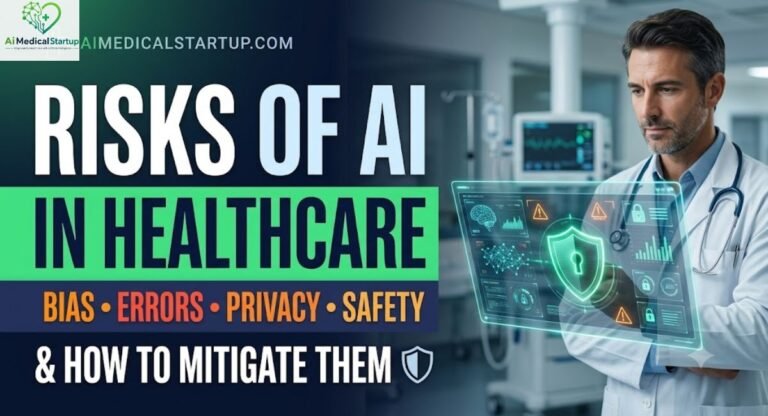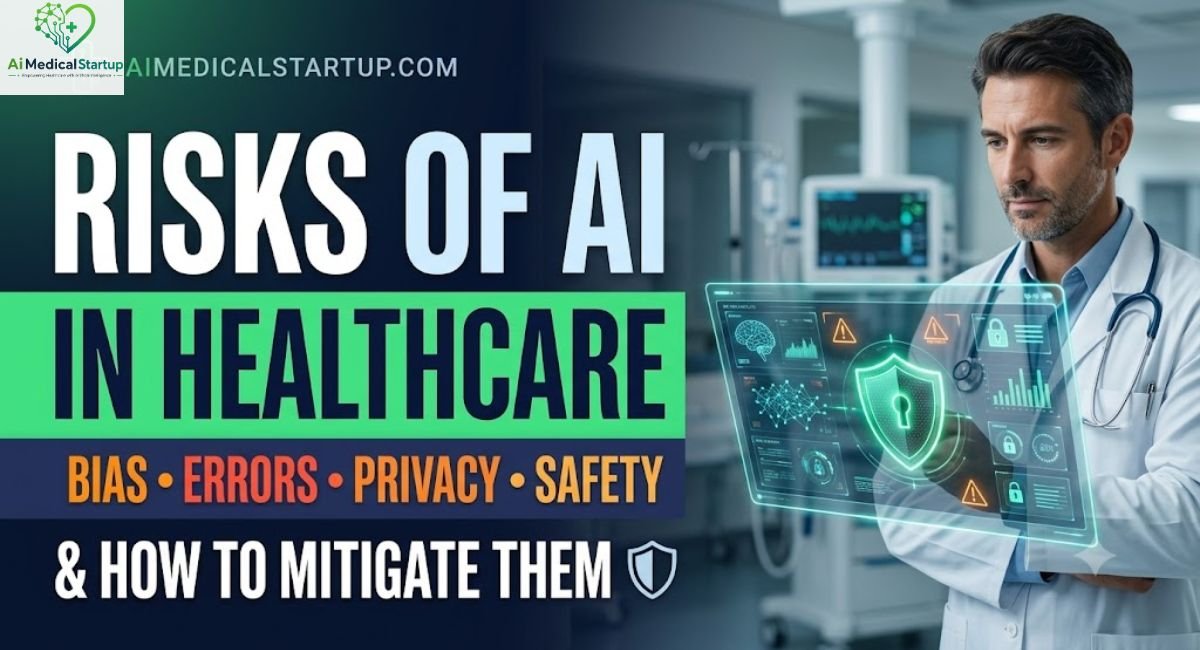
Featured image for Risks of AI in Healthcare blog post on aimedicalstartup.com, showing a doctor looking at a digital AI interface with metrics for bias, errors, privacy, safety, and mitigation.

Risks of AI in Healthcare

Risks of AI in Healthcare: Bias, Errors, Privacy, Safety & How to Mitigate Them


Share this guide:

AI changes how healthcare teams diagnose disease, analyze medical images, document consultations, predict deterioration and manage workloads. Yet the same technology that can process enormous amounts of information can also introduce new forms of AI risks in healthcare. A wrong recommendation is not simply an inconvenient software bug when it influences a diagnosis, treatment plan, triage decision or patient’s medical record.

The most important question is therefore not whether artificial intelligence in healthcare can make mistakes. In addition, it can. The more useful question is whether healthcare organizations can identify those mistakes, reduce their probability, detect them quickly and prevent them from causing avoidable harm. That is the foundation of AI safety in healthcare and it requires much more than choosing an accurate model.

What Are the Risks of AI in Healthcare?

Moreover, the risks of AI in healthcare span clinical, ethical, operational, privacy, cybersecurity and accountability concerns. Furthermore, a model could produce biased predictions, miss an important diagnosis, generate alerts, reveal sensitive data or trust automated recommendations. As a result, these healthcare AI risks often overlap, allowing one weakness to cause multiple downstream problems.

A useful way to understand healthcare artificial intelligence is to treat it as a powerful decision-support assistant rather than an infallible expert. AI can process information quickly, but it does not automatically understand context, uncertainty, patient preferences or the consequences of a wrong decision. Patient safety therefore depends on the entire system around AI, including data quality, clinical workflows, human review, governance, cybersecurity, monitoring and escalation procedures.

Risk Category What Can Go Wrong Potential Consequence
Clinical Risk Incorrect predictions or missed findings Delayed or inappropriate care
Equity Risk Unequal model performance Health inequities or inequitable care
Privacy Risk Unauthorized data exposure Patient privacy violations
Security Risk Cyberattacks or data manipulation Disrupted care or data breaches
Operational Risk Poor workflow integration Alert fatigue or inefficient care
Accountability Risk Unclear responsibility Delayed investigation and corrective action
Human-Factor Risk Automation bias or overreliance Reduced independent clinical review

Why AI Risk Is Different in Healthcare

The consequences of AI failure can be unusually serious because healthcare decisions affect real people under conditions of uncertainty. A small classification error in an administrative application may be inconvenient, while an incorrect medical diagnosis or medication recommendation can have much greater consequences.

Healthcare AI must also operate within complicated environments. Indeed, hospitals and clinics contain different patient populations, medical devices, documentation habits, treatment protocols, staffing patterns and information systems. A model that performs well in one setting may therefore show poor generalization in another.

The Main Categories of Healthcare AI Risk

The broadest AI risks in healthcare can be grouped into seven areas: clinical safety, equity, privacy, security, operational performance, accountability and human factors. This classification helps healthcare organizations avoid the mistake of evaluating an AI product only through one number such as model accuracy.

The risk profile also changes according to the technology. Diagnostic AI used to analyze CT images has different failure modes from AI medical scribes, while a patient-facing chatbot creates different concerns from predictive AI used for sepsis alerts. Safe deployment therefore begins by understanding the actual task, users, data and consequences involved.

AI Bias and Health Inequities

AI bias in healthcare occurs when an AI system produces systematically different or unfair results across patient groups. Bias can affect people according to race, ethnicity, age, sex, language, socioeconomic circumstances, insurance status, disability, geography or underlying comorbidity. When those differences affect access, diagnosis, treatment or risk prediction, they can reinforce existing healthcare bias and contribute to wider health inequities.

The problem is rarely as simple as an algorithm being deliberately discriminatory. Algorithmic bias can emerge from incomplete training data, historical inequalities, biased labels, inappropriate outcome definitions or proxy variables that indirectly encode social or demographic characteristics. WHO guidance stresses that AI for health should place ethics and human rights at the centre of design, development, deployment and use.

How Bias Enters Healthcare AI Systems

Bias can enter at almost every stage of the AI lifecycle. A dataset may under-represent certain patient populations, labels may reflect historical clinical practices or a feature that appears neutral may correlate strongly with race, income, insurance or access to care. Deployment can introduce another problem when a model is used with a population that differs from its development dataset.

A particularly important issue is the choice of prediction target. If a system predicts healthcare costs rather than actual health needs, historical differences in access to care can become embedded in the model. The algorithm may then appear statistically effective while still producing systematically unequal outcomes.

Impact of Algorithmic Bias on Patient Inclusion

Comparing default healthcare spending proxies vs. remediated clinical need models for Black patients identified for extra care.

Black Patients Enrolled for Care 17.7%

How to Detect and Reduce AI Bias

Healthcare organizations should measure subgroup performance rather than relying on one overall accuracy figure. Teams can compare sensitivity, specificity, calibration, false-positive rates, false-negative rates and meaningful clinical outcomes across relevant demographic and clinical groups. Monitoring should continue after deployment because changing populations can create new disparities.

A practical equity assessment can include:

AI Evaluation & Fairness Checklist

Key questions to ask during health tech assessment

0 of 7 Completed
Representation

Does the dataset reflect the intended population?

Labels

Does the target represent the actual clinical objective?

Proxy variables

Could a feature indirectly encode protected characteristics?

Subgroup performance

Does performance vary substantially between groups?

Calibration

Do predicted risks correspond to observed outcomes?

Access

Could deployment itself create unequal access?

Monitoring

Will disparities be checked after deployment?

AI Errors, Incorrect Predictions and Diagnostic Mistakes

AI diagnostic errors can take several forms, including false positives, false negatives, incorrect classifications, misleading risk scores or recommendations based on incomplete information. These AI medical errors can occur even when a system performs strongly during development because real clinical environments contain unusual cases, missing information, different equipment and constantly changing workflows.

Clinical AI models learn patterns from historical data rather than understanding a patient in the same way a doctor does. Missing information, noisy labels, measurement errors, hidden confounders, unusual disease presentations and flawed model assumptions can therefore affect outputs. A high benchmark score is useful evidence, but it is not proof that a model will improve health outcomes in every clinical setting.

Why AI Models Make Medical Errors

AI systems are often trained to optimize a specific prediction or classification task. That objective may not capture every factor that matters to a clinician. A model can therefore identify a statistical pattern without understanding why the pattern exists or whether it remains valid in a new environment.

Consider a model trained on one hospital’s EHR records. Its performance may partly depend on local coding patterns, laboratory systems, documentation habits, referral practices or treatment protocols. Move that model to another hospital and the same relationships may no longer hold.

Poor Generalization Across Hospitals and Patients

External validation tests a model outside the environment where it was developed. It is particularly important because internal testing can overestimate real-world performance when development and validation datasets share similar characteristics.

A notable example is the external validation of the Epic Sepsis Model at Michigan Medicine. Researchers evaluated 38,455 hospitalizations and found a hospitalization-level AUC of 0.63. At the studied alert threshold, the model generated alerts for 18% of hospitalizations while failing to identify 67% of patients who developed sepsis.

Clinical Validation Before Deployment

Clinical validation should reflect the actual population, workflow, equipment and intended use. Where possible, healthcare organizations should conduct independent validation and local validation rather than relying solely on vendor-provided performance metrics.

Additionally, useful evaluation measures include:

Core Model Performance Metrics

Essential evaluation benchmarks for AI in healthcare

9 Indicators
Sensitivity

Shows how often important positive cases are detected

Specificity

Shows how effectively non-cases are excluded

AUC

Summarizes discrimination across thresholds

Calibration

Compares predicted and observed risk

False Positives

Indicates unnecessary alerts or interventions

False Negatives

Highlights potentially missed cases

Clinical Utility

Asks whether predictions improve decisions

Subgroup Performance

Identifies unequal performance

Usability

Tests whether clinicians can use the tool safely

Automation Bias, Human Oversight and AI Overreliance

One of the less obvious disadvantages of AI in healthcare comes from people rather than algorithms. Automation bias occurs when users give excessive weight to automated recommendations, particularly when those recommendations appear objective, sophisticated or authoritative. Moreover, AI overreliance can reduce independent checking and allow an incorrect output to pass through clinical workflows.

WHO has specifically highlighted automation bias as a concern with large multimodal models in healthcare. The organization notes that such systems can cause health professionals or patients to overlook errors that might otherwise have been detected or to delegate difficult decisions inappropriately.

What Is Automation Bias in Healthcare?

Consequently, automation bias becomes more likely under time pressure, heavy workloads or repetitive decision-making. A clinician who receives dozens of alerts may gradually treat the AI system as a shortcut rather than as one source of evidence.

The problem is particularly concerning when AI outputs look precise. A risk score of 87% may appear authoritative even though the underlying model could have poor calibration in the local population. A number is not automatically more trustworthy simply because a computer generated it.

When Should Clinicians Question AI?

Therefore, the level of scrutiny should correspond to the potential consequence of an error. However, administrative drafting may require a different review process from autonomous diagnosis or medication changes.

AI Tasks & Safeguard Matrix

Essential oversight measures for healthcare AI deployments

6 AI Tasks
Task 01

Administrative drafting

Key Concern

Incorrect details

Appropriate Safeguard
Human review
Task 02

Documentation support

Key Concern

Missing or fabricated information

Appropriate Safeguard
Clinician sign-off
Task 03

Imaging assistance

Key Concern

Missed or false findings

Appropriate Safeguard
Specialist confirmation
Task 04

Risk prediction

Key Concern

Incorrect prioritisation

Appropriate Safeguard
Clinical review
Task 05

Medication support

Key Concern

Potential patient harm

Appropriate Safeguard
Qualified professional review
Task 06

Autonomous diagnosis

Key Concern

High clinical consequence

Appropriate Safeguard
Strong validation and human oversight

Designing Effective Human-in-the-Loop AI

Moreover, a human-in-the-loop system keeps qualified professionals involved in consequential decisions. Effective human oversight requires more than placing an approval button at the end of a workflow.

Additionally, clinicians should have information to understand the recommendation, time to assess it, override authority and an escalation route. The EU AI Act similarly emphasizes human oversight for high-risk AI systems, including the ability for people to monitor, interpret and override systems while guarding against overreliance.

Generative AI, ChatGPT & LLM Risks in Healthcare

Explore how foundational models and GenAI tools pipeline critical risks into medical environments. Click or hover on any item to view its details.

AI Platforms & LLMs
ChatGPT / GPT-4 General-purpose LLMs
Anthropic Claude Constitutional conversational AI
IBM Watson / Granite Enterprise healthcare & clinical data AI
Google Med-PaLM 2 / AMIE Medical-specific LLMs
Bio-Specific / Specialized GPTs Pathology & Bio-science models
Generative AI Risks in Healthcare
Core Safety Risks
Clinical Hallucinations Fabrication of facts & diagnostic errors
HIPAA & Privacy Breaches Patient data leaks & unregulated prompt usage
Amplified Algorithmic Bias Re-marginalizing non-majority patient groups
Automation Bias De-skilling clinicians & human oversight failures
Systemic Cyber Security Adversarial jailbreaks & inaccurate pipeline ingestion
💡 Hover on or click any network node to analyze its healthcare hazard & implications.

AI Hallucinations and Incorrect Medical Information

AI hallucinations occur when a generative system produces information that appears plausible but is unsupported or incorrect. For example, in healthcare, an incorrect answer can involve a medication, contraindication, diagnosis, symptom interpretation, guideline or treatment recommendation.

Moreover, the danger is amplified by fluent language. A poorly written error may trigger suspicion, while a polished paragraph can appear authoritative. Medical information generated by an LLM should therefore be verified when it could affect patient care, clinical education, research or published health content.

Fabricated Medical Citations

Citation hallucinations, sometimes called fabricated medical citations, occur when an AI system creates references that look authentic but do not exist or do not support the associated claim.

Additionally, medical citations should be checked against the original publication. As a result, confirm the authors, article title, journal, publication year, DOI where available and the actual findings. Never assume that a citation is reliable simply because it contains a realistic journal name.

Prompt Sensitivity and Inconsistent Outputs

Moreover, prompt sensitivity means that changes in wording, context, instructions or available information can affect an AI response. Inconsistent outputs may also arise when models change versions or receive different context.

Additionally, clinical teams can reduce these risks with standardized prompts, controlled workflows, guardrails, version tracking and human verification. Context also matters: context length, missing information, ambiguous language and incomplete patient history can all affect a generative model’s response.

Which Healthcare Tasks Are Appropriate for Generative AI?

Moreover, Generative AI can be useful for bounded tasks where outputs receive meaningful review. For instance, administrative drafts, summaries of clinician-provided information, patient-friendly explanations and documentation support are included.

Moreover, caution is required for autonomous diagnosis, treatment advice or medication changes where an incorrect output could affect patient care. Thus, the principle is straightforward: the more consequential the task, the stronger the validation and human review should be.

Patient Privacy, Data Protection and AI Furthermore, security risk warrants ongoing attention within data protection and AI security discussions

Thus, healthcare AI often processes highly sensitive information. AI privacy risks can arise when systems handle EHR records, medical images, laboratory results, patient messages or voice recordings without adequate controls. Patient data privacy therefore needs to be considered from the beginning of system design rather than added after deployment.

Privacy and cybersecurity are related but different. Privacy asks whether information is collected, used, disclosed and retained appropriately. Security asks whether systems and information are protected against unauthorized access, manipulation, disruption or theft. In addition, both are essential to healthcare data security.

How AI Systems Handle Sensitive Patient Data

Additionally, AI applications may process diagnoses, medications, laboratory results, imaging, clinical notes, genetic information or voice transcripts. Furthermore, each integration can expand the attack surface and risk data leakage or unauthorized access.

Organizations should understand where information goes, who can access it, how long it is retained, whether third parties process it and whether data is transferred between jurisdictions.

HIPAA and Healthcare AI Privacy

In the United States, HIPAA establishes specific protections for protected health information handled by covered entities and business associates. The HIPAA Privacy Rule includes a minimum necessary principle that generally requires covered entities to limit uses, disclosures and requests for PHI to what is needed for the intended purpose.

The HIPAA Security Rule addresses safeguards for electronic protected health information and should be considered alongside organizational security controls, contracts, state privacy requirements and other applicable laws. HIPAA should not be treated as a universal certification that automatically makes any AI product appropriate for healthcare.

Cybersecurity Threats to AI-Powered Healthcare

Healthcare organizations must defend AI infrastructure against data breaches, ransomware, stolen credentials, insecure APIs, malicious inputs and unauthorized access. AI systems can also become targets because they may contain valuable data or connect to important clinical workflows. A major healthcare cyber incident illustrates the potential scale. HHS reported that the Change Healthcare breach affected approximately 192.7 million individuals as of July 31, 2025.

Security Controls for Healthcare AI

Essential technical & operational security safeguards

8 Controls Enforced

Multi-Factor Authentication

Enforce MFA across privileged and sensitive access points.

Strong Encryption

Robust encryption standards applied for data in transit and at rest.

Network Segmentation

Isolate medical AI subnets to limit unauthorized lateral movement.

Detailed Audit Logs

Comprehensive logging for all user access and AI system activities.

Data Minimization

Restrict healthcare dataset exposure to only essential variables.

Retention & Deletion Policies

Clear lifecycle policies for safe data retention and destruction.

Vendor Due Diligence

Rigorous third-party security assessments and risk verification.

Incident Response & Recovery

Tested emergency procedures to guarantee rapid threat recovery.

Can Patient Data Be Used to Train AI?

The answer depends on the jurisdiction, purpose, data-identification status, organization, contractual relationship and applicable laws. Healthcare organizations should not assume that information collected for treatment can automatically be reused for every AI-development purpose.

For US organizations, questions may include whether information is PHI, whether the organization is a covered entity or business associate, whether an appropriate agreement exists and whether the intended use satisfies applicable requirements. Business associate agreements may also be relevant when vendors handle PHI on behalf of covered entities.

AI Safety, Transparency, Explainability and Accountability

AI transparency matters because clinicians, patients and healthcare organizations need enough information to understand what a system is designed to do and where its limitations lie. A model can produce an impressive risk score while providing little useful information about why the score was generated.

AI accountability is equally important. If an AI-supported decision contributes to harm, responsibility may involve clinicians, hospitals, vendors, developers, workflow designers and governance teams. Establishing those responsibilities before deployment is far more effective than trying to determine them after an incident.

Why Black-Box AI Creates Clinical Challenges

Black-box AI can produce a result without giving users a clinically meaningful explanation of the underlying reasoning. This can make it difficult to challenge a recommendation or determine whether an unexpected result is plausible. AI explainability and explainable AI can provide supporting signals, relevant inputs, confidence information or other context. However, an explanation should not create false reassurance. Clinicians still need information about intended use, known limitations, validation populations and performance metrics.

Who Is Responsible When AI Makes a Medical Error?

Responsibility depends on the technology, workflow, contractual arrangements, applicable law and circumstances surrounding the incident. A hospital may remain responsible for appropriate governance and oversight even when a vendor developed the underlying model.

Developers should communicate limitations and validation evidence. Vendors should provide appropriate documentation and mechanisms for reporting problems. Healthcare organizations need governance, monitoring, training and escalation procedures. Clinicians need to understand how a tool is intended to be used and apply professional clinical judgment.

Building an AI Accountability Framework

A practical accountability framework assigning responsibilities across the AI lifecycle

01

Procurement

Evaluate evidence, intended use, vendor controls

02

Validation

Test performance and safety

03

Deployment

Integrate safely into clinical workflows

04

Training

Teach users limitations and escalation

05

Monitoring

Track performance and equity

06

Incident response

Investigate errors and near-misses

07

Updates

Revalidate meaningful changes

08

Retirement

Remove unsafe or obsolete systems

This framework addresses AI liability without assuming that every AI-related incident has one simple cause. Good governance makes responsibility traceable while creating a mechanism for learning and correction.

Model Drift, AI Performance Degradation and Post-Deployment Risks

A model that performs well at launch can become less reliable as healthcare changes. Model drift can occur when patient populations, clinical practices, equipment, coding patterns, treatment protocols or disease prevalence change. Seasonal changes can also alter the relationship between model inputs and outcomes.

This is why continuous monitoring and post-deployment monitoring should be treated as part of the AI lifecycle rather than optional extras. The FDA’s AI-device guidance increasingly emphasizes lifecycle management, while its predetermined change-control approach addresses planned AI-enabled device modifications and their validation.

What Is Model Drift in Healthcare AI?

Imagine training a navigation system using a map that never gets updated. Roads change, construction appears and traffic patterns shift. The software may still calculate routes correctly using its old map, but the map no longer represents reality. Healthcare AI can face a similar problem. Patient population changes, new treatments, different medical devices, new documentation systems, changing coding patterns and altered clinical practice can all affect model performance.

Post-Deployment Operations

How to Monitor AI After Deployment

Combine technical metrics with clinical and operational signals to ensure system safety and adoption.

Technical

Model Performance

Accuracy, sensitivity, specificity

Technical

Calibration

Predicted vs observed risk

Clinical Safety

Safety

False negatives, false alarms

Governance

Equity

Subgroup performance

Operations

Workflow

Override rates, alert volume

Clinical Safety

Clinical Outcomes

Relevant patient outcomes

Operations

User Behaviour

Acceptance and escalation

Governance

Security

Access anomalies and incidents

Critical Consideration

Monitoring should also include near-misses and user feedback. A model may retain good statistical performance while creating workflow problems that increase alert fatigue or encourage inappropriate reliance.

When Should an AI System Be Updated or Suspended?

Healthcare organizations should define thresholds before problems occur. Meaningful performance degradation may trigger investigation, additional validation, a model update, temporary suspension or rollback.

Post-market monitoring is particularly important for regulated AI-enabled medical devices because changes to deployed software can affect safety and effectiveness. FDA guidance on predetermined change-control plans addresses planned modifications, including methods for developing, validating, implementing and assessing their impact.

How AI Risks Differ Across Healthcare Use Cases

Not every application of medical AI carries the same clinical or operational risk. Clinical AI, patient-facing tools, diagnostic systems, documentation assistants and operational applications interact with different data and workflows. The right safeguards therefore depend on what the technology does and what happens when it fails.

The most useful question is not simply whether an AI system is “safe.” Instead, healthcare teams should ask: safe for whom, doing what, with which data, in which environment and with what level of human oversight? That approach connects technical performance with real-world patient care.

AI in Medical Imaging and Diagnosis

AI can support medical imaging by identifying patterns in scans and prioritizing potentially urgent cases. Examples include analysis of CT images, stroke detection and identification of possible large vessel occlusion. The risks include false positives, false negatives, poor image quality, differences in scanners, and changes in scanning protocols. Imaging systems therefore require validation across relevant patient populations and clinical environments, followed by appropriate specialist confirmation.

Predictive AI for Sepsis and Patient Deterioration

Sepsis prediction, readmission prediction and early warning systems attempt to identify patients at increased risk of deterioration. Their value depends not only on discrimination but also on whether predictions arrive at a useful time and lead to beneficial clinical action. The Epic Sepsis Model provides an important example. In external validation, researchers found an AUC of 0.63 and reported that alerts were generated for 18% of hospitalizations while 67% of patients who developed sepsis were not identified by the studied alert threshold.

AI Medical Scribes and Clinical Documentation

AI medical scribes use speech-to-text and other AI technologies to support clinical documentation. They may reduce administrative burden by creating draft notes from an ambient recording or clinician-patient conversation. However, transcription can introduce errors involving terminology, negation, clinical nuance or unclear attribution. A missing “no,” incorrect medication or wrongly attributed statement can materially change the meaning of a medical record. Clinicians should therefore perform human review before finalizing AI-generated documentation.

Patient-Facing AI and Symptom Checkers

Patient-facing AI includes symptom checkers, chatbots, educational assistants and other tools designed for direct interaction with patients. These systems must account for incomplete information, different levels of health literacy, language barriers and the possibility that patients describe symptoms inaccurately.

A major concern is false reassurance. If an AI system underestimates urgency, a patient may delay seeking care. Excessive escalation can create unnecessary anxiety or inappropriate use of urgent care. Clear safety boundaries and access to human support are therefore essential.

AI in Drug Discovery and Clinical Research

AI can help researchers analyze molecular data, identify candidate compounds and priorities experimental hypotheses. Yet computational predictions remain hypotheses until they are supported by appropriate laboratory, preclinical or clinical evidence. Problems can arise from poor-quality datasets, hidden confounders, incorrect labels or models that fail to generalize. AI should accelerate research rather than replace experimental validation, scientific judgment or regulatory review.

Administrative and Operational Healthcare AI

Operational AI can support scheduling, staffing, bed optimization, operating room planning, billing, supply chains and resource allocation. These applications may not diagnose patients directly, but their decisions can influence access, waiting times, workload and service availability. Hospitals should therefore monitor equity metrics, operational outcomes, override rates and unintended consequences. A system that optimizes one operational metric can still create problems elsewhere in the healthcare system.

How Hospitals Can Mitigate AI Risks and Improve Patient Safety

Reducing AI risks in healthcare requires more than purchasing a reputable product. Hospitals need AI governance, clinical validation, cybersecurity controls, staff training, monitoring, documentation and clear escalation procedures. NIST’s NIST AI Risk Management Framework provides a voluntary, use-case-agnostic framework designed to help organizations manage AI risks and promote trustworthy and responsible AI across design, development, deployment, use and evaluation.
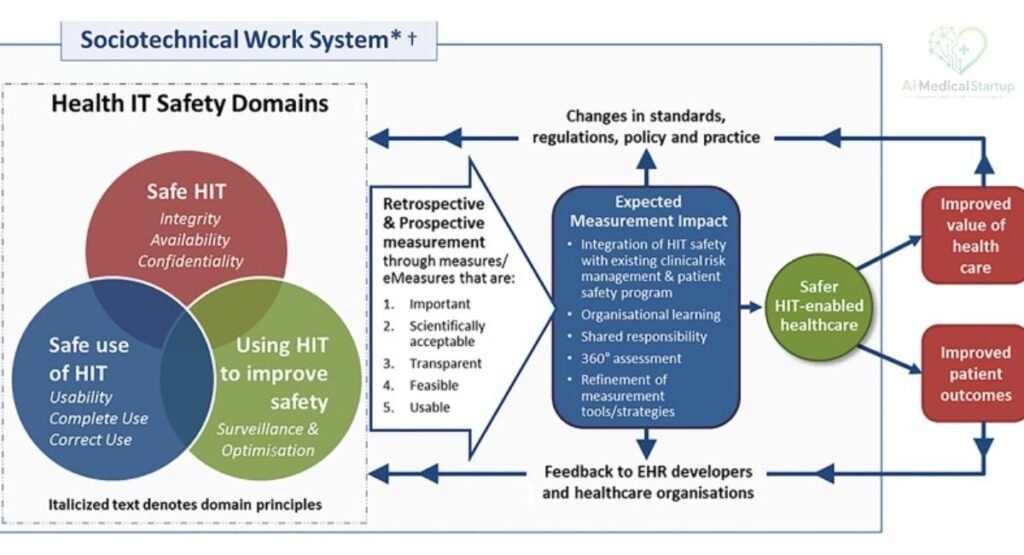
how-hospitals-can-mitigate-ai-risks-and-improve-patient-safety

Establish a Multidisciplinary AI Governance Team

A healthcare AI governance team should include appropriate representatives from clinical leadership, nursing, quality and safety, compliance, privacy, security, IT, data teams and operations. The exact structure will vary by organization, but important decisions should not be left to one technical department. The purpose of governance is not to slow innovation. It is to create a repeatable process for assessing intended use, clinical evidence, privacy, security, equity, usability, monitoring and accountability before a system reaches patients.

Clinical Preparedness

Validate AI Before Clinical Deployment

Evaluate systems using representative populations, relevant clinical workflows, and realistic conditions. Vendor evidence should not automatically substitute for local evaluation.

0 / 10 Tasks Checked

Population Representativeness

Assess performance across local demographic datasets.

01

Subgroup Testing

Evaluate for equal efficacy and equity across subgroups.

02

Edge Cases

Stress-test system behavior under rare or unusual inputs.

03

Clinical Performance

Measure statistical precision and predictive value.

04

Safety Testing

Analyze risk profiles for false positives and negatives.

05

Usability Testing

Verify clinicians can interact safely and seamlessly.

06

Cybersecurity

Verify data protection, access controls, and resilience.

07

Privacy & Data Governance

Enforce consent, compliance, and lifecycle policies.

08

Workflow Impact

Assess potential operational friction and alert volume.

09

Escalation & Rollback Procedures

Establish clear fallback protocols for unsafe events.

10

Monitor AI Continuously After Deployment

AI monitoring should continue after launch. Teams should track model performance, calibration, false positives, false negatives, alert volume, overrides, subgroup outcomes, user feedback, incidents and relevant clinical outcomes. Lifecycle monitoring is especially important when systems are updated. Changes to a model, data source, patient population, device or workflow may affect performance. Meaningful changes should trigger appropriate re-validation rather than automatic acceptance.

Keep Humans in the Decision-Making Loop

Human oversight should be practical rather than symbolic. A clinician who technically has the ability to override an AI recommendation does not have meaningful control if the interface is confusing, the alert volume is overwhelming or organizational culture discourages disagreement. For high-consequence clinical decisions, the reviewer should have appropriate expertise, sufficient information, enough time and authority to reject an AI recommendation. The workflow should also include clear escalation policies for unexpected or conflicting outputs.

Maintain Documentation and Audit Trails

Good documentation helps organizations reconstruct how an AI system influenced a decision. Depending on the application, relevant records may include model versions, timestamps, AI outputs, users, overrides, final decisions and incident information. These audit logs should support safety investigations without becoming unnecessary administrative burdens. They can reveal patterns of frequent overrides, inappropriate use, unexpected performance changes or potential operational risk.

Train Healthcare Professionals to Use AI Safely

AI literacy does not require every doctor or nurse to become a machine-learning engineer. It means understanding what a system does, what its outputs mean, where it can fail and when professional review is necessary. Training should cover intended use, limitations, privacy, cybersecurity, hallucinations, automation bias, verification, documentation requirements and escalation. Effective clinician training can be one of the most practical safeguards because users are often the final checkpoint before an AI output affects patient care.

Healthcare AI Regulation, Standards and Global Safety Frameworks

AI regulation is evolving because healthcare technologies differ in purpose and risk. AI medical devices, clinical decision-support software, generative AI, research applications and administrative tools may fall under different regulatory or organizational requirements.

For organizations operating across the USA, UK and EU, compliance should be assessed according to the actual product, intended use, data, market and workflow. Regulatory frameworks should be treated as part of broader AI risk management, not as a substitute for clinical validation and responsible deployment.

FDA and AI-Enabled Medical Devices

The US FDA regulates certain AI-enabled products through established medical-device pathways. In January 2025, the FDA issued draft guidance covering AI-enabled device software functions across the total product lifecycle, including design, development, documentation, transparency and risk management. The FDA also issued final guidance on predetermined change-control plans for AI-enabled device software functions. These plans address planned modifications and the methods used to develop, validate, implement and assess those changes.

HIPAA and Healthcare AI Privacy

HIPAA applies to covered entities and business associates under specified circumstances. It protects PHI through requirements covering privacy and security, while the Privacy Rule includes the minimum necessary principle for many uses and disclosures. Healthcare organizations should assess AI applications alongside contractual arrangements, state privacy laws, cybersecurity requirements and other applicable regulations. A tool should never be considered appropriate merely because a vendor uses the word “healthcare” in its marketing.

WHO Principles for Ethical AI in Healthcare

WHO AI guidance places ethics and human rights at the centre of AI development and deployment in healthcare. Its guidance addresses autonomy, safety, transparency, accountability, equity and responsible governance. WHO’s more recent guidance on large multimodal models also highlights privacy, cybersecurity, biased data, automation bias, accessibility and the importance of stakeholder involvement.

EU AI Act and Healthcare AI

The EU AI Act takes a risk-based approach to artificial intelligence. The European Commission identifies AI-based medical software among examples of high-risk systems subject to requirements including risk mitigation, data quality, user information and human oversight. For high-risk systems, human oversight is intended to help minimize risks to health, safety and fundamental rights. The framework also emphasizes the ability of people to monitor and, where appropriate, override AI systems.

NIST AI Risk Management Framework

The NIST AI Risk Management Framework is a voluntary framework intended to help organizations manage AI risks and incorporate trustworthy characteristics into the design, development, deployment, use and evaluation of AI systems. NIST identifies characteristics including validity and reliability, safety, security, accountability, transparency, explainability, privacy and fairness. NIST also published a Generative AI Profile in 2024 to help organizations identify and manage risks specific to generative systems.

Practical AI Healthcare Risk Assessment Checklist

A practical risk assessment should begin before an organization purchases or deploys an AI product. Teams should evaluate the intended use, target population, evidence, data flows, vendor responsibilities, security controls, clinical workflow and consequences of failure. The same assessment should continue after deployment. Responsible AI, ethical AI and trustworthy AI are not one-time certifications. They describe an ongoing approach to managing technology throughout its lifecycle.

Procurement & Safety Check

Before Buying or Deploying AI

Essential questions and rationale to evaluate before procuring or integrating AI systems.

01 Scope Control

What is the intended use?

Why it matters

Prevents inappropriate expansion of use

02 Relevance

Who is the target population?

Why it matters

Establishes relevance

03 Credibility

What evidence supports performance?

Why it matters

Tests credibility

04 Validation

Was there external validation?

Why it matters

Tests generalization

05 Equity

How does performance vary by subgroup?

Why it matters

Identifies equity concerns

06 Privacy

What data does the system process?

Why it matters

Supports privacy assessment

07 Security

Who can access the data?

Why it matters

Reduces security risk

08 Limitations

What are the known limitations?

Why it matters

Supports informed use

09 Safety

What happens when the model fails?

Why it matters

Supports safety planning

10 Lifecycle

How are updates controlled?

Why it matters

Supports lifecycle management

Before Using AI With Patients

Healthcare teams should confirm that the system has been evaluated for the actual clinical context. They should understand the AI’s intended use, limitations, evidence base, privacy controls, security architecture and human-review requirements. Patients may also need understandable information about AI use depending on the application and applicable requirements. Patient disclosure should be considered where AI materially affects a service or where transparency is important to informed participation.

After AI Goes Live

Post-deployment governance should monitor performance, safety, equity, security, user behavior and clinical outcomes. Organizations should maintain clear procedures for incident reporting, near-miss investigation, model updates, rollback plans and system retirement.

Governance Pipeline

AI System Lifecycle Flow

A end-to-end framework for managing AI deployments from initial assessment to retirement.

01

Assess

Define intended use, target population, and initial risk assessment.

02

Validate

Rigorous local clinical performance, safety, and equity testing.

03

Pilot

Controlled trial run in real-world workflows with user feedback.

04

Deploy

Full integration into active clinical operations and workflows.

05

Monitor

Continuous tracking of statistical, clinical, and usability signals.

06

Investigate

Analyze near-misses, overrides, performance drift, and incidents.

07

Re-validate

Evaluate the impact of data changes, workflow shifts, or software updates.

08

Update / Roll Back

Deploy verified improvements or revert to safe manual procedures.

09

Retire

Safely decommission obsolete, unsafe, or redundant models.

This lifecycle reflects the central lesson of healthcare AI safety: deployment is not the finish line. It is the beginning of real-world learning.

Clinical Guidance & Risk Mitigation

FAQs About the Risks of AI in Healthcare

Common concerns regarding healthcare AI risks, diagnostic precision, bias, privacy, regulation, and safe deployment.

What are the biggest risks of AI in healthcare?

The major risks include AI bias, inaccurate predictions, automation bias, model drift, privacy breaches, cybersecurity attacks, poor transparency, unclear accountability, and inappropriate use. Generative AI adds risks such as hallucinations, inconsistent outputs, and fabricated citations. The seriousness of each risk depends on the technology, intended use, patient population, and consequences of failure.

Can AI make mistakes in medical diagnosis?

Yes. AI can produce false positives, false negatives, incorrect classifications, and misleading recommendations. Performance can also change when a model encounters different patient populations, medical devices, disease prevalence, or clinical workflows. Independent validation, clinical testing, human review, and continuous monitoring are therefore important before relying on AI for consequential medical decisions.

What is AI bias in healthcare?

AI bias occurs when an AI system produces systematically different or unfair results across groups. It can arise from training data, labels, proxy variables, model design, deployment practices, or unequal access to healthcare. Bias can affect race, ethnicity, age, sex, language, socioeconomic circumstances, or other characteristics relevant to health outcomes.

Can AI put patient privacy at risk?

Yes. AI systems may process sensitive medical records, imaging, laboratory results, messages, and voice recordings. Poor access controls, insecure vendors, excessive data collection, weak retention practices, or cyberattacks can increase privacy exposure. Organizations should use appropriate data minimization, encryption, authentication, monitoring, contractual safeguards, and privacy governance.

What are AI hallucinations in healthcare?

AI hallucinations are outputs that appear plausible but contain unsupported or incorrect information. In healthcare, this could involve a fabricated citation, incorrect medical fact, inaccurate medication information, or misleading treatment statement. Important AI-generated information should therefore be checked against authoritative sources or qualified professionals before it influences patient care.

Is generative AI safe for healthcare?

Generative AI can support carefully bounded healthcare tasks, but safety depends on the application and controls. Privacy risks, hallucinations, inconsistent outputs, automation bias, fabricated references, and inappropriate delegation can create problems. WHO recommends well-defined tasks, appropriate accuracy and reliability, stakeholder involvement, governance, and ongoing oversight for large multimodal models.

Can doctors rely on AI for clinical decisions?

Doctors can use validated AI as clinical decision support when it is appropriate for the intended use and clinical context. However, AI should not automatically replace professional judgment. Clinicians should understand limitations, review important outputs, recognize uncertainty, and retain the ability to override recommendations when the evidence or patient’s circumstances indicate otherwise.

What happens when a healthcare AI system makes a mistake?

The response depends on the severity and circumstances of the incident. Organizations may need to investigate the root cause, assess patient impact, document the event, notify relevant parties, retrain staff, modify the workflow, update the model, or temporarily suspend the system. A mature governance programme should establish these procedures before deployment.

How do hospitals test AI before using it?

Hospitals can review development evidence, perform local and external validation, test representative populations, examine subgroup performance, assess edge cases, conduct safety and usability testing, evaluate cybersecurity, and monitor pilot deployment. Testing should reflect the actual clinical environment rather than relying only on vendor-provided performance metrics.

Does the FDA regulate AI used in healthcare?

The FDA regulates certain AI-enabled medical devices through established medical-device pathways. Its current guidance includes lifecycle recommendations for AI-enabled device software, while separate guidance addresses predetermined change-control plans for AI-enabled device software functions. The applicable requirements depend on the product, functionality, and intended use.

How can healthcare organizations reduce AI risks?

Healthcare organizations can reduce risk through multidisciplinary governance, local validation, subgroup testing, privacy controls, cybersecurity, human oversight, continuous monitoring, clinician training, audit trails, incident reporting, and clear escalation procedures. Frameworks such as NIST’s AI RMF can provide a structured approach to managing risk across the AI lifecycle.

Key Takeaway & Conclusion

Final Thoughts on AI Risks in Healthcare

The future of artificial intelligence in healthcare does not depend on eliminating every possible error; no complex technology can promise that. Instead, the goal is to build healthcare systems that recognize uncertainty, limit harm, detect failures, and keep qualified professionals responsible.

Pillars of Safe AI Deployment

  • Comprehensive Safeguards: Combining clinical safety, equity, privacy, cybersecurity, transparency, human oversight, and lifecycle governance.
  • Local Execution: Validating systems locally, monitoring performance continuously, and protecting patient information.
  • Human Accountability: Training healthcare teams and creating clear responsibility to prevent automation from quietly replacing professional judgment.

Ultimately, the safest healthcare AI is not necessarily the system that makes the boldest claims. It is the system whose purpose is clear, evidence is available, limitations are understood, risks are monitored, and human professionals remain capable of questioning the machine when it gets something wrong.
AI Medical Scribes

AI Medical Scribes: How AI Is Transforming Clinical Documentation Clinical documentation can take…

AI-Based Prediction of Preeclampsia

AI-Based Prediction of Preeclampsia Using First-Trimester Biomarkers Preeclampsia can turn a…

Future of FemTech

AI Is Revolutionizing Women’s Health: The Future of FemTech Artificial intelligence is changing how…
ai-in-healthcare

AI in Healthcare

AI in Healthcare: Uses, Benefits, Risks & the Future of Medicine

Healthcare is entering a new era, and artificial intelligence in healthcare is becoming one of the technologies driving that change. From analyzing medical images to assisting doctors with clinical documentation, AI is already influencing how healthcare professionals diagnose, monitor, and treat patients. Unlike traditional software, modern AI in healthcare can recognize patterns, analyze large amounts of medical data, and generate useful insights within seconds. This creates exciting opportunities for faster workflows, earlier disease detection, personalized care, and medical research.

However, the growing use of healthcare AI also raises important questions about accuracy, privacy, bias, safety, and accountability. As AI technologies become more common across hospitals, clinics, and digital health platforms, understanding their real capabilities and limitations matters more than ever. In this guide, you’ll explore the uses, benefits, risks, regulation, and future of AI in healthcare, including whether AI could ever replace doctors.

What Is Artificial Intelligence in Healthcare?

Artificial intelligence in healthcare refers to the use of computational systems that can analyze medical data, recognize patterns, generate predictions, produce content, or support decisions related to health and medicine. These systems can work with information such as medical images, laboratory results, electronic health records, clinical notes, genomic information, physiological measurements, and other patient data. In simple terms, AI allows computer technology to perform tasks that normally require some form of human cognitive ability.

The phrase AI in healthcare covers a very broad field. A machine-learning model that helps identify abnormalities on an X-ray is different from a generative AI assistant that summarizes clinical notes. Both are examples of medical artificial intelligence, but they solve different problems. The U.S. FDA describes AI-enabled medical devices as technologies that can support diagnosis, prognosis, risk assessment, and other medical functions, while WHO emphasizes that responsible deployment must remain safe, ethical, equitable, and people-centered.

Artificial Intelligence in Healthcare Definition

The simplest definition is this: artificial intelligence in healthcare uses computational models to analyze information and produce useful outputs for patient care, research, administration, or public health. Some systems predict outcomes. Others classify images, summarize information, detect patterns, or generate text. Their capabilities depend heavily on their training data, design, validation, and intended use.

What Does AI in Healthcare Mean?

AI in health care means applying AI methods to real healthcare problems. These problems can range from detecting cancer in medical images to predicting which patients may deteriorate, organizing clinical information, or helping researchers identify promising compounds. The important point is that AI is not one single technology. It is an umbrella term covering many AI technologies with different levels of complexity and risk.

AI in Healthcare vs Traditional Healthcare Technology

Traditional healthcare technology often stores, transmits, or displays information. An electronic health record, for example, helps clinicians document and retrieve patient information. An AI-enabled system can go further by analyzing that information and identifying patterns or generating predictions. The difference is similar to having a filing cabinet versus having an assistant who can rapidly examine thousands of files and identify connections.

Types of Artificial Intelligence Used in Healthcare

Modern AI applications include machine learning, deep learning, natural language processing, computer vision, generative models, and increasingly large language models. Machine learning identifies patterns from data, while deep learning uses layered neural networks for complex tasks. Generative models create new content, such as text or images. More recent multimodal AI systems can work across several forms of information at once.

AI technologyCommon healthcare useTypical output
Machine learningRisk predictionProbability or score
Deep learningMedical imagingClassification or detection
Natural language processingClinical documentationExtracted or summarized text
Generative AIDocumentation and researchGenerated content
Computer visionRadiology and pathologyImage-based findings
Multimodal AIComplex clinical analysisCombined interpretation

How Does AI Work in Healthcare?

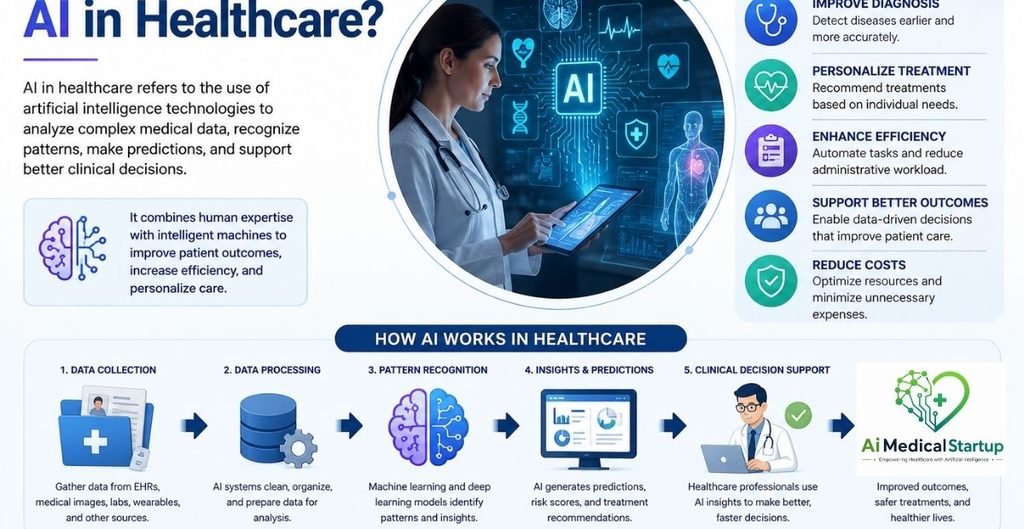
At a basic level, an AI system receives data, processes it using a trained model, and produces an output. The output might be a prediction, classification, recommendation, summary, alert, or generated response. Clinicians interpret that output within the patient’s wider context. AI does not automatically understand every factor that a physician considers during clinical decision-making.

The quality of an AI result depends on much more than the algorithm itself. Data quality, population representation, model design, validation, workflow integration, and monitoring all matter. The FDA highlights challenges around limited training data, bias, uncertainty, performance evaluation, and post-market monitoring of AI-enabled medical devices. This is why a sophisticated model can still perform poorly when it encounters a population or environment that differs from the one used during development.

How AI Processes Healthcare Data

Healthcare produces enormous quantities of clinical data, including medical records, laboratory results, medical images, prescriptions, physiological measurements, and narrative notes. AI models can transform these different data sources into structured information. A model might recognize a pattern in thousands of images or extract relevant information from millions of clinical documents.

Machine Learning in Healthcare

Machine learning allows an algorithm to learn relationships within data rather than relying entirely on manually written rules. Researchers train models in supervised learning using examples with known outcomes. For example, researchers may train a model using labeled medical images. The model then learns patterns associated with particular findings and can later evaluate new images.

Deep Learning and Medical Pattern Recognition

Deep learning uses multi-layer neural networks to identify complex patterns. It has become particularly important in image-heavy areas such as radiology and pathology. A deep-learning model may learn subtle visual characteristics that are difficult to describe through simple rules. However, strong performance in one dataset does not guarantee equal performance in another healthcare environment.

Generative AI and Large Language Models in Healthcare

Generative AI can create text, images, summaries, or other content from learned patterns. Large language models are particularly relevant to documentation, research assistance, communication, and information retrieval. WHO has specifically highlighted the potential and governance challenges of large multimodal models in health, including their ability to process multiple forms of input and generate varied outputs.

From AI Output to Clinical Decision

An AI prediction is not automatically a medical decision. A clinician must consider symptoms, history, examination findings, patient preferences, available evidence, and uncertainty. This is why human oversight and clinical oversight remain essential. FDA guidance on machine-learning-enabled medical devices also emphasizes evaluating the performance of the human-AI team rather than viewing the technology in isolation.

How do we use AI in healthcare?

The practical uses of AI in healthcare now stretch across diagnosis, imaging, documentation, research, monitoring, administration, and personalized care. Some applications are relatively low risk, such as helping organize information. Others can influence clinical decisions and therefore require much stronger clinical validation, governance, and regulatory scrutiny.

The most important distinction is between AI that assists a professional and AI that directly influences a high-stakes medical decision. A system that summarizes a consultation is not equivalent to one that interprets a scan or recommends a treatment. The potential value may be substantial in both cases, but the safety requirements are very different.

artificial-intelligence-in-healthcare

AI for Medical Diagnosis and Disease Detection

AI can analyze clinical information and identify patterns associated with disease. In some settings, models support medical diagnosis by highlighting findings that deserve attention. This can be particularly useful when clinicians face large workloads or large volumes of diagnostic information. AI may also contribute to early detection, screening, and risk prediction.

We should not treat diagnostic AI as an infallible oracle. A model can produce false positives and false negatives. Its performance may also change when the patient population, equipment, clinical workflow, or disease prevalence changes. The FDA identifies early disease detection, diagnosis, prognosis, and risk assessment in areas where AI-enabled medical devices are developed.

AI in Medical Imaging and Radiology

Medical imaging is one of the most visible applications of healthcare AI. Systems can analyze X-rays, CT scans, MRI images, ultrasound, mammography, and other imaging data. In radiology, AI can help prioritize examinations, identify suspicious regions, perform measurements, or assist with image interpretation.

The role of AI is often complementary rather than completely autonomous. A radiologist brings clinical context, experience, and responsibility to the process. AI can act like another set of computational eyes, but it does not carry the same professional judgment. That distinction becomes especially important when findings are ambiguous or when the model encounters an unusual presentation.

AI in Pathology and Laboratory Medicine

Pathology is another area where image analysis and pattern recognition can be useful. Deep learning analyzes the large quantities of visual information produced by digital pathology. AI can potentially help identify cellular patterns, classify tissue characteristics, and support quantitative analysis.

The promise is significant, but so is the need for careful validation. Tissue preparation, scanners, laboratories, staining methods, and patient populations can vary. A model trained under one set of conditions may not behave identically elsewhere. Therefore, AI evaluation should reflect the real-world environment where the system will be used.

AI-Powered Clinical Decision Support

Clinical decision support systems can provide alerts, risk scores, recommendations, or relevant information to clinicians. They may help identify potential medication interactions, estimate deterioration risk, or bring relevant information to the clinician’s attention.

The value of decision support depends on how well it fits the clinical workflow. Too many alerts can create fatigue. Poorly calibrated recommendations can distract rather than help. Good AI systems therefore need careful design, appropriate thresholds, transparent limitations, and meaningful human supervision.

AI Medical Scribes and Clinical Documentation

One of the fastest-growing practical applications is AI medical scribes. These tools can listen to clinical conversations, generate transcripts, and create draft documentation. In England, NHS guidance specifically addresses AI-enabled ambient scribing products used for clinical and patient documentation and workflow support.

This application demonstrates an important principle of healthcare automation. AI does not have to diagnose a disease to create value. Reducing documentation burden can give clinicians more time to communicate with patients. NHS England reported in 2026 that AI note-taking tools could save clinicians several minutes per consultation, although generated documentation still requires appropriate review and governance.

AI in Drug Discovery and Medical Research

Drug discovery is another major field for AI. Researchers can use models to analyze biological information, identify molecular patterns, predict properties, and prioritize potential candidates. AI can also support parts of the wider medical research process by helping researchers examine large datasets and scientific literature.

AI already supports many stages of pharmaceutical development, and the WHO expects its influence to expand further. At the same time, the organization emphasizes that commercial benefits should not replace public-health considerations, ethical safeguards, and appropriate governance.

AI for Patient Monitoring and Predictive Healthcare

Patient monitoring can generate continuous streams of information, particularly when combined with connected sensors and wearable technology. AI can analyze trends in heart rate, oxygen levels, activity, glucose, sleep, or other measurements and potentially identify changes that deserve attention.

This supports the idea of predictive healthcare, where the goal is not simply to react after a patient becomes seriously ill. Instead, healthcare systems can use data to identify risk earlier. Remote patient monitoring can be especially valuable for chronic conditions, although false alarms, data quality, accessibility, and clinical follow-up remain important concerns.

AI in Personalized and Precision Medicine

Personalized medicine aims to tailor healthcare decisions to individual characteristics rather than treating every patient as identical. AI can analyze combinations of clinical history, laboratory information, imaging, genetics, and other data to identify patterns that may support individualized care.

Precision medicine is closely related but often emphasizes biological and molecular characteristics. AI may help researchers identify subgroups of patients who respond differently to particular treatments. Yet personalization depends on representative data. If the underlying datasets are incomplete or biased, personalization can unintentionally reproduce healthcare disparities.

AI in Healthcare Administration

Many healthcare problems are administrative rather than clinical. Hospitals and clinics manage scheduling, billing, coding, claims, referrals, records, staffing, and communication. Healthcare automation can reduce repetitive work in some of these areas.

This may be less dramatic than an AI detecting cancer, but it can still have substantial operational value. If a system saves staff time without compromising accuracy or privacy, it can improve the efficiency of healthcare services. The best applications are often the ones that quietly remove friction from the system.

AI-Powered Virtual Health Assistants and Chatbots

AI assistants can help patients navigate services, answer general health questions, provide reminders, or support appointment processes. Health apps can also incorporate AI for education, symptom tracking, or personalized wellness functions.

The boundaries matter. A conversational system can sound confident even when it is wrong. That makes inaccurate information, unsupported recommendations, and delayed professional care important concerns. Patient-facing AI should therefore communicate limitations clearly and direct users toward professional care when appropriate.

AI-Assisted Surgery and Medical Devices

AI can also contribute to surgical planning, image guidance, robotics, monitoring, and other medical technology. AI medical devices may use algorithms to interpret information or support a clinical procedure. The FDA maintains a public list of authorized AI-enabled medical devices in the United States, while noting that the list is not comprehensive.

A device that affects diagnosis or treatment incorporates AI. Regulators should evaluate these systems for their intended use, safety, and effectiveness. The FDA’s current work also reflects the challenge of monitoring AI products as technology evolves after deployment.

What Are the Benefits of AI in Healthcare?

The strongest case for AI in healthcare is not that machines are inherently better than humans. It is that computers can perform certain tasks at a scale and speed that humans cannot easily match. AI can examine enormous datasets, recognize patterns, automate repetitive processes, and organize complex information.

We understand the benefits as human-AI collaboration. A clinician can bring empathy, context, experience, communication, and professional accountability. An AI system can bring rapid computation, consistency in defined tasks, and large-scale pattern analysis. When those capabilities complement each other, AI-powered healthcare can potentially become more efficient and responsive.

Faster and More Efficient Healthcare Workflows

Healthcare professionals spend significant amounts of time on administrative tasks. Healthcare automation can help reduce repetitive work such as documentation, information extraction, scheduling, and data processing. The benefit is not simply speed. Better workflow design can reduce cognitive load and allow staff to focus on work that requires human judgment.

Supporting Doctors and Healthcare Professionals

AI for doctors is increasingly about assistance rather than replacement. A physician can use AI to organize information, summarize records, draft documentation, analyze research, or support specific clinical tasks. The doctor remains responsible for interpreting the information and deciding what is appropriate for the patient.

Earlier Disease Detection

AI can recognize patterns across large datasets and potentially identify signals associated with disease before they are obvious. In screening and imaging, this may support early detection. The value of earlier detection depends on the disease, the quality of the screening process, and whether appropriate follow-up care is available.

Reducing Administrative Burden

Clinical documentation is a practical example. AI can create a draft from a clinical conversation, allowing the clinician to review rather than manually construct every sentence. NHS England has expanded access to AI tools partly because administrative efficiency can create more time for direct patient care.

More Personalized Patient Care

AI can combine multiple sources of patient data to support more individualized recommendations. AI systems can analyze genomic, clinical, imaging, and longitudinal information together to advance personalized healthcare and precision medicine.

Accelerating Medical Research and Drug Development

Researchers can use AI to analyze data, identify relationships, model biological processes, and prioritize research questions. In drug development, AI can potentially reduce the time needed to evaluate large numbers of candidates. It does not remove the need for laboratory experiments or clinical trials, but it can change where researchers spend their time.

Expanding Access to Healthcare

Digital tools can extend some healthcare capabilities beyond traditional facilities. Telehealth, telemedicine, remote monitoring, and AI-supported services help people access information and care in resource-limited areas.

However, access is not automatic. Poor internet connectivity, language barriers, disability, digital literacy, cost, and limited healthcare infrastructure can create new barriers. Technology should therefore reduce healthcare inequality, not quietly deepen it.

Potential Cost and Resource Savings

AI may reduce costs when it removes unnecessary administrative work, improves resource allocation, or supports earlier intervention. Yet implementation itself can be expensive. Organizations need infrastructure, cybersecurity, training, evaluation, integration, and ongoing AI monitoring. Organizations should measure cost savings rather than assume them.

Potential benefitHow AI contributesImportant condition
EfficiencyAutomates repetitive tasksWorkflow must be well designed
Diagnosis supportIdentifies patternsClinical validation is required
DocumentationDrafts clinical notesHumans must review outputs
ResearchAnalyzes large datasetsData quality matters
MonitoringDetects changes and riskAlerts need clinical follow-up
PersonalizationCombines patient informationData must be representative

What Are the Risks and Challenges of AI in Healthcare?

The same capabilities that make AI useful can create serious risks. A system that processes information rapidly can also process the wrong information rapidly. A model trained on biased data can produce biased results consistently. A generative model can create fluent text containing hallucinations or unsupported claims.

Healthcare is therefore different from many ordinary technology markets. A bad recommendation in a shopping application may be annoying. A bad recommendation in clinical practice can affect someone’s health. That is why AI safety, patient safety, validation, governance, and accountability must remain central to healthcare AI adoption.

AI Errors and Inaccurate Outputs

AI errors can take many forms. A diagnostic model may miss a disease. A predictive model may overestimate risk. A language model may invent a citation or provide inaccurate information. The danger is amplified when users assume that sophisticated technology must be accurate.

We should measure AI accuracy against an appropriate clinical benchmark. Sensitivity, specificity, calibration, false-positive rates, false-negative rates, and other measures may matter depending on the application. One impressive performance number rarely tells the whole story.

Bias and Health Inequality

Algorithmic bias can arise when training data do not adequately represent the people who will use the system. Historical healthcare inequalities can also become embedded in datasets. If a model performs better for one demographic group than another, the technology may unintentionally widen existing healthcare disparities.

The NHS has specifically warned that algorithms can introduce or exacerbate inequalities. Its guidance gives examples of how differences in training data can affect performance across populations. This makes AI fairness more than an abstract ethical idea. It is a practical patient-safety issue.

Patient Privacy and Healthcare Data Security

Healthcare data can reveal highly sensitive information about a person’s physical and mental health, genetics, medications, and history. Using such information in AI systems creates important questions about consent, storage, access, security, and secondary use.

Developers must build patient privacy, data protection, and healthcare privacy into AI projects from the beginning. Do not treat security as an afterthought; integrate it before deployment. A powerful model is useless if patients cannot trust how we handle their information.

Lack of Transparency and Explainability

Some complex AI models are difficult to interpret. This creates concerns about explainability. If an AI system recommends a particular action, clinicians and patients may reasonably ask why.

Not every AI system needs the same level of explanation. However, higher-risk applications generally demand stronger evidence, documentation, testing, and communication about limitations. Transparency should include information about intended use, known limitations, data characteristics, validation, and expected human involvement.

Automation Bias and Overreliance on AI

Automation bias occurs when people give excessive weight to an automated recommendation. A clinician may trust an AI output because it looks objective or technologically sophisticated.

The solution is not to distrust every AI system. Instead, healthcare professionals need appropriate AI literacy. They should understand what a tool can do, where it can fail, and how its output should influence not replace professional judgment.

Accountability and Liability

When an AI-assisted decision goes wrong, responsibility can become complicated. The developer may have responsibilities. The healthcare organization may have responsibilities. The clinician may have responsibilities. Regulators also influence the standards governing the technology.

We must establish clear accountability before deployment. The provider should identify who monitors the system, who investigates incidents, and who decides when to suspend it.

Integration With Existing Healthcare Systems

AI rarely works in isolation. It must interact with existing healthcare systems, electronic records, devices, databases, staff workflows, and security controls. Poor integration can create duplicate work instead of reducing it.

Interoperability is particularly important. If information cannot move reliably between systems, the AI may not receive the context it needs. Technology should fit the workflow rather than forcing clinicians to redesign their entire day around a new tool.

Cost, Infrastructure and Accessibility

AI requires data infrastructure, computing resources, technical expertise, maintenance, cybersecurity, and ongoing evaluation. Smaller healthcare organizations may have fewer resources to support these requirements.

This creates a risk of a digital divide. Wealthier organizations may gain access to sophisticated AI while under-resourced systems fall further behind. Responsible healthcare innovation should therefore consider not only whether a technology works, but also who can realistically benefit from it.

Lack of AI Skills Among Healthcare Professionals

Doctors and other healthcare professionals do not need to become software engineers. They do, however, need enough knowledge to evaluate AI tools critically.

AI literacy means understanding basic concepts such as model limitations, validation, data quality, bias, uncertainty, privacy, and appropriate use. It is becoming part of modern professional competence because clinicians increasingly encounter AI inside the tools they already use.

How can we use AI in Healthcare safely and responsibly?

Safe AI-enabled healthcare starts with a simple principle: the technology should serve a clearly defined healthcare need. Organizations should not adopt AI merely because it is fashionable. They should identify the problem, determine whether AI is an appropriate solution, assess risks, validate the tool, train users, and monitor performance after deployment.

WHO emphasizes safe, ethical, equitable, and governed adoption of AI for health. Its guidance also places ethics and human rights at the center of the design and use of healthcare AI. The goal is not to slow healthcare innovation. It is to make innovation trustworthy enough to last.

Keep Humans in the Loop

Human oversight is essential when AI outputs can affect patient care. The clinician should understand when to use the AI, what the AI produces, and its limitations. Clinicians should not delegate high-risk decisions simply because automation is possible.

Verify AI-Generated Medical Information

Generative systems can produce plausible language without guaranteeing factual accuracy. We should treat Generative AI as an assistant, not as an unquestionable authority. Clinicians should verify clinical information, citations, medication details, and recommendations against appropriate sources before they influence patient care.

Protect Patient Data and Privacy

AI projects should use appropriate safeguards for patient data. Organizations should determine what information enters the system, where it is processed, how long it remains, and who can access it. Privacy requirements vary by jurisdiction, so organizations operating across the USA, UK, and EU need jurisdiction-specific compliance processes.

Validate AI Tools Before Clinical Use

AI evaluation should occur before deployment. Organizations should examine clinical performance, intended use, population characteristics, usability, safety, privacy, and workflow impact.

NHS England guidance requires that implementation occur only after robust clinical validation has been performed. This is an important reminder: a model that performs well in a research paper is not automatically ready for routine medical practice.

Monitor AI Performance After Deployment

AI performance can change when the real-world environment changes. Patient populations evolve. Clinical practices change. Data sources change. Developers update the software.

That is why AI monitoring matters after deployment. Organizations should track performance, incidents, near misses, unexpected behavior, and changes in data. FDA regulatory science work specifically highlights the challenge of evaluating evolving AI-enabled medical devices and monitoring them after deployment.

Address Bias and Fairness

AI fairness requires testing across relevant patient groups. Organizations should examine whether performance differs across age groups, sexes, ethnicities, socioeconomic groups, geographic populations, or other relevant characteristics.

We should treat bias as a measurable technical and clinical issue. Simply declaring that a model is fair does not solve algorithmic bias. It requires appropriate data, testing, documentation, monitoring, and corrective action.

Tell patients when AI is used.

Patients deserve understandable information about meaningful AI involvement in their care. The appropriate level of disclosure can depend on the application and legal context.

Transparency helps build trust. If a patient discovers later that an AI system influenced their care without any explanation, confidence may suffer even when the technology performed well.

Build an AI Governance Framework

A responsible organization needs policies covering procurement, validation, data use, security, training, monitoring, incident reporting, updates, and accountability. Responsible AI should therefore become part of institutional governance rather than remaining the responsibility of one enthusiastic technology team.

Safety areaKey question
Intended useWhat problem is the AI designed to solve?
Clinical validationHas it been tested for the actual intended use?
DataAre the data appropriate and representative?
PrivacyIs patient information protected?
FairnessDoes performance differ across patient groups?
Human oversightWho reviews the AI output?
MonitoringWho checks performance after deployment?
AccountabilityWho is responsible when something goes wrong?

AI for Doctors and Healthcare Professionals

For doctors, the most useful question is not “Will AI replace me?” but “Which parts of my work can AI perform safely and which parts still require my expertise?” AI can support documentation, research, information retrieval, image analysis, administrative work, and selected forms of clinical decision support.

This shift is already visible in healthcare organizations. NHS England has been expanding access to AI tools for administrative work and clinical documentation. In June 2026, it announced access to AI tools for more than 500,000 NHS staff, reflecting a broader move toward integrating AI into everyday workflows.

How Doctors Can Use AI in Everyday Practice

AI for doctors can include clinical documentation, research assistance, patient communication, information organization, and selected decision-support functions. The safest uses are usually those where the clinician can easily review the output before acting on it.

AI Tools for Doctors

Modern AI tools range from ambient documentation systems to imaging software, research assistants, predictive models, and workflow applications. The problem they solve determines their usefulness. A general-purpose chatbot is not automatically an appropriate clinical tool simply because it can discuss medical topics.

AI for Medical Research and Literature Review

Researchers can use AI to search, classify, summarize, and organize scientific information. This can reduce the time spent navigating large volumes of literature.

However, researchers must verify sources and claims. A generated summary can omit an important limitation or incorrectly connect two findings. Human scientific judgment remains essential.

AI in Medical Education and Training

AI can create simulated cases, explain concepts, generate practice questions, and adapt educational material. This could make learning more personalized for students and professionals.

The technology should complement formal education rather than replace expert teaching. Medical training cannot be reduced to text generation, despite involving uncertainty, communication, examination skills, ethics, and professional judgment.

What Doctors Should Check Before Using an AI Tool

A doctor evaluating an AI tool should consider its intended purpose, evidence, validation, privacy controls, regulatory status where relevant, limitations, integration, and monitoring arrangements. We must determine if the system has demonstrated safe performance for the task where it will be used.

Why AI Literacy Is Becoming a Core Healthcare Skill

AI literacy will increasingly matter because AI is becoming embedded within ordinary software. Clinicians may not always realize that an algorithm is influencing a workflow.

Understanding the basic strengths and weaknesses of AI technology helps professionals use it intelligently. The goal is not to turn every doctor into a programmer. It is to make every professional capable of asking the right questions.

AI, Digital Health and Medical Technologies

Digital health is broader than AI. It includes electronic records, telemedicine, mobile health applications, connected devices, remote monitoring, digital therapeutics, and other forms of health technology. AI can operate within this ecosystem as an analytical or generative layer. The relationship is similar to a city and its transport system. Digital healthcare provides much of the infrastructure for moving information, while AI can provide tools for interpreting and using that information. Neither works well without reliable data, secure systems, appropriate workflows, and people who understand how to use them.

ai-health-technologies-and-digital-health

AI and Digital Health

The growth of digital health creates more data that AI can potentially analyze. This includes information from records, apps, sensors, imaging systems, and connected devices.

Yet more data is not automatically better. Poor-quality or irrelevant information can make AI less reliable. Effective AI depends on useful, accurate, appropriately governed data.

AI and Electronic Health Records

Electronic health records contain rich clinical information but can also be difficult to navigate. AI can help summarize records, extract relevant information, identify trends, and support documentation.

The challenge is preserving context. A summary that omits an important historical detail can be dangerous. AI should therefore reduce information overload without turning complex medical histories into oversimplified narratives.

AI and Telemedicine

Telehealth and telemedicine can use AI for patient navigation, documentation, scheduling, triage support, and information management. This can make remote healthcare more efficient.

However, remote care has limits. Some conditions require physical examination, diagnostic testing, or urgent intervention. AI should help determine appropriate pathways without creating false reassurance.

AI and Wearable Health Technology

Wearable devices can collect continuous or frequent information about activity, heart rate, sleep, temperature, oxygen levels, and other measures. AI can analyze these streams to identify changes and patterns.

This creates opportunities for earlier intervention and personalized monitoring. It also creates questions about data quality, false alarms, privacy, and how clinicians should respond to consumer-generated health information.

AI and Remote Patient Monitoring

Remote patient monitoring can extend healthcare beyond hospitals and clinics. AI can examine incoming measurements and prioritize cases that may need attention. The workflow after an alert matters just as much as the algorithm. A warning has little value if nobody reviews it or if healthcare teams receive too many low-value alerts.

AI-Powered Medical Devices

AI-enabled medical devices can support imaging, diagnosis, monitoring, and other clinical tasks. In the United States, the FDA maintains a public resource identifying authorized AI-enabled medical devices and continues to develop evaluation approaches for evolving AI technologies.

AI, Health Apps and Consumer Health Technology

Health apps increasingly use AI to personalize recommendations, track behavior, or answer questions. These products can support health education and self-management.

But consumers should understand the difference between wellness information and medical advice. A health application should not create a false impression that it has performed a professional clinical assessment when it has not.

AI in Healthcare Regulation, Ethics and Governance

AI regulation is evolving because healthcare AI sits at the intersection of technology, medicine, privacy, safety, and fundamental rights. Different jurisdictions take different approaches, and regulators determine a product’s regulatory status by its function and use.

Healthcare organizations should not treat regulation as a final paperwork step. Healthcare regulation, governance, and safety should influence procurement and deployment from the beginning. In practice, organizations need to understand both technology-specific rules and broader laws covering privacy, medical devices, professional responsibilities, and patient rights.

Why AI Healthcare Regulation Matters

The purpose of regulation is not simply to stop innovation. It is to establish safeguards around products that can affect health and safety. Regulators increasingly focus on performance, transparency, risk management, post-market monitoring, and the behavior of evolving AI systems.

AI Healthcare Regulation in the United States

In the United States, the FDA regulates certain AI-enabled products when they fall within its medical-device framework. The FDA maintains an AI-enabled medical-device list and develops regulatory science methods for evaluating safety, effectiveness, uncertainty, bias, and post-market performance.

The U.S. regulatory environment is also evolving alongside generative AI. In August 2026, the FDA issued a discussion paper seeking feedback on regulatory considerations for generative-AI-enabled medical devices, including risk assessment, premarket evaluation, and post-market monitoring.

AI Healthcare Regulation in the European Union

The European Union uses the EU AI Act, a risk-based framework that includes requirements for certain high-risk AI systems. The high-risk framework includes healthcare applications that connect AI to regulated products or high-impact uses.

As of 2026, the implementation timeline has evolved. The European Commission states that high-risk rules under relevant categories apply on different dates, including rules for certain high-risk AI systems from December 2027 and AI embedded in regulated physical products from August 2028. Organizations should therefore check the latest implementation guidance rather than relying on older summaries.

AI Healthcare Regulation in the United Kingdom

The United Kingdom regulates many AI-enabled products through its medical-device framework when they meet the relevant definition. The MHRA provides guidance for software and AI used as medical devices and has been developing its approach to the wider regulation of AI in healthcare.

NHS England is also developing practical guidance for responsible AI adoption. Its current AI resources emphasize ethical deployment, patient safety, transparency, trust, and improved health outcomes.

Healthcare Data Privacy and AI

Privacy laws remain highly relevant to AI. Organizations in the United States may need to consider HIPAA and other applicable laws. Organizations operating in Europe must consider GDPR and other requirements. UK organizations must consider UK data-protection law and sector-specific requirements.

The precise legal obligations depend on the use case, data, organization, and jurisdiction. Organizations should embed patient privacy in AI workflows rather than treating it as a technical footnote.

Ethical Principles for Healthcare AI

AI ethics includes fairness, safety, transparency, accountability, privacy, autonomy, and respect for human rights. WHO has emphasized that ethics and human rights should remain central to the design, development, deployment, and use of AI for health.

Ethics also requires us to decide whether to use an AI application at all. A technically possible system is not automatically a socially desirable system. Good healthcare innovation begins with a genuine patient or clinical need.

Who Is Responsible for an AI-Assisted Medical Decision?

We must ensure that responsibility does not disappear simply because software is involved. The answer depends on the circumstances, product, law, and professional context. Developers, healthcare organizations, clinicians, and regulators can all have different responsibilities.

Clear governance should establish who approves the system, who monitors it, who handles incidents, who manages updates, and who communicates with patients. Accountability is especially important when AI becomes deeply embedded in clinical workflows.

RegionMajor regulatory focusPractical consideration
United StatesFDA and applicable federal/state requirementsMedical-device status and intended use
European UnionEU AI Act plus medical-device and data lawsRisk classification and conformity obligations
United KingdomMHRA and UK healthcare governanceMedical-device classification and safe deployment

What Is the Future of AI in Healthcare?

The future of AI in healthcare will probably be less about one revolutionary machine and more about thousands of small integrations. AI will increasingly become part of electronic records, imaging systems, patient portals, research platforms, medical devices, and administrative software.

The most important shift may be from standalone AI tools toward invisible assistance. A clinician may not open a separate AI application. Instead, the software they already use may summarize a record, identify relevant information, draft a note, highlight an unusual image, or suggest a question to consider. The technology becomes part of the workflow rather than another destination.

Generative AI and the Future of Medicine

Generative AI is likely to remain important because medicine contains enormous amounts of unstructured language. Language models can process the information found in clinical notes, research papers, discharge summaries, patient communications, and guidelines.

The challenge will be reliability. Future systems need better grounding, verification, provenance, privacy controls, and clinical evaluation. The most valuable medical AI may not be the model that talks most impressively. It may be the one that knows when it is uncertain.

AI-Assisted Doctors and Clinical Workflows

The future will likely involve more AI-assisted doctors rather than autonomous AI doctors. Systems can prepare information, summarize records, flag patterns, and reduce administrative work while clinicians retain responsibility for interpretation and patient communication.

This aligns with the broader concept of the human-AI team. FDA transparency principles specifically emphasize evaluating how humans and AI perform together.

More Personalized Healthcare

As datasets become more integrated, AI may support increasingly individualized healthcare. Personalized medicine could combine clinical history, imaging, laboratory data, genetics, lifestyle information, and longitudinal monitoring.

The opportunity is substantial, but personalization must remain evidence-based. A highly personalized recommendation is not automatically a good recommendation. It must still be clinically appropriate, validated, and understandable.

AI in Drug Discovery and Biomedical Research

AI will likely become more deeply integrated into drug discovery, molecular modeling, clinical-trial planning, and biomedical research. Researchers can use AI to narrow enormous search spaces and identify promising relationships.

This does not mean AI will eliminate laboratory science. Biology is too complex for that. Instead, AI may help researchers decide which experiments are worth performing and which hypotheses deserve closer investigation.

Predictive and Preventive Healthcare

Predictive healthcare could move medicine toward earlier intervention. Instead of waiting for symptoms to become severe, systems may identify combinations of signals that suggest rising risk.

This could be particularly useful for chronic diseases and remote monitoring. Yet prediction alone is not treatment. Healthcare systems need pathways for acting on predictions responsibly.

Multimodal AI in Healthcare

Multimodal AI can combine text, images, audio, video, laboratory data, and other information. This could eventually allow systems to analyze a more complete clinical picture than models restricted to one data type.

WHO’s work on large multimodal models recognizes both the potential applications and governance challenges of these systems in health and scientific research.

The Future Healthcare Workforce

The healthcare workforce will probably not become less important. Its responsibilities will change. Professionals may spend less time entering information and more time interpreting information, communicating with patients, managing complex decisions, and supervising technology.

That means AI literacy could become as practical as learning to use an electronic health record. Healthcare professionals who understand AI’s strengths and limitations position themselves to use AI safely.

What Healthcare Organizations Should Prepare for Now

Healthcare organizations should prepare for AI by improving data quality, strengthening cybersecurity, establishing governance, training staff, evaluating vendors, and creating clear processes for monitoring AI after deployment.

The organizations most likely to benefit will not necessarily be those that adopt the largest number of AI tools. They will be the ones that choose useful applications, evaluate them carefully, and integrate them into clinical workflows without losing sight of patients.

Will AI Replace Doctors?

The short answer is unlikely to replace doctors as a profession. AI can automate individual tasks, but medicine is not a single task. A doctor combines clinical reasoning, physical examination, communication, ethical judgment, uncertainty management, professional responsibility, and knowledge of the patient’s circumstances.

The more realistic future is collaboration. Automated tasks will emerge. Certain jobs will change. As some skills lose importance, others gain value. The central question will shift from “human or machine?” to “what should humans and machines each do best?”

Can AI Replace Doctors?

AI can perform specific activities faster than humans. It can analyze large datasets, detect patterns, generate summaries, and automate repetitive work. But those abilities do not equal the complete role of a physician.

A doctor must decide what information matters, understand the patient’s goals, explain uncertainty, recognize unusual situations, and accept professional responsibility. Professionals must not hand those responsibilities to an algorithm.

What AI Can Do Better Than Humans

Computers are exceptionally good at processing large quantities of structured information. Computers examine thousands of images or records without tiring. They can calculate probabilities rapidly and identify patterns across datasets.

This makes AI powerful for selected tasks. It does not make AI universally superior. The strength of technology lies in scale and computation, while human strength often lies in context and judgment.

What Doctors Still Do Better

Doctors and other medical professionals can build relationships, understand emotions, perform physical examinations, recognize contextual clues, communicate difficult information, and make decisions under uncertainty.

Medicine is also deeply human. A patient may need more than a statistically optimal recommendation. They may need someone who can explain the choices, understand their concerns, and help them decide what matters most.

AI will support healthcare in the future, not replace doctors.

AI-assisted healthcare will shape the future. AI handles appropriate computational tasks while clinicians supervise, interpret, and communicate.

This model can make medicine more efficient without stripping it of human judgment. The technology becomes an additional capability rather than a replacement for the professional.

Could Doctors Who Use AI Replace Doctors Who Do Not?

There is a more interesting possibility. Doctors who use AI effectively may eventually work more efficiently than doctors who ignore it. The competitive advantage would not come from blindly trusting AI. It would come from knowing how to use the right tool for the right task.

In that sense, the future may not be “AI versus doctors.” It may be “doctors using AI versus doctors who do not.” The difference will be competence, judgment, and responsible adoption.

AI is well suited toHumans remain essential for
Pattern recognitionClinical judgment
Large-scale data analysisContextual reasoning
Repetitive documentationPatient communication
Data summarizationEthical decisions
Risk calculationManaging uncertainty
Administrative automationProfessional accountability

Frequently Asked Questions About AI in Healthcare

The rapid growth of artificial intelligence in healthcare has created understandable questions among patients, clinicians, researchers, technology companies, and policymakers. People frequently ask whether AI is safe, if it can diagnose diseases, how it is regulated, and what its implications are for the future of medicine.

The most useful answers require balance. AI technology can provide real benefits, but those benefits depend on appropriate design, evidence, implementation, and human oversight. Healthcare should not treat either optimism or fear as a substitute for evidence.

What Is Artificial Intelligence in Healthcare?

Artificial intelligence in healthcare is the use of computational systems to analyze medical data, recognize patterns, make predictions, generate information, or support healthcare tasks. It includes technologies such as machine learning, deep learning, natural language processing, generative models, and computer vision.

How does AI help in healthcare?

In healthcare, AI powers imaging, diagnosis support, clinical decision support, documentation, drug discovery, patient monitoring, administration, research, personalized care, and AI-enabled devices. The exact role depends on the system and its intended use.

What Are the Benefits of AI in Healthcare?

The main potential benefits include faster information processing, reduced administrative workload, improved workflow efficiency, support for medical diagnosis, earlier detection, research acceleration, personalized care, and expanded access to some healthcare services.

What Are the Risks of AI in Healthcare?

Important AI risks include AI errors, hallucinations, bias, privacy problems, cybersecurity threats, automation bias, lack of transparency, poor integration, and unclear accountability. We should evaluate healthcare AI systems for both performance and real-world safety.

Is AI Safe for Use in Healthcare?

Organizations can use AI safely when the specific system has appropriate evidence, validation, governance, privacy protections, monitoring, and human supervision. Safety is not a property that automatically comes with the word “AI.” How the technology is designed, evaluated, deployed, and monitored determines safety.

Can AI Diagnose Diseases?

Some AI systems can support disease detection and medical diagnosis by identifying patterns in images, clinical information, or other data. Healthcare professionals should interpret the output within the appropriate clinical context. Whether an AI product can legally perform a particular diagnostic function also depends on its intended use and regulatory status.

Can AI Replace Doctors?

AI is unlikely to replace doctors as a complete profession because medicine requires clinical reasoning, communication, physical assessment, ethical judgment, and accountability. AI will more likely automate selected tasks and help create AI-assisted doctors who can work more efficiently.

How Do Doctors Use AI?

Doctors can use AI for documentation, medical research, information organization, imaging support, administrative workflows, patient communication, and selected forms of clinical decision support. The appropriate use depends on the tool and the clinical setting.

Do regulators regulate AI in healthcare?

Yes, but regulation varies by country, product, and intended use. The FDA regulates AI-enabled medical devices in the United States. Within the European Union, the EU AI Act creates a risk-based framework alongside other relevant laws. Under UK regulation, the MHRA governs applicable software and AI as medical devices while the broader healthcare AI framework continues to evolve.

What Is the Future of AI in Healthcare?

The future of AI in healthcare will likely involve deeper integration into clinical workflows, medical devices, digital health platforms, research, documentation, monitoring, and personalized care. Generative AI, multimodal AI, predictive models, and AI-enabled medical technologies are likely to become increasingly important.

What Is the Most Important Principle for Healthcare AI?

The most important principle is that technology should remain accountable to patient well-being. Responsible AI, AI safety, patient safety, privacy, fairness, transparency, and clinical oversight should matter more than simply deploying the newest model.

Final Thoughts: AI Is Changing Medicine, But Humans Still Define Good Care

Artificial intelligence in healthcare is no longer a distant idea. It is becoming part of diagnosis, imaging, documentation, research, monitoring, administration, and medical technology. The technology can process information at remarkable speed and scale. It can also create new forms of risk that healthcare systems cannot afford to ignore.

We must evaluate the future by outcomes, not the extent of AI deployment by providers. Evaluate the technology by its ability to produce safer patient care, better experiences, more efficient workflows, stronger research, and fairer access to healthcare. WHO continues to emphasize that AI adoption should be safe, ethical, equitable, and people-centered.

The strongest model is not a machine replacing a doctor. It is a capable professional using a carefully evaluated tool, understanding its limitations, and remaining responsible for the patient in front of them. That is the real promise of AI-powered healthcare: not removing humans from medicine, but giving them better tools to do what humans do best.

AI-Based Diabetes Management

Primary Healthcare & AI AI-Based Diabetes Management: How Artificial Intelligence Is…

Risks of AI in Healthcare

Risks of AI in Healthcare: Bias, Errors, Privacy, Safety & How to Mitigate Them Sept 16, 2026 •…

AI in Fitness

Hero Section – AI Fitness Calculator The Future of Digital Health AI in the Fitness Industry:…

AI in Pulmonology

Special Report 2026 The Rise of AI in Respiratory Care A Comprehensive Guide to Next-Gen Pulmonology…

AI in Mental Health

AI in Mental Health: Revolutionizing Diagnosis and Treatment Mental healthcare is changing rapidly…

AI Medical Scribes

AI Medical Scribes: How AI Is Transforming Clinical Documentation Clinical documentation can take…

AI-Based Prediction of Preeclampsia

AI-Based Prediction of Preeclampsia Using First-Trimester Biomarkers Preeclampsia can turn a…

Future of FemTech

AI Is Revolutionizing Women’s Health: The Future of FemTech Artificial intelligence is changing how…

Best AI Tools in Radiology

Best AI Tools in Radiology: Top Solutions for Medical Imaging in 2026 Radiology is changing quickly…

AI in Healthcare

AI in Healthcare: Uses, Benefits, Risks & the Future of Medicine Healthcare is entering a new…
how-the-medical-industry-is-adapting-to-a-new-better-tomorrow

Healthcare Tech

How the Medical Industry Is Adapting to a New Better Tomorrow

Healthcare is changing faster than ever, and the shift is reaching far beyond hospital walls. From smarter diagnosis to virtual consultations, medical technology is helping doctors work more efficiently while giving patients greater access to care. At the same time, digital health, artificial intelligence, connected devices, and precision medicine are creating new ways to prevent, detect, and treat disease. These advances are not simply about replacing old systems with new ones.

They are about building a healthcare model that is more personalized, connected, proactive, and patient-focused. As healthcare innovation accelerates across the USA, UK, and EU, understanding how the medical industry is adapting can help you see where modern medicine is heading—and why patient outcomes remain at the heart of this transformation.

Artificial Intelligence and Machine Learning

The biggest change in modern medicine may be happening behind the screen rather than inside the operating room. Artificial intelligence in healthcare can help clinicians process large amounts of information, identify patterns, and prioritize cases. The FDA maintains an updated list of AI-enabled medical devices authorized for marketing in the United States, showing how AI has moved beyond experimentation into regulated clinical applications.

At the same time, machine learning in healthcare is becoming useful across imaging, risk prediction, documentation, research, and workflow management. A clinician might still make the final decision, but an intelligent system can act like a second pair of eyes. That partnership could make AI-powered healthcare more practical, provided organizations validate systems carefully and monitor performance after deployment.

How AI Is Transforming the Medical Industry

AI can quietly remove friction from many parts of healthcare. It can summarize records, flag unusual findings, organize information, and support clinicians during complex decisions. Clinical decision support tools are especially valuable when they present relevant information without overwhelming the professional using them.

The real opportunity lies in augmentation rather than replacement. Doctors bring context, experience, empathy, and accountability. AI brings speed and pattern recognition. When those strengths meet, AI diagnostics can support earlier disease detection and more consistent clinical workflows.

AI-Powered Diagnosis and Disease Detection

Medical imaging offers a useful example. Algorithms can examine images for patterns associated with particular conditions and highlight areas that deserve closer attention. This does not mean a machine independently understands a patient. Instead, it gives clinicians another source of evidence.

The FDA’s regulatory work reflects this distinction. Authorized AI-enabled devices must meet applicable premarket requirements for safety and effectiveness. Meanwhile, developers increasingly need to consider transparency, bias, monitoring, and lifecycle management.

Generative AI and Clinical Decision Support

Generative AI has pushed healthcare technology into a new phase. Instead of only detecting patterns, modern systems can generate summaries, draft documentation, answer questions, and organize complex information. Used carefully, this can reduce administrative pressure and give clinicians more time for patients.

However, fluent language does not guarantee factual accuracy. A system can produce an answer that sounds convincing but contains an error. That is why generative AI in medicine needs strong validation, human review, secure data handling, and clear accountability.

Machine Learning in Drug Discovery and Medical Research

Drug development can take years and requires enormous amounts of scientific analysis. AI may help researchers search biological relationships, identify promising molecules, model interactions, and prioritize experiments. In that sense, drug discovery becomes less like searching through a haystack and more like narrowing the haystack before scientists begin.

The same principle applies to medical research more broadly. Machine learning can analyze datasets that would be difficult to review manually. Yet algorithms still depend on the quality of their training data. Poor data can produce misleading conclusions, while biased datasets can reinforce existing inequalities.

AI Safety, Bias, and Human Oversight

Every powerful medical tool needs guardrails. AI bias can appear when training data does not adequately represent the populations receiving care. Algorithmic errors can also occur when systems encounter unusual cases or conditions outside their validated use.

The FDA has been developing regulatory approaches that address transparency, bias, lifecycle management, and emerging generative AI-enabled medical devices. In August 2026, the agency opened discussion around regulatory considerations for generative AI-enabled medical devices.

Telemedicine and Remote Patient Monitoring

Healthcare can now travel with the patient. Telemedicine allows clinicians to communicate with patients without requiring every interaction to happen inside a clinic. This has particular value for follow-up appointments, routine consultations, specialist access, and people who face transportation or geographic barriers.

Alongside it, remote patient monitoring is changing what happens between appointments. Connected devices can transmit health measurements from home, allowing clinicians to follow trends rather than relying only on occasional readings. Together, these approaches strengthen virtual healthcare and create new models of remote care.

telemedicine-and-remote-patient-monitoring

The Rise of Telemedicine in Modern Healthcare

Telemedicine has evolved from a convenient alternative into an important part of modern care delivery. A patient managing a stable condition may not need to travel for every appointment. A specialist can also review a case remotely when local expertise is limited.

Still, virtual care has boundaries. Physical examinations, emergency treatment, certain diagnostic procedures, and some complex interventions require in-person services. The strongest model is therefore hybrid care, where digital and physical services complement each other rather than compete.

Telemedicine vs. Remote Patient Monitoring

The distinction is straightforward. Telemedicine focuses primarily on communication between patients and healthcare professionals. Remote patient monitoring focuses on collecting and transmitting health information while the patient remains outside a clinical setting.

For example, a video appointment allows a clinician to discuss symptoms. A connected blood-pressure monitor can continuously provide readings between appointments. When combined, these tools can strengthen chronic disease management by giving clinicians both conversation and data.

Wearable Devices and Continuous Health Monitoring

A smartwatch may look like a consumer accessory, but many wearable health devices now capture useful physiological information. Heart rate, activity, sleep patterns, oxygen-related measurements, and other signals can provide additional context.

The value grows when those signals are interpreted appropriately. Real-time patient monitoring can help identify changes that deserve attention, although not every fluctuation indicates disease. Clinicians must understand device limitations and distinguish meaningful trends from everyday biological variation.

Remote Care for Chronic Diseases

Chronic conditions often require long-term management rather than a single intervention. Diabetes, cardiovascular disease, respiratory conditions, and hypertension can involve repeated measurements and lifestyle adjustments.

Remote monitoring can bring some of that process into the home. Instead of waiting weeks for the next appointment, patients may share relevant readings more frequently. That creates opportunities for earlier intervention, better communication, and more personalized management.

Making Healthcare More Accessible Through Virtual Care

Geography can quietly determine who receives timely specialist care. Rural patients may travel for hours simply to see a clinician whose expertise is unavailable locally. Virtual services can reduce some of that burden. However, healthcare accessibility depends on more than having an app. Patients need reliable internet, suitable devices, digital skills, language support, and affordable services. If those foundations are missing, digital health can unintentionally widen the gap it was designed to close.

Internet of Medical Things (IoMT)

Hospitals are becoming increasingly connected. The Internet of Medical Things links medical devices, monitoring systems, software platforms, and networks so that information can move between them. This creates a digital layer around clinical care. The concept becomes easier to understand through a simple example. A connected patient monitor can collect measurements, transmit them to a hospital system, and trigger an alert when a value crosses a defined threshold. In this ecosystem, IoMT turns individual devices into participants in a wider healthcare workflow.

What Is the Internet of Medical Things?

IoMT is essentially healthcare-focused connected technology. General IoT can include thermostats, vehicles, appliances, and industrial equipment. IoMT concentrates on medical and health-related devices.

internet-of-medical-things

That distinction matters because medical information is unusually sensitive. A connected medical device does not simply exchange data. It may handle information that can affect diagnosis, treatment, insurance, or personal privacy. Security therefore needs to be designed into the system from the beginning.

Smart Medical Devices and Connected Hospitals

Connected hospitals can use sensors and devices to track patients, equipment, environmental conditions, and operational activity. Such systems may help staff locate equipment, monitor patients, and manage resources more efficiently.

The long-term value comes from integration. A collection of disconnected devices creates more data but not necessarily better care. When connected medical devices communicate through compatible systems, information can become actionable rather than merely abundant.

Real-Time Patient Monitoring Through IoMT

Continuous monitoring can give clinicians a richer picture of a patient’s condition. Instead of relying only on snapshots taken during appointments, providers can examine trends over time.

That approach is especially useful when small changes matter. A gradual shift in vital signs could prompt closer review before a situation becomes more serious. Still, alerts need careful design. Too many notifications can create alarm fatigue and overwhelm already busy clinical teams.

How IoMT Can Improve Healthcare Efficiency

Connected devices can reduce manual data entry and help automate repetitive processes. A hospital can potentially use sensor information to understand equipment usage, patient movement, or bed availability.

This is where healthcare automation becomes more practical. The goal is not to automate everything. It is to remove unnecessary friction so healthcare professionals can spend more attention on decisions, communication, and patient care.

IoMT Security and Privacy Challenges

Connectivity creates another doorway for attackers. Every connected device can introduce potential security weaknesses, especially when systems use outdated software or weak authentication.

Strong patient data protection therefore requires more than securing a central database. Organizations need device-level security, network controls, software updates, access management, monitoring, and clear response plans. In connected healthcare, cybersecurity must follow the data wherever it travels.

Precision Medicine and Genomics

Medicine is moving away from the idea that one treatment should work equally well for everyone. Precision medicine uses information about an individual’s biology, environment, and lifestyle to help guide prevention and treatment decisions.

Genomic information is one important part of that picture. Modern sequencing can reveal biological differences that influence disease risk or treatment response. As costs and analytical capabilities change, genomics is becoming increasingly relevant to personalized healthcare, particularly in cancer and rare disease research.

What Is Precision Medicine?

Traditional medicine often relies on population-level evidence. Precision approaches add another layer by asking what makes this particular patient different.

That can involve genetics, biomarkers, clinical history, lifestyle, and other information. The goal is personalized treatment, where decisions reflect the characteristics of the individual rather than relying solely on broad averages.

How Genomics Is Changing Medical Treatment

Genomic testing can identify variants that provide clues about inherited conditions, disease mechanisms, or potential treatment responses. For some patients, that information can help clinicians select more appropriate therapies.

The challenge is interpretation. Genomic data can be enormous and complex. It may also reveal uncertain findings that require expert explanation. Therefore, genetic information works best when paired with qualified counseling, clinical context, and careful data governance.

Precision Oncology and Targeted Cancer Treatments

Cancer illustrates the potential of precision medicine particularly well. Two tumors that appear similar under a microscope may have different molecular characteristics.

Testing can sometimes identify biomarkers associated with specific treatments. Targeted therapies can then focus on biological features that drive a particular cancer. This approach does not guarantee success, but it can make treatment selection more individualized.

AI, Genomics, and Personalized Healthcare

Genomics produces complex datasets that humans cannot always interpret efficiently on their own. AI can help researchers identify patterns across genomic and clinical information.

This combination could strengthen predictive healthcare by identifying risk signals earlier. However, prediction is not destiny. Genetic information can indicate probability, not certainty, and healthcare decisions must still consider the person’s complete clinical picture.

Challenges of Genomic and Precision Medicine

Precision medicine also raises difficult questions about affordability, privacy, consent, and access. Genetic information can reveal details about relatives as well as the individual tested.

For patients, trust is essential. Genomic data should receive strong protection, clear explanations, and responsible governance. Otherwise, the technology may advance faster than public confidence.

Robotics and Automation

Robots are becoming useful partners in healthcare rather than futuristic machines wandering through hospital corridors. Healthcare robotics can support surgery, rehabilitation, logistics, medication handling, and other specialized tasks.

At the same time, automation is spreading into less visible areas. Hospital automation can help with scheduling, inventory, documentation, laboratory processes, and repetitive administrative work. These changes matter because healthcare professionals often lose valuable time to tasks that do not require their full clinical expertise.

Robotic-Assisted Surgery

Modern robotic surgery does not mean a robot independently decides how to operate. In many systems, surgeons control specialized instruments that provide enhanced precision, visualization, or dexterity.

The potential benefits depend on the procedure, system, clinician training, and patient factors. Robotic-assisted surgery is therefore best understood as a surgical platform rather than a replacement for the surgeon.

Robots in Rehabilitation and Patient Care

Rehabilitation technology can help patients repeat movements, track progress, and receive structured assistance. Robotic systems may support people recovering from neurological injuries, surgery, or mobility-related conditions.

These technologies can also provide consistent exercises. However, rehabilitation remains deeply human. Motivation, encouragement, pain assessment, and individualized judgment are difficult to automate fully.

Automation in Hospitals and Medical Facilities

Hospitals contain thousands of moving parts. Medicines need to reach the right location. Equipment needs maintenance. Laboratory samples require tracking. Staff need accurate schedules.

Automation can coordinate many of these processes. When designed well, it becomes almost invisible. The best automation does not make the hospital feel more technological. It makes the hospital feel less chaotic.

Healthcare Automation and Administrative Work

Administrative workload is a persistent source of frustration for healthcare professionals. Documentation, coding, billing, appointment management, and record preparation can consume substantial time.

Software can handle portions of these repetitive activities. This is where healthcare automation can produce practical value quickly. Even small reductions in administrative friction can give professionals more time for patients.

Will Robots Replace Healthcare Professionals?

The short answer is unlikely. Healthcare depends on judgment, communication, empathy, physical assessment, ethics, and trust. Machines may perform particular tasks better than humans. Humans remain better at understanding the broader situation. The future is therefore more likely to involve collaboration between people and machines than wholesale replacement.

will-robots-replace-healthcare-professionals

3D Printing in Healthcare

A patient’s anatomy is not identical to anyone else’s. 3D printing in healthcare addresses that reality by allowing physical objects to be created from digital designs and patient-specific information.

The technology already has practical applications in prosthetics, models, implants, surgical planning, and research. Its more ambitious frontier is biological manufacturing. That field remains experimental, but it could eventually change how damaged tissues are repaired.

How 3D Printing Is Changing Modern Medicine

Traditional manufacturing often requires standardized production. 3D printing can create highly customized shapes without requiring the same manufacturing process for every patient. That flexibility makes it attractive for medical applications. Clinicians and engineers can design objects around a person’s anatomy, potentially improving fit and usability.

3D-Printed Prosthetics and Medical Implants

Customized 3D-printed prosthetics can be designed around individual measurements. This can make personalization more accessible, especially when traditional manufacturing is expensive or slow. Researchers also use additive manufacturing to develop implant designs and anatomical structures. Clinical suitability still depends on material safety, mechanical performance, manufacturing quality, and regulatory requirements.

3D Printing for Surgical Planning

A surgeon can study a digital scan on a screen, but a physical model can provide another form of understanding. A printed anatomical replica can help clinicians visualize complex structures before an operation. This may be particularly useful when anatomy is unusual or difficult to interpret. Medical students can also use models for education without relying solely on traditional specimens.

Bio-printing and Tissue Engineering

The most ambitious branch is bio-printing, which attempts to use biological materials and cells to construct tissue-like structures. Researchers are exploring how printing techniques could support regenerative medicine. Tissue engineering combines cells, bio-materials, engineering methods, and biological signals. The science is promising, but building living tissue that develops correct structure, blood supply, function, and long-term stability remains extremely difficult.

Can 3D Printing Produce Functional Human Organs?

The idea of printing a replacement heart or kidney sounds like science fiction, but researchers are actively investigating related technologies. Yet a fully functional, transplant-ready human organ remains a far greater challenge than printing a physical model.

An organ needs intricate architecture, living cells, blood vessels, nerves, and reliable biological function. Current research is therefore better described as a journey toward regenerative medicine than a finished organ-printing solution.

Blockchain and Health Data Security

Healthcare generates enormous amounts of sensitive information. Healthcare data security has therefore become inseparable from digital transformation. Blockchain is one technology that has attracted attention because it can create tamper-evident records across distributed networks. However, blockchain is not a magic shield. Its usefulness depends on the problem being solved. A healthcare system may benefit from blockchain in specific data-sharing or verification scenarios, while a conventional database may remain more suitable elsewhere.

Why Healthcare Needs Better Data Security

Medical records contain deeply personal information. They can include diagnoses, medications, genetic details, financial information, and identifying data. As healthcare becomes more digital, the consequences of a breach can become severe. In April 2026, HHS announced four ransomware settlements affecting more than 427,000 individuals, highlighting the continuing pressure on healthcare organizations to strengthen security controls.

How Blockchain Can Be Used in Healthcare

Blockchain can create a distributed record of transactions. Instead of relying on one central record keeper, participating systems can maintain synchronized information about approved transactions. In theory, this can strengthen traceability and trust. In practice, healthcare organizations must still solve interoperability, privacy, performance, governance, and integration problems. Blockchain can support a system, but it cannot repair poor architecture by itself.

Secure Medical Data Sharing

Patients often receive care from several organizations. Data may sit in hospitals, clinics, laboratories, pharmacies, and specialist systems. Secure sharing can reduce duplication and improve continuity. Blockchain may support consent or transaction tracking in some architectures, while established interoperability standards may handle the actual exchange of clinical information more efficiently.

Blockchain and Patient Data Ownership

The idea of patients having more control over their information is attractive. Patients could potentially manage permissions and see how certain records are accessed.

Yet ownership is not simply a technical problem. Laws, contracts, clinical obligations, and data governance all influence who may access health information. Technology needs to fit those rules rather than operate in isolation.

Limitations of Blockchain in Healthcare

Blockchain can introduce complexity, storage concerns, performance constraints, and governance challenges. Putting sensitive health information directly onto an immutable ledger can also create privacy problems if the architecture is poorly designed. Therefore, blockchain in healthcare should be evaluated like any other technology. The important question is not whether blockchain is fashionable. It is whether it solves a specific problem better than available alternatives.

Technology for mental health.

Technology can widen access to mental healthcare while creating new responsibilities. Mental health technology includes digital platforms, remote counseling, assessment tools, monitoring systems, and AI-supported services. The opportunity is substantial because demand remains high. WHO reported in 2025 that more than one billion people globally live with a mental health condition, while many remain underserved.

The Growing Role of Technology in Mental Healthcare

Digital tools can help people find information, connect with professionals, track symptoms, and access support. For someone living far from a specialist, digital services may remove a major barrier.

However, technology should not be confused with comprehensive treatment. Some conditions require clinical assessment, medication management, crisis intervention, or intensive therapy. Digital services work best when they connect people to appropriate care.

AI-Powered Mental Health Tools

AI systems can support screening, conversational assistance, and personalized digital interventions. These tools may help people reflect on symptoms or find appropriate resources. Yet mental health involves nuance. A person may describe the same symptom for very different reasons. Responsible AI therefore matters enormously here, especially when systems interact directly with vulnerable users.

Teletherapy and Virtual Mental Health Services

Virtual therapy can make professional support more convenient. Patients may attend sessions from home rather than traveling to a clinic. This can help people with transportation problems, busy schedules, or limited local services. Still, privacy, clinical appropriateness, emergency procedures, licensing rules, and secure communication remain essential.

Digital Tools for Stress, Sleep, and Well-Being

Many digital products focus on sleep, stress management, mindfulness, activity, and emotional well-being. These tools can encourage healthy routines and help users recognize patterns. The evidence is not equally strong for every product. WHO notes that digital environments can produce both benefits and harms, particularly for young people.

Safety, Privacy, and the Limits of Mental Health Technology

Mental health information can be intensely personal. Digital platforms should therefore explain how information is collected, stored, shared, and used.

Digital mental health should also have clear boundaries. A wellness application is not automatically a medical service, and an AI chatbot is not a substitute for emergency care or qualified clinical judgment.

Healthcare Data, Interoperability and Cybersecurity

The future of healthcare depends on information moving safely. Healthcare interoperability allows different systems to exchange and understand data rather than forcing clinicians to work with isolated digital islands. This issue is becoming particularly important in Europe. The European Health Data Space creates a common framework for electronic health data exchange and aims to strengthen patient access, interoperability, research, and secure data reuse.

Why Healthcare Interoperability Matters

Imagine visiting a specialist who cannot easily access your previous test results. The technology may exist, yet the systems cannot communicate effectively. Interoperability reduces that friction. When systems exchange information reliably, clinicians can build a more complete picture of the patient. That can support safer decisions and smoother transitions between providers.

Electronic Health Records and Connected Data

Electronic health records have become central to digital healthcare, but simply digitizing paperwork does not guarantee better care. Information must be accurate, accessible, structured, and usable. The EU’s health-data framework places strong emphasis on interoperable EHR systems. The European Commission describes interoperability as essential for effective collaboration between healthcare providers.

Protecting Healthcare Systems From Cyber attacks

Digital connectivity creates enormous benefits, but it also expands the attack surface. Ransomware, phishing, credential theft, and vulnerable devices can disrupt clinical operations. Recent HHS enforcement actions demonstrate that this is not an abstract concern. In July 2026, HHS announced a ransomware settlement involving OSF Healthcare System and emphasized the importance of thorough risk analysis.

Healthcare Data Privacy and Regulation

The USA, UK, and EU approach health information through different legal frameworks. Organizations therefore need technology strategies that reflect their operating environment. Strong medical data privacy requires more than compliance paperwork. It involves access controls, encryption, data minimization, monitoring, staff training, incident response, and clear patient communication.

Building Trust in AI and Digital Healthcare

Trust is becoming a competitive advantage in healthcare technology. Patients want to know how their information is used. Clinicians want systems that behave predictably. Organizations need evidence that a technology delivers value. Strong healthcare data governance can provide the foundation. It connects policies, technical controls, accountability, data quality, and ethical decision-making into one operating model.

The Future of Healthcare Technology

The next stage of healthcare will not be defined by one breakthrough. Instead, different technologies will increasingly converge. AI may interpret information from connected devices. Genomic data may influence treatment selection. Robotics may support procedures. Virtual care may continue monitoring afterward. That convergence is the deeper story behind healthcare technology trends. Technology is gradually moving healthcare from isolated episodes toward connected journeys. The patient becomes the common thread across diagnosis, treatment, monitoring, prevention, and follow-up.

From Reactive Healthcare to Predictive Healthcare

Traditional healthcare often responds after symptoms become serious. Technology can help shift attention toward earlier intervention. Predictive analytics can identify patterns associated with risk, while wearable devices and clinical records can provide continuous information. The aim is not to predict every illness perfectly. It is to identify useful signals early enough for action.

The Convergence of AI, IoMT, Genomics, and Robotics

Imagine a patient whose wearable detects a concerning trend. The system securely sends the information to the clinical platform. AI analyzes it alongside the patient’s history. A clinician reviews the result and decides whether intervention is necessary. That scenario illustrates how medical technology becomes more powerful when systems work together. The value comes from the connection between technologies, not merely from each individual tool.

More Personalized and Patient-Centered Care

Patients increasingly expect healthcare to fit their lives. That means easier communication, clearer information, flexible appointments, and treatment decisions that reflect individual needs. Technology can support personalized healthcare by combining clinical information with relevant patient-generated data. The challenge is keeping the experience human. More data should not mean more confusion for the person receiving care.

The Rise of Smart Hospitals

A smart hospital connects clinical systems, devices, infrastructure, analytics, and operational workflows. Staff can potentially see problems sooner and manage resources more efficiently. The concept is broader than installing screens everywhere. A genuinely smart facility uses data to improve decisions. It should also remain resilient when technology fails, because healthcare cannot stop simply because a network goes offline.

What Healthcare Could Look Like by 2030

By 2030, patients may interact with healthcare through a mixture of physical clinics, virtual consultations, connected devices, AI-supported services, and personalized treatment pathways.

healthcare-could-look-like-by-2030

The exact future remains uncertain. Technology adoption varies by country, regulation, funding, workforce capacity, and public trust. Still, the direction is clear: digital health is becoming part of the basic infrastructure of modern medicine.

Challenges and Risks of Healthcare Technology Adoption

Every technological leap carries a shadow. Healthcare organizations must consider privacy, cost, regulation, workforce readiness, bias, cybersecurity, and unequal access before deploying new systems. Patient safety should remain the final filter when enthusiasm starts moving faster than evidence.

The strongest approach is balanced innovation. Organizations should test technologies in appropriate settings, measure results, involve clinicians and patients, and improve systems continuously. WHO has emphasized the need for responsible digital technology that reduces inequities rather than deepening them.

Patient Privacy and Sensitive Health Data

Health information is among the most sensitive forms of personal data. A technology that collects more information can create more value, but it can also create greater exposure.

Organizations need clear rules around collection, access, retention, sharing, and deletion. Privacy should be designed into the system rather than added after a product reaches the market.

Cybersecurity and Increasing Digital Threats

Healthcare is an attractive target because systems contain valuable information and cannot easily tolerate prolonged downtime. A cyber attack can therefore become a clinical problem, not merely an IT problem.

The answer requires layered protection. Security teams, clinicians, administrators, vendors, and executives all have roles to play. Regular risk assessments and rehearsed response plans can reduce the damage when an incident occurs.

AI Bias, Errors, and Lack of Transparency

AI systems can produce inaccurate recommendations. They may also perform differently across populations if their training data lacks diversity.

That is why organizations need validation, monitoring, documentation, and human oversight. Responsible AI is not about slowing innovation. It is about making innovation trustworthy enough to use in real clinical environments.

High Implementation and Infrastructure Costs

Advanced technology can be expensive. Costs may include software, hardware, integration, cybersecurity, training, maintenance, and workflow redesign.

The cheapest product is not always the least expensive choice. A poorly integrated system can create hidden costs for staff. Strong healthcare implementation therefore considers total cost, long-term maintenance, and measurable clinical value.

Regulatory and Ethical Challenges

Healthcare technology operates within complex regulatory environments. A medical device, wellness application, AI model, and EHR system may face very different requirements.

regulatory-and-ethical-challenges-in-healthcare

Regulation can sometimes feel slow compared with technological development. Yet the reason is understandable. Healthcare decisions can affect safety, privacy, and human life. Responsible innovation must therefore work with regulators rather than treating regulation as an obstacle.

Digital Health Inequality and the Access Gap

A sophisticated healthcare application is useless to someone without connectivity, suitable hardware, digital skills, or affordable access.

This makes equity a central issue. The future should not create two healthcare systems: one powered by advanced technology and another left behind. Healthcare accessibility needs to remain part of technology planning from the beginning.

Training Healthcare Professionals for New Technologies

A new system can fail even when its technology works perfectly. If clinicians do not understand it, trust it, or have time to use it, adoption suffers.

Training should therefore focus on real workflows. Professionals need to understand what a tool does, what it cannot do, when to question it, and how to respond when something goes wrong.

Balancing Innovation With Patient Safety

Healthcare should never adopt technology simply because it is impressive. The better question is whether it improves care without introducing unacceptable risks.

This is where clinical outcomes become crucial. If a system saves time but reduces diagnostic accuracy, it is not progress. If it improves efficiency while protecting patients, it becomes genuinely valuable.

How Healthcare Organizations Can Prepare for the Future

Preparing for tomorrow does not mean buying every new technology today. Healthcare organizations should begin with real problems. They should identify where patients experience delays, where clinicians lose time, and where better information could improve decisions.

A thoughtful strategy also needs measurable goals. Organizations can test smaller projects before expanding them, compare results against existing workflows, and listen to patients and staff. This practical approach makes healthcare implementation less risky and more sustainable.

Identify the Right Technology for the Right Problem

Technology should follow the problem, not the other way around. A hospital should not introduce AI merely because competitors are discussing it.

Instead, leaders can ask what outcome they want to improve. The answer might involve faster diagnosis, fewer administrative tasks, better follow-up, improved medication management, or stronger patient communication.

Build Strong Digital and Data Infrastructure

Advanced tools depend on reliable foundations. Organizations need secure networks, interoperable systems, accurate data, strong identity management, and resilient infrastructure.

Without those foundations, even excellent AI or IoMT solutions can struggle. Think of digital infrastructure as the plumbing of modern healthcare. Nobody notices it when it works, but everything depends on it.

Put Patients at the Center of Technology Decisions

Technology should make healthcare easier to navigate, not harder. Patients need clear explanations, accessible interfaces, privacy protections, and meaningful choices.

Patient feedback can reveal problems that technical teams miss. A system may look elegant in a demonstration but become frustrating during a stressful medical appointment. Designing with patients helps close that gap.

Train Healthcare Workers for a Technology-Driven Future

Training should extend beyond basic software instructions. Clinicians need enough digital literacy to understand AI recommendations, recognize limitations, protect data, and communicate technology-related decisions with patients.

Continuous learning will become increasingly important. Healthcare professionals will not need to become programmers, but they will need confidence working alongside increasingly sophisticated digital systems.

Establish Responsible AI and Technology Governance

Governance creates boundaries around innovation. Organizations should define who approves technologies, who monitors performance, who handles incidents, and who remains accountable for decisions.

Clear governance also supports patient data protection. It ensures that new tools are evaluated for security, privacy, bias, effectiveness, and ethical implications before they become embedded in everyday care.

Measure Whether New Technology Actually Works

A successful technology project needs measurable outcomes. Organizations can examine patient experience, safety, efficiency, cost, access, and clinical performance.

The most useful question is simple: did the technology improve something that matters? If the answer is unclear, expansion may be premature. Measurement keeps healthcare innovation grounded in evidence rather than excitement.

Conclusion

The story of How the Medical Industry Is Adapting to a New, Better Tomorrow is ultimately a story about people. AI, connected devices, robotics, genomics, virtual care, automation, and advanced data systems are tools. Their real value depends on how thoughtfully people use them.

The future will not belong to organizations that simply collect the most technology. It will belong to those that connect innovation with evidence, safety, privacy, accessibility, and human expertise. When technology removes friction instead of adding it, healthcare can become more responsive and more personal.

The most exciting possibility is not a hospital filled with machines. It is a healthcare system where the right information reaches the right professional at the right moment, while patients receive care that fits their individual needs. That is the direction in which healthcare technology is heading.

In the USA, UK, and EU, regulatory frameworks are already evolving around AI, health data, interoperability, and digital services. The EU’s European Health Data Space, for example, is designed to strengthen cross-border health-data access and interoperability over a phased implementation period.

So, How the Medical Industry Is Adapting to a New, Better Tomorrow is not simply about predicting the next medical gadget. It is about building a smarter healthcare ecosystem. If innovation remains patient-centered, evidence-driven, secure, and inclusive, tomorrow’s medicine could be not only more advanced, but genuinely better.

FAQs

How is the medical industry adapting to a new, better tomorrow?

The medical industry is combining AI, connected devices, virtual care, genomics, robotics, automation, and advanced data systems. The broader goal is to support safer decisions, improve access, personalize treatment, and strengthen patient outcomes without removing human judgment from healthcare.

What technology is having the biggest impact on healthcare?

AI is among the most influential technologies because it can support diagnosis, research, documentation, prediction, and operational workflows. However, its impact becomes greater when it connects with IoMT, EHR systems, genomics, and remote monitoring rather than operating as a standalone tool.

How is AI changing the medical industry?

AI can analyze large datasets, identify patterns, support diagnosis, summarize information, and assist medical research. AI-powered healthcare is increasingly moving into regulated medical-device applications, although safe deployment requires validation, monitoring, transparency, and appropriate clinical oversight.

What is the role of telemedicine in modern healthcare?

Telemedicine allows patients to communicate with healthcare professionals remotely. It can improve convenience and access, particularly for follow-up appointments and geographically underserved communities. It works especially well when combined with remote patient monitoring and appropriate in-person services.

What is the difference between IoMT and IoT?

IoT is a broad term for connected devices across many industries. The Internet of Medical Things focuses specifically on connected medical and health-related devices. IoMT requires particularly strong security because its systems can process sensitive health information and influence clinical decisions.

How is precision medicine changing patient treatment?

Precision medicine uses individual characteristics to guide healthcare decisions. Genomics, biomarkers, clinical history, and other information can help clinicians identify more suitable treatment strategies for certain patients. Cancer care is one area where this approach has become especially important.

Will robots replace doctors and nurses?

Robots are more likely to support healthcare professionals than replace them completely. They can assist with surgery, rehabilitation, logistics, and repetitive tasks. Human professionals remain essential for judgment, empathy, communication, complex decisions, and accountability.

Can 3D printing create human organs?

Researchers are studying bio-printing and tissue engineering, but printing a complete, fully functional transplant-ready human organ remains a major scientific challenge. Researchers must solve complex problems involving living cells, blood vessels, tissue organization, biological function, and long-term stability.

How does blockchain protect healthcare data?

Blockchain can create tamper-evident records and may support secure transactions, verification, or consent management. However, it is not automatically safer than every alternative. Effective blockchain in healthcare depends on appropriate architecture, governance, privacy design, interoperability, and the specific problem being addressed.

How is technology improving mental healthcare?

Technology can expand access through virtual services, digital assessments, remote support, and other tools. Mental health technology can complement professional care, but it should not be treated as a universal substitute for clinical assessment or emergency intervention. WHO highlights both opportunities and risks associated with digital environments.

Why is interoperability important in healthcare?

Interoperability allows different healthcare systems to exchange and understand information. Without it, clinicians may struggle to obtain complete patient histories. Strong healthcare interoperability can support continuity of care, reduce information gaps, and make cross-provider collaboration easier.

What are the biggest risks of healthcare technology?

Major risks include cybersecurity threats, privacy breaches, AI errors, bias, high costs, regulatory uncertainty, poor integration, and unequal access. These risks do not mean healthcare should avoid innovation. They mean every technology needs careful evaluation before widespread adoption.

How can hospitals prepare for future healthcare technology?

Hospitals can begin by identifying specific problems, strengthening digital infrastructure, improving data governance, training staff, involving patients, and measuring results. A gradual approach can reduce unnecessary spending while helping organizations discover which technologies actually improve clinical outcomes.

Will healthcare technology become more accessible in developing countries?

Access could improve as digital services, mobile technologies, remote care, and lower-cost devices expand. However, infrastructure, affordability, workforce capacity, connectivity, and regulation remain important barriers. WHO emphasizes responsible digital transformation that addresses inequity rather than allowing technology to deepen existing gaps.

AI-Based Diabetes Management

Primary Healthcare & AI AI-Based Diabetes Management: How Artificial Intelligence Is…

Risks of AI in Healthcare

Risks of AI in Healthcare: Bias, Errors, Privacy, Safety & How to Mitigate Them Sept 16, 2026 •…

AI in Fitness

Hero Section – AI Fitness Calculator The Future of Digital Health AI in the Fitness Industry:…

AI in Pulmonology

Special Report 2026 The Rise of AI in Respiratory Care A Comprehensive Guide to Next-Gen Pulmonology…

AI in Mental Health

AI in Mental Health: Revolutionizing Diagnosis and Treatment Mental healthcare is changing rapidly…

AI Medical Scribes

AI Medical Scribes: How AI Is Transforming Clinical Documentation Clinical documentation can take…

AI-Based Prediction of Preeclampsia

AI-Based Prediction of Preeclampsia Using First-Trimester Biomarkers Preeclampsia can turn a…

Future of FemTech

AI Is Revolutionizing Women’s Health: The Future of FemTech Artificial intelligence is changing how…

Best AI Tools in Radiology

Best AI Tools in Radiology: Top Solutions for Medical Imaging in 2026 Radiology is changing quickly…

AI in Healthcare

AI in Healthcare: Uses, Benefits, Risks & the Future of Medicine Healthcare is entering a new…