Risks of AI in Healthcare

Risks of AI in Healthcare: Bias, Errors, Privacy, Safety & How to Mitigate Them
AI changes how HEALTHCARE TEAMS diagnose disease, analyze MEDICAL IMAGES, document CONSULTATIONS, predict deterioration, and manage workloads. Yet the same technology that can process enormous amounts of information can also introduce new forms of AI RISKS IN HEALTHCARE. A wrong recommendation is not simply an inconvenient software bug when it influences a DIAGNOSIS, TREATMENT PLAN, TRIAGE DECISION, or patient’s MEDICAL RECORD.
The most important question is therefore not whether ARTIFICIAL INTELLIGENCE IN HEALTHCARE can make mistakes. In addition, it can. The more useful question is whether HEALTHCARE ORGANIZATIONS can identify those mistakes, reduce their probability, detect them quickly, and prevent them from causing avoidable harm. That is the foundation of AI SAFETY IN HEALTHCARE, and it requires much more than choosing an accurate model.
What Are the Risks of AI in Healthcare?
Moreover, the RISKS OF AI IN HEALTHCARE span CLINICAL, ETHICAL, OPERATIONAL, PRIVACY, CYBERSECURITY, and ACCOUNTABILITY concerns. Furthermore, a model could produce BIASED PREDICTIONS, miss an important DIAGNOSIS, generate alerts, reveal SENSITIVE DATA, or trust AUTOMATED RECOMMENDATIONS. As a result, these HEALTHCARE AI RISKS often overlap, allowing one weakness to cause multiple downstream problems.
A useful way to understand HEALTHCARE ARTIFICIAL INTELLIGENCE is to treat it as a powerful DECISION-SUPPORT ASSISTANT rather than an infallible expert. AI can process information quickly, but it does not automatically understand context, uncertainty, patient preferences, or the consequences of a wrong decision. PATIENT SAFETY therefore depends on the entire system around AI, including DATA QUALITY, CLINICAL WORKFLOWS, HUMAN REVIEW, GOVERNANCE, CYBERSECURITY, MONITORING, and ESCALATION PROCEDURES.
| Risk Category | What Can Go Wrong | Potential Consequence |
|---|---|---|
| Clinical Risk | Incorrect predictions or missed findings | Delayed or inappropriate care |
| Equity Risk | Unequal model performance | Health inequities or inequitable care |
| Privacy Risk | Unauthorized data exposure | Patient privacy violations |
| Security Risk | Cyberattacks or data manipulation | Disrupted care or data breaches |
| Operational Risk | Poor workflow integration | Alert fatigue or inefficient care |
| Accountability Risk | Unclear responsibility | Delayed investigation and corrective action |
| Human-Factor Risk | Automation bias or overreliance | Reduced independent clinical review |
Why AI RISK Is Different in HEALTHCARE
Understanding the unique failure modes, systemic biases, and operational complexities of ARTIFICIAL INTELLIGENCE in medical environments.
The Stakes of HEALTHCARE AI Failure
The consequences of AI failure can be unusually serious because HEALTHCARE DECISIONS affect real people under conditions of uncertainty. A small classification error in an administrative application may be inconvenient, while an incorrect medical DIAGNOSIS or MEDICATION RECOMMENDATION can have much greater consequences.
HEALTHCARE environments are complex. Hospitals and clinics contain different patient populations, MEDICAL DEVICES, documentation habits, treatment protocols, staffing patterns, and information systems. A model that performs well in one setting may show poor generalization in another.
Main Categories of HEALTHCARE AI RISKS
The broadest AI RISKS in HEALTHCARE span seven critical areas: CLINICAL SAFETY, EQUITY, PRIVACY, SECURITY, OPERATIONAL PERFORMANCE, ACCOUNTABILITY, and HUMAN FACTORS. This classification helps organizations avoid evaluating tools solely through metrics like model accuracy.
Risk profiles vary by technology. DIAGNOSTIC AI analyzing CT images differs from AI MEDICAL SCRIBES, while patient-facing chatbots create distinct challenges compared to predictive AI for SEPSIS ALERTS.
AI BIAS IN HEALTHCARE & Inequities
AI BIAS occurs when an AI system produces systematically unfair results across patient groups. Bias affects individuals across race, ethnicity, age, sex, language, socioeconomic status, insurance coverage, disability, and geography, reinforcing wider HEALTH INEQUITIES.
As WHO guidance stresses, AI for health must place ethics and human rights at the center of design, development, and deployment.
Entry Points of ALGORITHMIC BIAS
Bias can enter at almost every stage of the AI LIFECYCLE. Datasets may under-represent certain patient groups, or labels may reflect historical clinical disparities.
A key vulnerability is the choice of PREDICTION TARGET. Predicting healthcare costs rather than true health needs embeds historical access disparities directly into the model, yielding statistically effective yet discriminatory outcomes.
Impact of Algorithmic Bias on Patient Inclusion
Comparing default healthcare spending proxies vs. remediated clinical need models for Black patients identified for extra care.
AI Evaluation & Fairness Checklist
Key questions to ask during health tech assessment
Does the dataset reflect the intended population?
Does the target represent the actual clinical objective?
Could a feature indirectly encode protected characteristics?
Does performance vary substantially between groups?
Do predicted risks correspond to observed outcomes?
Could deployment itself create unequal access?
Will disparities be checked after deployment?
AI ERRORS, Incorrect Predictions, and DIAGNOSTIC MISTAKES
Analyzing why CLINICAL AI MODELS fail to generalize and the absolute necessity of rigorous EXTERNAL VALIDATION.
Why AI SYSTEMS Make MEDICAL ERRORS
AI DIAGNOSTIC ERRORS manifest as false positives, false negatives, incorrect classifications, or misleading risk scores. These AI MEDICAL ERRORS occur even when systems perform strongly during development because real clinical environments feature unusual cases, missing information, and changing workflows.
CLINICAL AI MODELS learn statistical patterns from historical data rather than understanding patients like doctors do. Noisy labels, measurement errors, and flawed assumptions impact outputs. A high BENCHMARK SCORE does not guarantee improved HEALTH OUTCOMES in every care setting.
Poor Generalization Across HOSPITALS
EXTERNAL VALIDATION tests models outside their training environments to prevent inflated performance estimates. A prime example is the evaluation of the EPIC SEPSIS MODEL at MICHIGAN MEDICINE.
Researchers found the model generated alerts for 18% of hospitalizations while failing to catch two-thirds of patients who developed SEPSIS.
Additionally, useful evaluation measures include:
Core Model Performance Metrics
Essential evaluation benchmarks for AI in healthcare
Shows how often important positive cases are detected
Shows how effectively non-cases are excluded
Summarizes discrimination across thresholds
Compares predicted and observed risk
Indicates unnecessary alerts or interventions
Highlights potentially missed cases
Asks whether predictions improve decisions
Identifies unequal performance
Tests whether clinicians can use the tool safely
AUTOMATION BIAS, HUMAN OVERSIGHT, and AI OVERRELIANCE
One of the less obvious disadvantages of ARTIFICIAL INTELLIGENCE IN HEALTHCARE comes from people rather than algorithms, specifically where AUTOMATION BIAS and AI OVERRELIANCE occur when HEALTHCARE PROFESSIONALS give excessive weight to automated recommendations that appear objective or authoritative. As highlighted by the WORLD HEALTH ORGANIZATION regarding LARGE MULTIMODAL MODELS, such systems under TIME PRESSURE or heavy workloads can cause CLINICIANS to overlook errors, bypass HUMAN OVERSIGHT, or delegate difficult TRIAGE DECISIONS inappropriately. Because precise-looking outputs like an 87% risk score can foster an uncritical illusion of certainty, safe deployment requires maintaining rigorous CLINICAL SCRUTINY and independent verification before any AUTONOMOUS DIAGNOSIS or medication change is finalized.
AI Tasks & Safeguard Matrix
Essential oversight measures for healthcare AI deployments
Administrative drafting
Incorrect details
Documentation support
Missing or fabricated information
Imaging assistance
Missed or false findings
Risk prediction
Incorrect prioritisation
Medication support
Potential patient harm
Autonomous diagnosis
High clinical consequence
Generative AI, ChatGPT & LLM Risks in Healthcare
Explore how foundational models and GenAI tools pipeline critical risks into medical environments. Click or hover on any item to view its details.
AI Hallucinations, Fabricated Medical Citations, and Prompt Sensitivity in Healthcare
When deploying GENERATIVE AI IN HEALTHCARE and LARGE LANGUAGE MODELS (LLMs), clinical teams must guard against AI HALLUCINATIONS and FABRICATED MEDICAL CITATIONS, where systems produce plausible-sounding yet entirely incorrect clinical information, medications, contraindications, or non-existent DOIS and fake references. Furthermore, because models exhibit high PROMPT SENSITIVITY and yield inconsistent outputs due to wording variations, version changes, or incomplete context, any GENERATIVE AI tool used for CLINICAL DOCUMENTATION, summaries, or research requires strict HUMAN VERIFICATION and standardized prompts. While bounded administrative tasks remain safe with proper review, autonomous DIAGNOSIS or medication changes demand intense caution, following the core principle that the more consequential the task, the stronger the required CLINICAL VALIDATION and oversight to protect PATIENT SAFETY.
Patient Privacy, Data Protection, and AI CYBERSECURITY Threats
Safeguarding PATIENT PRIVACY and ensuring robust DATA PROTECTION are critical components of HEALTHCARE AI SECURITY, especially when systems process highly sensitive EHR RECORDS, medical images, laboratory results, and voice recordings without adequate controls. While PRIVACY governs the appropriate collection, use, and disclosure of information, CYBERSECURITY protects these systems against unauthorized access, data breaches, ransomware, and insecure APIS. In the United States, regulations like the HIPAA PRIVACY RULE establish minimum necessary standards for PROTECTED HEALTH INFORMATION (PHI) handled by COVERED ENTITIES and BUSINESS ASSOCIATES, while the HIPAA SECURITY RULE outlines essential safeguards for electronic data. However, HEALTHCARE ORGANIZATIONS must recognize that compliance does not automatically guarantee safety; massive incidents—such as the HHS-reported CHANGE HEALTHCARE BREACH impacting approximately 192.7 million individuals—demonstrate that AI INFRASTRUCTURE remains a prime target for sophisticated cyber threats requiring continuous vigilance and proactive risk management.
Security Controls for Healthcare AI
Essential technical & operational security safeguards
Multi-Factor Authentication
Enforce MFA across privileged and sensitive access points.
Strong Encryption
Robust encryption standards applied for data in transit and at rest.
Network Segmentation
Isolate medical AI subnets to limit unauthorized lateral movement.
Detailed Audit Logs
Comprehensive logging for all user access and AI system activities.
Data Minimization
Restrict healthcare dataset exposure to only essential variables.
Retention & Deletion Policies
Clear lifecycle policies for safe data retention and destruction.
Vendor Due Diligence
Rigorous third-party security assessments and risk verification.
Incident Response & Recovery
Tested emergency procedures to guarantee rapid threat recovery.
Patient Data Usage, AI Safety, Transparency, Explainability, and Accountability
Navigating whether PATIENT DATA can be reused to train AI MODELS depends heavily on jurisdiction, regulatory compliance such as HIPAA, and whether proper BUSINESS ASSOCIATE AGREEMENTS are in place, as healthcare organizations cannot automatically assume treatment data is free for development use. Furthermore, because BLACK-BOX AI systems often produce INAPPROPRIATE RISK SCORES or recommendations without clear clinical reasoning, establishing robust AI TRANSPARENCY, AI EXPLAINABILITY, and EXPLAINABLE AI (XAI) is vital to prevent false reassurance and support CLINICAL JUDGMENT. When medical errors occur, liability does not rest on a single party; rather, shared AI ACCOUNTABILITY spans developers, software vendors, hospital administrators, and CLINICIANS who must maintain rigorous governance, continuous post-deployment monitoring, and active oversight to safeguard PATIENT SAFETY.
Building an AI Accountability Framework
A practical accountability framework assigning responsibilities across the AI lifecycle
Procurement
Evaluate evidence, intended use, vendor controls
Validation
Test performance and safety
Deployment
Integrate safely into clinical workflows
Training
Teach users limitations and escalation
Monitoring
Track performance and equity
Incident response
Investigate errors and near-misses
Updates
Revalidate meaningful changes
Retirement
Remove unsafe or obsolete systems
How to Monitor AI After Deployment
Combine technical metrics with clinical and operational signals to ensure system safety and adoption.
Model Performance
Accuracy, sensitivity, specificity
Calibration
Predicted vs observed risk
Safety
False negatives, false alarms
Equity
Subgroup performance
Workflow
Override rates, alert volume
Clinical Outcomes
Relevant patient outcomes
User Behaviour
Acceptance and escalation
Security
Access anomalies and incidents
System Updates, Use-Case Risk Differentiation, and Hospital Mitigation Strategies
Managing ARTIFICIAL INTELLIGENCE in clinical environments requires predefined thresholds for updates, rollbacks, or suspension, backed by rigorous POST-MARKET MONITORING and FDA GUIDANCE on change-control plans for AI-ENABLED MEDICAL DEVICES. Because risks vary drastically across use cases—ranging from MEDICAL IMAGING and stroke detection to PREDICTIVE AI FOR SEPSIS, AI MEDICAL SCRIBES, PATIENT-FACING AI, DRUG DISCOVERY, and OPERATIONAL AI—hospitals must account for false positives, transcription errors, and false reassurance through rigorous validation. Ultimately, mitigating these vulnerabilities and safeguarding PATIENT SAFETY requires comprehensive institutional governance, clinical oversight, and adoption of structured standards like the NIST AI RISK MANAGEMENT FRAMEWORK to ensure trustworthy and responsible deployment across every healthcare workflow.
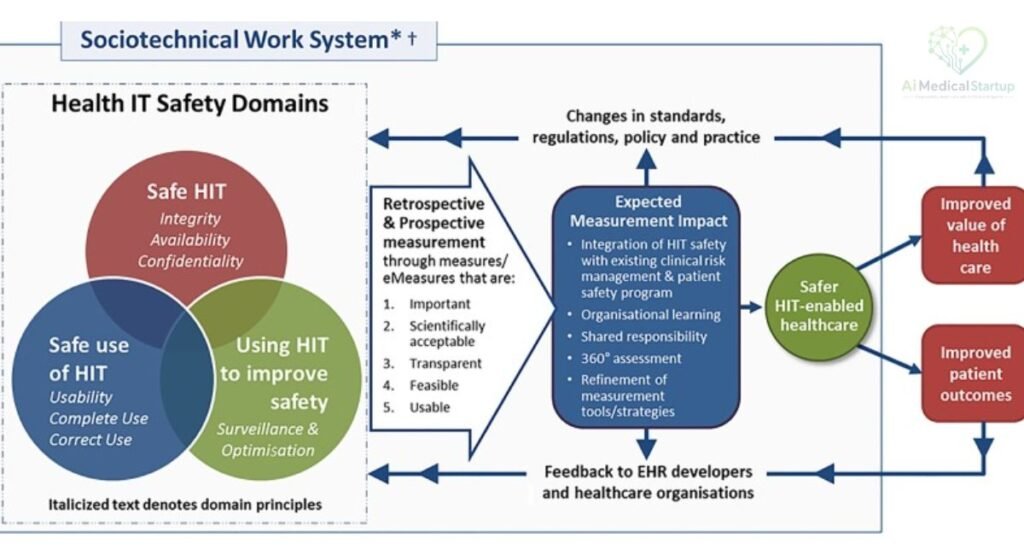
Validate AI Before Clinical Deployment
Evaluate systems using representative populations, relevant clinical workflows, and realistic conditions. Vendor evidence should not automatically substitute for local evaluation.
Population Representativeness
Assess performance across local demographic datasets.
Subgroup Testing
Evaluate for equal efficacy and equity across subgroups.
Edge Cases
Stress-test system behavior under rare or unusual inputs.
Clinical Performance
Measure statistical precision and predictive value.
Safety Testing
Analyze risk profiles for false positives and negatives.
Usability Testing
Verify clinicians can interact safely and seamlessly.
Cybersecurity
Verify data protection, access controls, and resilience.
Privacy & Data Governance
Enforce consent, compliance, and lifecycle policies.
Workflow Impact
Assess potential operational friction and alert volume.
Escalation & Rollback Procedures
Establish clear fallback protocols for unsafe events.
Continuous AI Monitoring, Human Oversight, Global Regulation, and Risk Management Frameworks
Ensuring long-term safety and operational reliability requires CONTINUOUS AI MONITORING across post-deployment lifecycles to detect performance degradation, manage false positives, and trigger re-validation when clinical environments or software versions change. To prevent automation bias, organizations must maintain practical HUMAN OVERSIGHT with clear escalation protocols, supported by robust documentation and AUDIT TRAILS that track overrides and incident metrics. Furthermore, building foundational AI LITERACY among CLINICIANS ensures that medical professionals understand model capabilities, limitations, and verification requirements. As HEALTHCARE AI REGULATION continues to evolve across the USA, UK, and EU, compliance must align with multi-faceted global frameworks—including the US FDA regulations on AI-ENABLED MEDICAL DEVICES and predetermined change-control plans, HIPAA protections for PROTECTED HEALTH INFORMATION (PHI), the EU AI ACT risk-based classifications, and the WHO PRINCIPLES FOR ETHICAL AI IN HEALTHCARE. Ultimately, integrating structured standards like the NIST AI RISK MANAGEMENT FRAMEWORK ensures that pre-purchase evaluations and ongoing lifecycle assessments transform responsible governance and trustworthy deployment into a continuous standard of care.
Before Buying or Deploying AI
Essential questions and rationale to evaluate before procuring or integrating AI systems.
What is the intended use?
Prevents inappropriate expansion of use
Who is the target population?
Establishes relevance
What evidence supports performance?
Tests credibility
Was there external validation?
Tests generalization
How does performance vary by subgroup?
Identifies equity concerns
What data does the system process?
Supports privacy assessment
Who can access the data?
Reduces security risk
What are the known limitations?
Supports informed use
What happens when the model fails?
Supports safety planning
How are updates controlled?
Supports lifecycle management
AI System Lifecycle Flow
A end-to-end framework for managing AI deployments from initial assessment to retirement.
Assess
Define intended use, target population, and initial risk assessment.
Validate
Rigorous local clinical performance, safety, and equity testing.
Pilot
Controlled trial run in real-world workflows with user feedback.
Deploy
Full integration into active clinical operations and workflows.
Monitor
Continuous tracking of statistical, clinical, and usability signals.
Investigate
Analyze near-misses, overrides, performance drift, and incidents.
Re-validate
Evaluate the impact of data changes, workflow shifts, or software updates.
Update / Roll Back
Deploy verified improvements or revert to safe manual procedures.
Retire
Safely decommission obsolete, unsafe, or redundant models.
This lifecycle reflects the central lesson of healthcare AI safety: deployment is not the finish line. It is the beginning of real-world learning.
FAQs About the Risks of AI in Healthcare
Common concerns regarding healthcare AI risks, diagnostic precision, bias, privacy, regulation, and safe deployment.
What are the biggest risks of AI in healthcare?
The major risks include AI bias, inaccurate predictions, automation bias, model drift, privacy breaches, cybersecurity attacks, poor transparency, unclear accountability, and inappropriate use. Generative AI adds risks such as hallucinations, inconsistent outputs, and fabricated citations. The seriousness of each risk depends on the technology, intended use, patient population, and consequences of failure.
Can AI make mistakes in medical diagnosis?
Yes. AI can produce false positives, false negatives, incorrect classifications, and misleading recommendations. Performance can also change when a model encounters different patient populations, medical devices, disease prevalence, or clinical workflows. Independent validation, clinical testing, human review, and continuous monitoring are therefore important before relying on AI for consequential medical decisions.
What is AI bias in healthcare?
AI bias occurs when an AI system produces systematically different or unfair results across groups. It can arise from training data, labels, proxy variables, model design, deployment practices, or unequal access to healthcare. Bias can affect race, ethnicity, age, sex, language, socioeconomic circumstances, or other characteristics relevant to health outcomes.
Can AI put patient privacy at risk?
Yes. AI systems may process sensitive medical records, imaging, laboratory results, messages, and voice recordings. Poor access controls, insecure vendors, excessive data collection, weak retention practices, or cyberattacks can increase privacy exposure. Organizations should use appropriate data minimization, encryption, authentication, monitoring, contractual safeguards, and privacy governance.
What are AI hallucinations in healthcare?
AI hallucinations are outputs that appear plausible but contain unsupported or incorrect information. In healthcare, this could involve a fabricated citation, incorrect medical fact, inaccurate medication information, or misleading treatment statement. Important AI-generated information should therefore be checked against authoritative sources or qualified professionals before it influences patient care.
Is generative AI safe for healthcare?
Generative AI can support carefully bounded healthcare tasks, but safety depends on the application and controls. Privacy risks, hallucinations, inconsistent outputs, automation bias, fabricated references, and inappropriate delegation can create problems. WHO recommends well-defined tasks, appropriate accuracy and reliability, stakeholder involvement, governance, and ongoing oversight for large multimodal models.
Can doctors rely on AI for clinical decisions?
Doctors can use validated AI as clinical decision support when it is appropriate for the intended use and clinical context. However, AI should not automatically replace professional judgment. Clinicians should understand limitations, review important outputs, recognize uncertainty, and retain the ability to override recommendations when the evidence or patient’s circumstances indicate otherwise.
What happens when a healthcare AI system makes a mistake?
The response depends on the severity and circumstances of the incident. Organizations may need to investigate the root cause, assess patient impact, document the event, notify relevant parties, retrain staff, modify the workflow, update the model, or temporarily suspend the system. A mature governance programme should establish these procedures before deployment.
How do hospitals test AI before using it?
Hospitals can review development evidence, perform local and external validation, test representative populations, examine subgroup performance, assess edge cases, conduct safety and usability testing, evaluate cybersecurity, and monitor pilot deployment. Testing should reflect the actual clinical environment rather than relying only on vendor-provided performance metrics.
Does the FDA regulate AI used in healthcare?
The FDA regulates certain AI-enabled medical devices through established medical-device pathways. Its current guidance includes lifecycle recommendations for AI-enabled device software, while separate guidance addresses predetermined change-control plans for AI-enabled device software functions. The applicable requirements depend on the product, functionality, and intended use.
How can healthcare organizations reduce AI risks?
Healthcare organizations can reduce risk through multidisciplinary governance, local validation, subgroup testing, privacy controls, cybersecurity, human oversight, continuous monitoring, clinician training, audit trails, incident reporting, and clear escalation procedures. Frameworks such as NIST’s AI RMF can provide a structured approach to managing risk across the AI lifecycle.
Final Thoughts on AI Risks in Healthcare
The future of artificial intelligence in healthcare does not depend on eliminating every possible error; no complex technology can promise that. Instead, the goal is to build healthcare systems that recognize uncertainty, limit harm, detect failures, and keep qualified professionals responsible.
Pillars of Safe AI Deployment
- Comprehensive Safeguards: Combining clinical safety, equity, privacy, cybersecurity, transparency, human oversight, and lifecycle governance.
- Local Execution: Validating systems locally, monitoring performance continuously, and protecting patient information.
- Human Accountability: Training healthcare teams and creating clear responsibility to prevent automation from quietly replacing professional judgment.
Ultimately, the safest healthcare AI is not necessarily the system that makes the boldest claims. It is the system whose purpose is clear, evidence is available, limitations are understood, risks are monitored, and human professionals remain capable of questioning the machine when it gets something wrong.


Dr. Kanza Sarfraz, M.B.B.S., is a medical doctor and graduate of Allama Iqbal Medical College, Lahore. She brings nearly seven years of clinical experience across tertiary-care hospitals, medical headquarters, and healthcare facilities in both the public and private sectors. Her clinical experience provides a practical perspective on healthcare delivery, emerging medical technologies, and the evolving role of artificial intelligence in medicine.