Why Clinicians Resist Healthcare AI

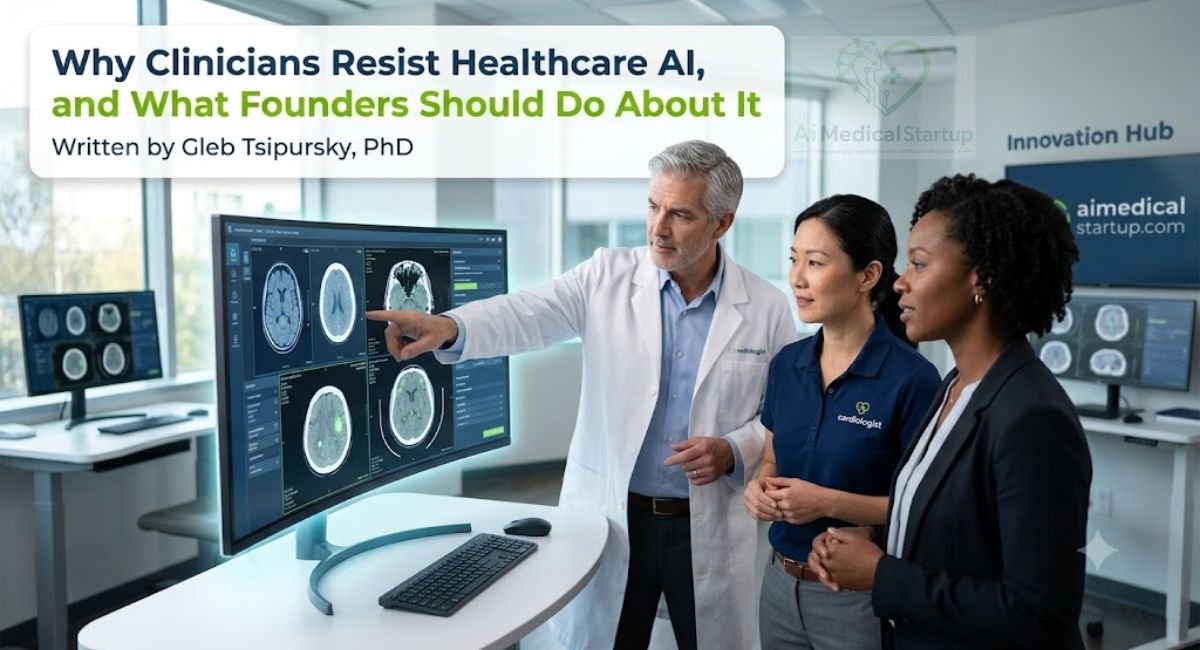
Why Clinicians Resist Healthcare AI, and What Founders Should Do About It
Bridging the gap between groundbreaking AI innovations and clinical adoption requires understanding physician workflows, trust barriers, and strategic onboarding for healthcare founders.
The American Medical Association’s 2026 physician survey found that 81% of physicians reported using AI professionally, more than double the share in 2023. Yet high usage does not mean health systems can drop a new tool into a workflow and expect clinicians to embrace it.
The same AMA survey found that 85% of physicians want to be consulted or directly involved in AI adoption decisions. Eighty-eight percent called robust safety and efficacy validation important for broader adoption, and 86% emphasized data privacy. For healthcare AI startups, the implication is practical: what looks like “resistance” may come from very different concerns. Treat every skeptical clinician the same, and you misdiagnose the adoption problem. In my work on AI adoption, I group resistance into three profiles: AI Alarmists, Reluctant Adopters, and Pragmatic Resistors. Each needs a different response.
Key Takeaways
Essential strategic insights for AI healthcare founders and decision-makers
Trust Over Adoption Rates
Do not use adoption rates as a proxy for trust or workflow acceptance.
Diagnose Root Causes
Diagnose the reason for resistance before offering training or persuasion.
Role Clarity for Anxious Clinicians
Give anxious clinicians clarity about roles, boundaries, and professional judgment.
Evidence for Skeptics
Give pragmatic skeptics evidence, verification gates, and a real feedback path.
Integrated Product Implementation
Treat clinician involvement as part of product implementation, not a courtesy after the purchase.
Resistance Is Usually an Implementation Signal
A 2024 systematic review in the Journal of Medical Internet Research examined 34 empirical studies of machine-learning implementation in healthcare organizations. The recurring factors included access to knowledge, IT infrastructure, organizational culture, system design, relative advantage over existing practice, complexity, stakeholder engagement, evaluation, and implementation leadership.
The list moves the discussion beyond personality. A clinician who keeps bypassing an AI tool may distrust the model, dislike the extra clicks, fear liability, resent a workflow imposed without consultation, or believe the tool threatens professional status. A generic training session cannot solve all of those problems.
A 2026 systematic review of human factors influencing trust in healthcare AI reached a similar conclusion from another direction. Clinicians valued workload reduction, alignment with clinical judgment, respect for professional autonomy, usability testing, peer support, and targeted training. Trust depends on how the tool fits the work and the people doing it.
Understanding the Three Resistance Archetypes
Tailoring founder strategies to specific clinician perspectives
AI Alarmists Fear What the Technology Means for Their Role
AI Alarmists focus on the downside of adoption. In healthcare, that can include fear of deskilling, job loss, reduced professional autonomy, or a gradual shift in authority from clinicians to software and administrators.
These concerns should not be dismissed as technophobia. The AMA’s 2026 survey found that 88% of physicians had at least some concern about AI-related skill loss, including concern about physicians in training. If a rollout message sounds like “the AI will do more of your work now,” leaders should expect some clinicians to hear “your expertise will matter less.”
The founder’s task is to make the operating model explicit. Show which tasks the system handles, which decisions stay with clinicians, when human review is required, and how professional judgment can override or escalate an AI output. If roles will change, say how. Ambiguity feeds the worst interpretation.
Reluctant Adopters May Use AI While Avoiding the Official Rollout
Reluctant Adopters present a different problem. They may already use AI for research summaries, documentation drafts, patient communications, or administrative work, but hesitate to use the sanctioned enterprise tool consistently or admit how much they rely on AI.
This can create a false signal. Leadership sees low official usage and assumes the workforce lacks interest, while employees may be experimenting privately because approved uses are unclear, AI use feels stigmatized, or the sanctioned workflow is harder than the workaround.
The response should focus on psychological safety and friction. Give clinicians a bounded environment for experimentation. Publish approved use cases in plain language. Let respected peers demonstrate how they use the tool, including where they reject its output. Create a feedback channel that does not punish the person who reports a bad result or awkward workflow.
A startup can help its customer here by making adoption observable without turning monitoring into surveillance. Track where users abandon the workflow, where they repeatedly override outputs, and which steps create duplicate work. Those behaviors often reveal a product or process problem faster than another satisfaction survey.
Pragmatic Resistors Want Proof Before They Trust the Workflow
Pragmatic Resistors may look like the hardest audience because they question accuracy, privacy, liability, integration, and edge cases. In healthcare, many of those objections are rational.
The right response is evidence. Show local performance where possible. Define what happens when confidence is low. Make the review step visible. Explain how data are handled. Give clinicians an easy way to flag errors and see what changed because of their feedback.
Patient trust reinforces this approach. A 2026 JAMA Network Open study of 3,000 U.S. adults found that people were more likely to trust and choose hypothetical AI-assisted medical encounters when the AI performed better, a clinician was present, representative training data were disclosed, and governance mechanisms were in place. The presence of a clinician increased the probability of choosing a visit by 18.4 percentage points compared with no clinician present in the hypothetical scenario.
For founders, the practical lesson is that human oversight can be part of the value proposition. A review gate is not automatically evidence that the product failed to automate enough. In high-stakes workflows, it can make adoption more credible to clinicians and patients.

Build an Adoption Layer Into the Product
Healthcare AI startups often invest heavily in model performance, integration, security, and regulatory work, then leave adoption to the customer’s training department. That creates avoidable risk. The product may work technically while the implementation stalls behaviorally.
The 5 Core Deployment Questions
A stronger deployment package should help the customer answer these essential steps:
Which clinician groups face which type of resistance?
What current workflow will change, step by step?
Where does human review remain mandatory or desirable?
What evidence will users see about accuracy, privacy, and limitations?
How will feedback, overrides, errors, and workarounds change the rollout?
Those questions turn “user resistance” into something a startup can diagnose and improve. They also prevent the mistake of persuading everyone with the same message.
Alarmists
Need credible role clarity.
Reluctant Adopters
Need safe, low-friction experimentation.
Pragmatic Resistors
Need evidence and control.
Some clinicians will move between profiles depending on the use case. A physician may welcome an ambient scribe and still oppose AI interpretation of pathology results.
The Ultimate Goal: Calibrated Trust
Clinicians should neither reject useful AI because of vague fears nor accept a system because a demo looked impressive. They should understand where it helps, where it fails, and what happens when the output conflicts with professional judgment.
Frequently Asked Questions
Key insights into overcoming clinician resistance and implementing AI in healthcare
Sometimes, but not always. Resistance can reflect poor usability, weak integration, unclear policy, inadequate evidence, fear about professional roles, or a reasonable concern about patient safety. The useful question is what specific barrier the clinician is reacting to.
Early enthusiasts can help generate practical use cases and peer examples, but they do not represent the whole workforce. A rollout built only around enthusiasts can miss workflow problems and trust concerns that appear when adoption expands.
Usage alone is too weak. Pair it with workflow outcomes, correction and override rates, time saved or added, error and escalation patterns, and whether clinicians keep using the tool when they have a meaningful choice.
Strategic Realization for Founders
Healthcare AI founders do not need every clinician to love AI. They need to understand why people hesitate, design the implementation around those reasons, and give clinicians enough evidence and control to use the technology responsibly. That is how a promising tool becomes part of ordinary care instead of another pilot that never changes the workflow.