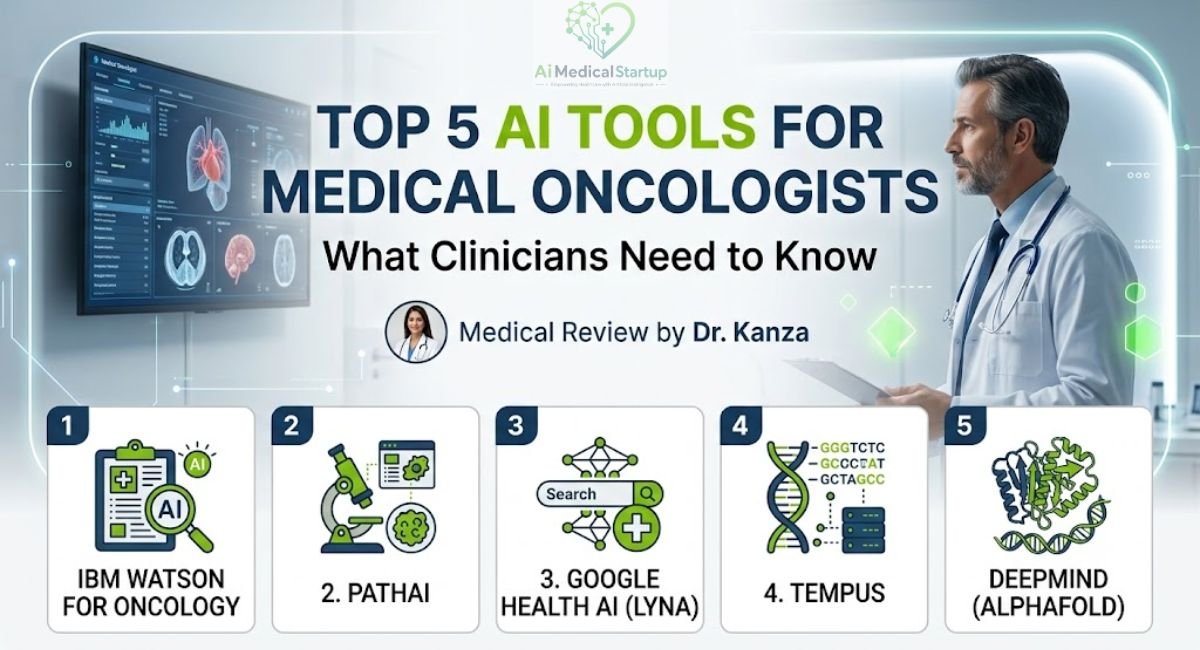
Top 5 AI Tools for Oncologists

Top 5 AI Tools for Medical Oncologists: What Clinicians Need to Know
Discover how artificial intelligence is transforming clinical oncology workflows, precision treatment planning, patient risk stratification, and real-world evidence analysis in modern cancer care.
Cancer care is entering a new era as clinicians manage increasingly complex pathology, genomic data, medical imaging and electronic health records. Against this backdrop, AI tools for medical oncologists are emerging as practical aids for interpreting information, supporting clinical reasoning and improving workflow efficiency. From digital pathology and cancer detection to precision medicine and clinical trial matching, AI in oncology is creating new ways to approach difficult clinical questions.
Yet not every algorithm belongs in routine practice, and impressive technical performance does not always translate into better patient outcomes. Understanding how each tool works, where it fits into medical oncology and what evidence supports its use is essential. In this guide, we explore five notable technologies shaping AI-driven cancer care and explain what clinicians should know before incorporating them into modern cancer treatment workflows.
Clinical perspective: AI should augment the oncologist’s reasoning rather than replace it. The strongest model is usually a clinician who understands both the patient and the limitations of the algorithm.
AI in Medical Oncology: How Artificial Intelligence Is Changing Cancer Care
The oncology clinic is an unusually fertile environment for Artificial Intelligence in Oncology because cancer generates enormous amounts of structured and unstructured information. Machine Learning can identify relationships within clinical datasets while Deep Learning can examine complex images. Natural Language Processing (NLP) can extract information from clinical notes. Meanwhile Predictive Analytics can estimate risks such as disease progression or treatment response. Together these technologies are expanding the role of AI in Oncology from laboratory research toward practical Cancer Treatment support.
Modern AI in Healthcare can influence several stages of the cancer pathway. A system may analyze Pathology Images before a treatment discussion or interpret Genomic Data alongside a patient’s clinical history. Another system may search Clinical Trials for potentially eligible patients. These applications are fundamentally different from one another. A pathology model detects visual patterns. A trial-matching model searches eligibility criteria. A treatment-support system synthesizes evidence. Understanding that distinction is essential before an oncologist evaluates any AI-Powered Oncology platform.
Oncology Workflow: AI Contribution & Human Responsibility
A structured breakdown of clinical oncology tasks, highlighting the collaborative synergy between AI tools and physician decision-making.
| Oncology Task | Potential AI Contribution | Human Responsibility |
|---|---|---|
| Cancer Diagnosis | Image and tissue analysis | Confirm diagnosis |
| Cancer Staging | Pattern recognition | Integrate clinical findings |
| Molecular Profiling | Variant interpretation | Assess clinical relevance |
| Treatment Planning | Evidence synthesis | Select appropriate therapy |
| Clinical Trial Matching | Eligibility screening | Confirm eligibility |
| Monitoring | Risk and response prediction | Interpret changes |
| Research | Data discovery | Establish scientific validity |
IBM Watson for Oncology: AI-Assisted Cancer Treatment Decisions
IBM Watson for Oncology became one of the most recognizable early examples of Cognitive Computing in cancer medicine. The system was designed to analyze patient information and provide evidence-informed treatment options. Its historical importance lies in showing how computers could attempt to connect Patient Records, Medical Literature and Clinical Guidelines to support complex Cancer Treatment Decisions. However, clinicians should understand that Watson for Oncology represents an earlier generation of oncology AI rather than assuming it is a current universal clinical platform.
Watson for Oncology Clinical Concordance Variability
Published clinical trials involving 362 patients revealed substantial variance in agreement between Watson AI recommendations and physician decisions across different cancer types and clinical stages.
Gastric Cancer Study (N=362)
Demonstrated the lowest alignment (12%), emphasizing the strong influence of localized treatment protocols, drug access, and surgical decision-making.
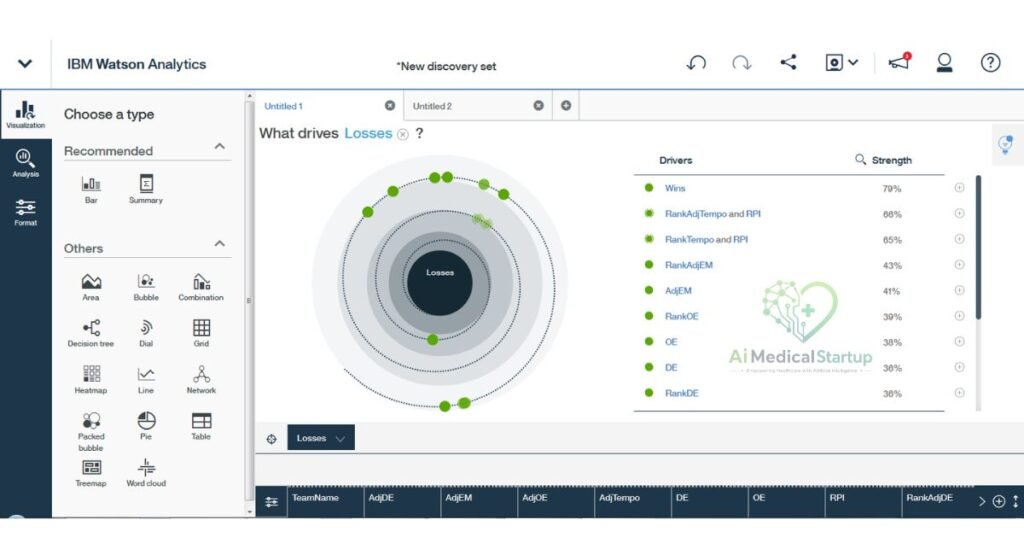
What Watson for Oncology Taught Medical Oncologists
The most valuable lesson from early AI deployments isn’t about raw algorithm power—it is the vital importance of localization and clinical context.
A treatment recommendation can appear scientifically reasonable while conflicting with local drug approvals, reimbursement rules, clinical preferences, or available therapies. Clinical Decision Support therefore requires current evidence combined with deep contextual awareness.
PathAI: AI-Powered Digital Pathology for Cancer Diagnosis
Pathology sits at the heart of many oncology decisions because tissue reveals information that cannot always be inferred from symptoms or imaging. PathAI develops Digital Pathology technologies that use Machine Learning Algorithms to analyze tissue and cellular features. Its platforms can convert whole-slide images into structured information for oncology research and clinical development. Such analysis can support Tumor Analysis, biomarker assessment and the investigation of treatment response at the cellular level.
For an oncologist, the practical significance is straightforward. Instead of viewing a pathology slide as a static image, AI can help quantify thousands of visual characteristics across a tissue sample. Tumor Morphology, cellular organization and Histopathological Features can become measurable variables. This creates opportunities for more standardized Pathology Image Analysis and deeper investigation of Tumor Heterogeneity. Importantly, PathAI identifies several of its oncology algorithms as research-use-only products. Therefore, clinicians must distinguish research capability from a product authorized for diagnostic use.
Why Digital Pathology Matters to Oncology
Quantitative comparison of traditional glass-slide histology versus AI-assisted digital pathology workflows.
| Metric / Parameter | Traditional Histology | AI Digital Pathology | Performance Impact |
|---|---|---|---|
| Output Depth | Binary (Malignant / Benign) | Sub-visual cellular features & patterns | Biomarker Discovery |
| Sensitivity (Lymph Nodes) | 73.2% | 92.4% – 99.0% | +19.2% – +25.8% |
| Analysis Speed / WSI | 5 – 15 minutes / slide | < 60 seconds / slide | 10x–15x Faster |
| Generalization Accuracy | Human stain-invariant | Drops ~8.4% across foreign scanners | Requires Validation |
Google Health AI and LYNA: Deep Learning for Cancer Detection
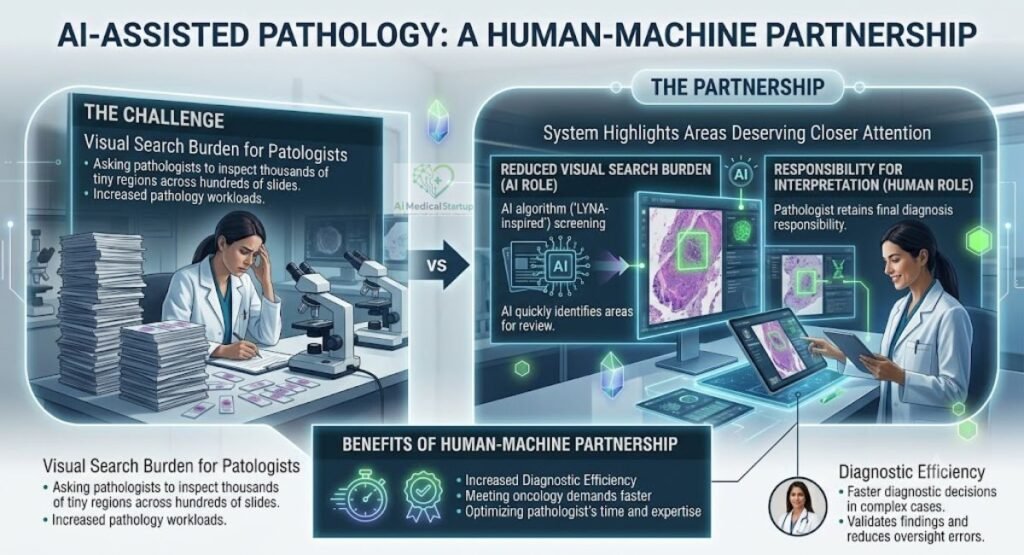
Google Health AI contributed important research to computational pathology through systems such as LYNA, or Lymph Node Assistant. LYNA used Deep Learning to detect metastatic breast cancer within lymph-node pathology images. The underlying problem is clinically meaningful because tiny metastatic deposits can be difficult to identify during routine microscopic examination. The research demonstrated how Deep Convolutional Neural Networks could recognize patterns associated with metastatic disease in digitized pathology images.
The significance of LYNA extends beyond one algorithm. It demonstrated how AI could act as a computational second reader for difficult pathology tasks. Detecting Micrometastases can influence Cancer Staging and consequently affect treatment planning. Yet high performance on a research dataset does not automatically mean that a model should make autonomous clinical decisions. Diagnostic Sensitivity, Diagnostic Specificity, scanner variation, staining differences and patient diversity all matter when moving from research to practice.
Tempus: Precision Medicine and AI-Driven Oncology
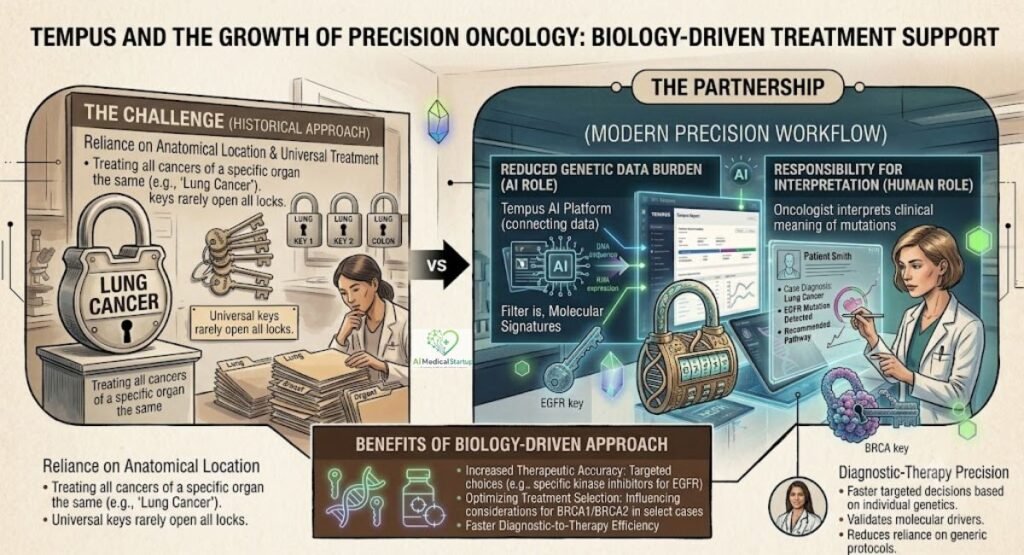
Tempus represents a more contemporary model of AI-Driven Cancer Care. Its oncology ecosystem combines molecular testing, clinical information and computational analysis to support Precision Oncology. Rather than looking at a tumor through only one lens, the approach can connect Genomic Profiling, clinical history and other patient-level information. This matters because cancer is not one disease. Even two patients with the same anatomical cancer type may have very different molecular landscapes.
Tempus also applies AI to clinical trial identification. Its TIME platform uses structured and unstructured clinical information to identify potentially eligible patients. The company reports that its system combines large language models, machine learning and clinical review. This illustrates an important design principle: automation does not necessarily remove humans from the process. Instead, AI can perform the initial data-intensive search while clinical professionals verify potentially relevant matches. That approach can improve Workflow Efficiency without pretending that eligibility decisions are purely computational.
DeepMind & AlphaFold: AI for Cancer Research and Drug Discovery
DeepMind and AlphaFold demonstrate another side of oncology AI. Unlike a clinical decision-support platform, AlphaFold primarily supports biological research. Protein Structure Prediction is important because proteins perform much of the molecular work inside cells. Their three-dimensional structures influence how they interact with DNA, other proteins and therapeutic compounds. Better structural predictions can therefore help researchers investigate Drug Targets, disease mechanisms and potential therapeutic strategies.
AlphaFold 3 extends this capability by predicting structures involving proteins, nucleic acids, small molecules, ions and modified residues. This broadens the computational landscape for studying biomolecular interactions. In cancer research, such tools may help scientists investigate Cancer-Related Proteins, potential Drug-Binding Sites and molecular mechanisms involved in tumor biology. However, an AI-generated structure is not itself a cancer therapy. Experimental validation remains essential before a computational prediction becomes a reliable biological conclusion.
What Can AI Tools Do for Medical Oncologists?
The practical value of AI tools for medical oncologists becomes clearer when viewed through the entire patient journey. AI can assist with information retrieval, image interpretation, molecular analysis, risk estimation and trial identification. Natural Language Processing (NLP) can extract useful facts from lengthy clinical notes while Predictive Analytics can identify patterns associated with disease progression or treatment response. These capabilities can reduce information overload without turning medicine into a purely automated process.
For example, consider a patient with metastatic lung cancer. The oncology team may need to review pathology, staging scans, prior systemic therapy, genomic sequencing, laboratory results and current clinical trials. An AI system may help organize these data into a coherent picture. The clinician then evaluates whether the output fits the patient’s actual circumstances. That distinction matters because AI-Assisted Treatment Planning should support clinical reasoning rather than replace the nuanced judgment required for complex cancer care.
AI Integration Across Clinical Oncology Areas
A structured breakdown of core clinical domains, key opportunities for artificial intelligence integration, and mandatory clinical validation factors.
| Clinical Area | AI Opportunity | Key Consideration |
|---|---|---|
| Diagnosis | Pattern recognition | Validation |
| Pathology | Tissue quantification | Image quality |
| Genomics | Variant interpretation | Clinical significance |
| Treatment | Evidence synthesis | Guideline alignment |
| Prognosis | Risk prediction | Calibration |
| Trials | Patient matching | Eligibility verification |
| Monitoring | Response prediction | Longitudinal validation |
AI in Clinical Oncology: Impact & Governance
Key operational benefits, technical risks, and critical evaluation parameters for AI integration.
Benefits
- Efficiency & Speed: Rapid chart screening, trial matching, and reduced TAT.
- Scalable Precision: High-throughput slide analysis and multi-cohort data processing.
- Personalized Care: Enhanced biomarker discovery for tailored therapy.
Risks & Pitfalls
- Error Risk: False positives/negatives leading to misdiagnosis.
- Performance Drift: Up to 88% discordance across foreign clinical settings.
- Automation Bias: Over-reliance on opaque black-box algorithms.
Algorithm Evaluation Checklist
| Key Question | Clinical Significance |
|---|---|
| Who trained the model? | Reveals training bias & dataset origin |
| Where was it validated? | Tests cross-hospital generalizability |
| What are false-negative rates? | Highlights critical patient safety limits |
| Does it work across populations? | Assesses demographic & health equity |
| Is performance monitored post-deployment? | Detects model degradation over time |
FAQs About AI Tools for Medical Oncologists
Essential insights into clinical utility, regulatory frameworks, risk mitigation, and the evolving role of artificial intelligence in cancer care.
AI tools for medical oncologists are software systems that use Artificial Intelligence (AI), machine learning, or related computational methods to analyze clinical information. Depending on their intended use, they can support pathology analysis, molecular interpretation, clinical trial matching, risk prediction, or treatment planning. Their clinical role varies considerably, so oncologists should evaluate each product according to its specific intended use.
AI in oncology can support cancer diagnosis, molecular profiling, clinical trial matching, prognosis, and treatment planning. Some systems analyze images while others process text or genomic information. The technology can identify patterns across large datasets that may be difficult to review manually. However, AI output remains one component of the clinical picture and should be interpreted alongside established evidence and patient-specific factors.
AI can provide treatment recommendations or rank potential therapeutic options in some clinical decision-support settings. That does not mean the algorithm independently chooses the appropriate treatment. Treatment decisions depend on tumor biology, stage, prior therapy, comorbidities, patient preferences, and available evidence. The clinician must determine whether an AI-generated suggestion is appropriate for the individual patient.
AI can analyze medical images, pathology slides, and other diagnostic information to identify patterns associated with disease. In computational pathology, algorithms may detect suspicious regions or quantify cellular characteristics. In imaging, machine learning can identify patterns that warrant further attention. The clinical value depends on validated diagnostic sensitivity, specificity, and performance across representative patient populations.
Precision oncology uses biological and clinical information to tailor cancer management to the characteristics of an individual patient’s disease. Molecular profiling, genomic sequencing, and biomarker analysis can reveal alterations that may influence treatment options. AI can help integrate these datasets. However, identifying a mutation does not automatically mean that a particular therapy will work or that the alteration is clinically actionable.
Yes. AI can help compare patient information with complex clinical trial eligibility criteria. Natural language systems can extract information from clinical notes while machine learning can help identify potential matches. Platforms such as Tempus use computational methods alongside clinical review. The final determination still requires confirmation because trial eligibility often depends on nuanced clinical details.
Some research systems use treatment response prediction models to estimate how patients may respond to specific therapies. These models can incorporate clinical variables, imaging, molecular information, or other data. Prediction is not certainty. Cancer biology changes over time and patients can respond differently despite similar characteristics. Therefore, predictive models require careful validation before clinicians use them to guide treatment.
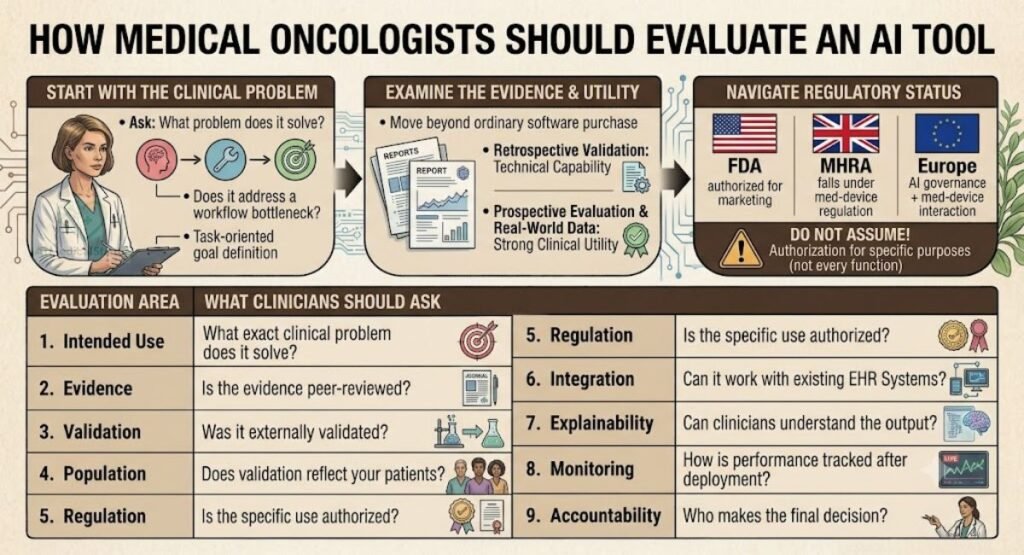
Some AI-enabled medical devices have received regulatory authorization for specific medical uses in the United States. The FDA maintains a public list of AI-enabled medical devices. In the UK, software and AI products that meet medical-device definitions may be regulated by the MHRA. Regulatory status always depends on the specific product and intended use rather than the presence of AI alone.
Important risks include biased training data, poor generalization, false negatives, false positives, automation bias, and inadequate monitoring. Privacy is another concern because oncology systems may process sensitive clinical and genomic information. There is also a risk that clinicians may misunderstand an algorithm’s intended use. Strong governance should therefore accompany technical evaluation before deployment.
AI is more likely to change the work of oncologists than eliminate the need for them. Oncology requires communication, ethical reasoning, uncertainty management, and individualized judgment. These responsibilities extend beyond pattern recognition. AI may automate selected analytical tasks while increasing the importance of clinicians who can interpret complex outputs and explain treatment choices to patients.
The most important questions concern intended use, validation, patient population, regulatory status, privacy, interoperability, and clinical outcomes. Oncologists should also ask how the vendor monitors performance after deployment and how model updates are controlled. Most importantly, determine whether independent evidence supports the claimed benefit. A sophisticated interface cannot compensate for weak clinical evidence.
Where AI Fits Into Modern Oncology
Core Lesson: AI is not a substitute for medical judgment. Its highest value is enabling oncologists to process complex datasets faster and detect critical patterns sooner.
The future of AI-driven cancer care lies in clinically validated, patient-centered intelligence—guided strictly by physician expertise.
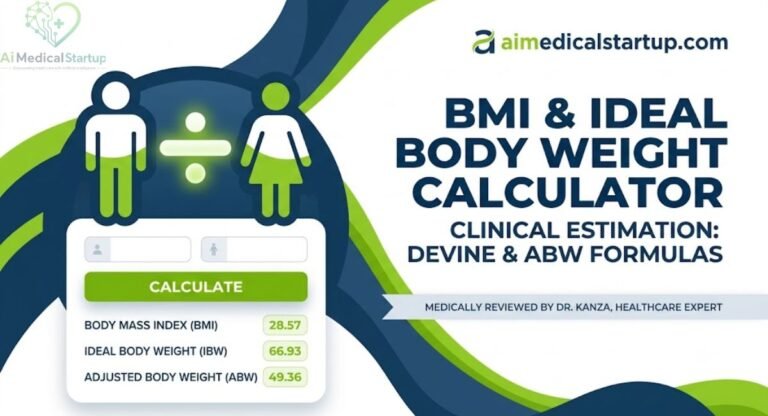

Dr. Kanza Sarfraz, M.B.B.S., is a medical doctor and graduate of Allama Iqbal Medical College, Lahore. She brings nearly seven years of clinical experience across tertiary-care hospitals, medical headquarters, and healthcare facilities in both the public and private sectors. Her clinical experience provides a practical perspective on healthcare delivery, emerging medical technologies, and the evolving role of artificial intelligence in medicine.