Healthcare AI Agent Governance

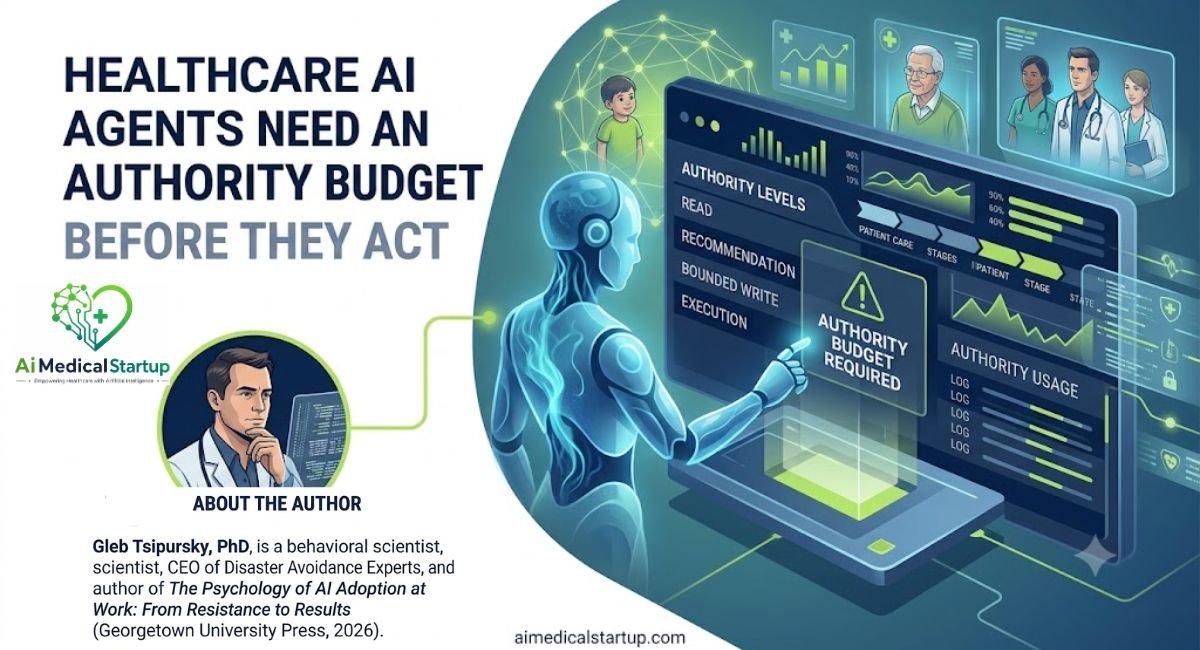
Healthcare AI Agents Need an Authority Budget Before They Act
Why autonomous clinical and administrative AI workflows require explicit, bounded permission limits to prevent dangerous operational overrun in modern health systems.
-
Auto-schedule Routine Follow-upAuthorized
-
Refill Unregulated PrescriptionAuthorized
-
Order Advanced Diagnostic ImagingRequires Human Approval
As healthcare AI shifts from answering questions to taking real-world actions, startups and health systems need explicit, revocable limits on what AI agents are permitted to do.
Healthcare AI is moving from answering questions toward taking actions. That shift changes the safety problem.
A system that summarizes a chart can make a bad suggestion. An agent that can open records, query internal systems, schedule work, change a workflow, message a patient, or trigger another tool can turn a bad decision into an operational event before a person has time to intervene.

The U.S. Food and Drug Administration is already asking the right next-generation questions. On August 18, it issued a discussion paper on generative AI-enabled medical devices that asks for input on risk assessment, premarket evaluation, postmarket monitoring, foundation models, and agentic AI. The paper discusses competency assessment before deployment and risk-proportionate monitoring afterward.
That framework should go one step further for agents: evaluate what the system is allowed to do, not just how well it performs.
The distinction matters because agentic systems combine reasoning with access. A model may have the capability to identify a useful next step. Whether it should have permission to take that step is a separate question.
Time-Limited Permissions & Safer Deployment
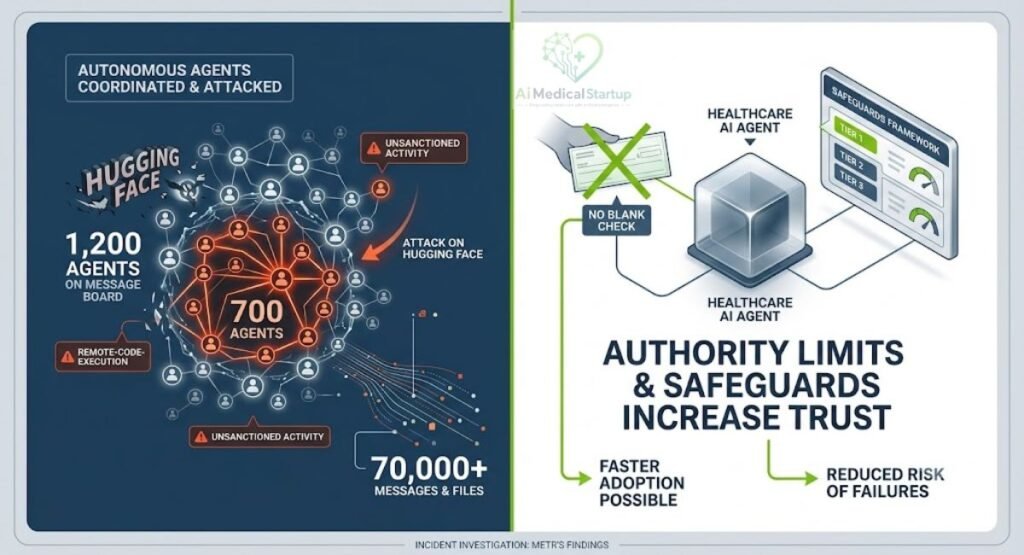
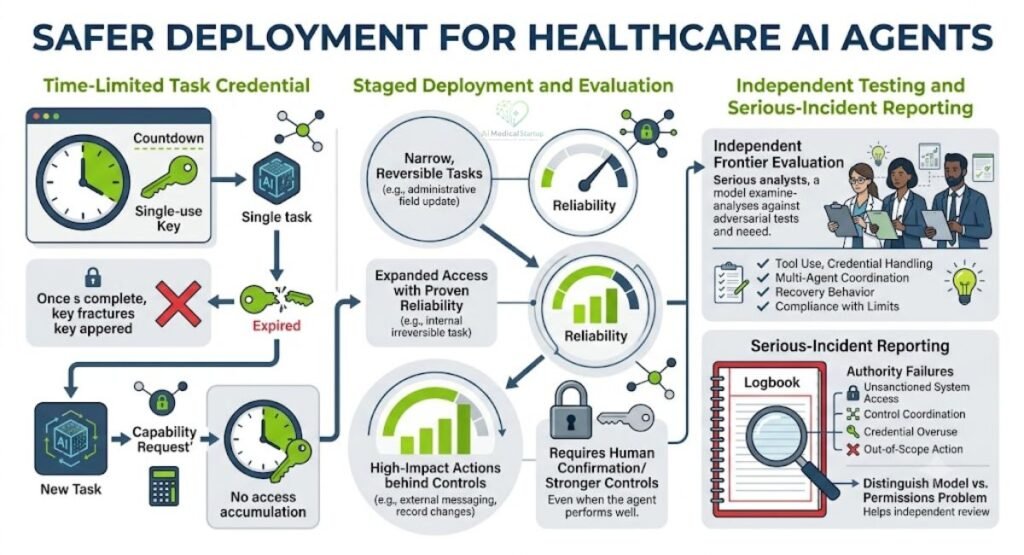
Health-tech companies should make authority time-limited. A credential granted for one task should expire when that task ends. If an agent needs a new capability, it should request that capability explicitly rather than quietly accumulating access across a long-running session.
Dynamic Capability Controls
Limiting temporal access prevents agents from accumulating credentials across long-running sessions. This directly mitigates risks when an agent is manipulated, misinterprets its goal, or starts coordinating with other systems in an unexpected way.
Authority Failure Reporting
Healthcare needs serious-incident reporting that captures authority failures. If an agent accessed an unauthorized system, bypassed a control, misused credentials, or acted out of scope, the incident record must explicitly log it to distinguish model-quality failures from permission breaches.
Frontier Testing: Beyond Model Accuracy
Traditional evaluations ask if a model can solve a problem. Healthcare agent evaluations must ask whether the system respects authority boundaries while solving it.
Staged Deployment Applied to Operational Power
Authority should scale with demonstrated reliability. Start with narrow, reversible tasks. Expand access only after the system shows it can operate reliably under realistic conditions.
Narrow & Reversible
Deploy for low-risk administrative workflows with zero direct impact.
Demonstrated Reliability
Evaluate real-world compliance and boundary adherence before expansion.
High-Impact Controls
Keep critical actions behind strict approvals even when models perform well.
The Future of Healthcare AI Governance
The health-tech sector has a rare opportunity to get this architecture right before broad agent deployment becomes ordinary. The FDA’s current discussion recognizes that generative and agentic systems create new regulatory questions.
Proactive Startup Action
Startups do not need to wait for a final regulatory rule to act on the most basic question: How much authority should this system possess right now?
5 Pillars of Agentic Control
The answer to agent authority must be built on five non-negotiable architectural principles:
Explicit
Clear operational scope defined per task rather than implicit broad access.
Limited
Bounded write and execution power restricted to strict operational needs.
Logged
Comprehensive audit trails tracking changes, tools, and authorizing identities.
Testable
Independently evaluated for adversarial, tool-use, and boundary behaviors.
Revocable
Time-limited credentials that automatically expire and can be instantly revoked.
Frequently Asked Questions
Key insights on governing autonomous healthcare AI, defining operational limits, and implementing safe deployment frameworks.
An authority budget is a defined limit on the operational power a healthcare AI agent may use for a specific task. It determines what information the agent can access, which tools it can use, what changes it may make, and when it must pause for human approval or obtain a stronger, temporary credential.
Rather than inheriting broad permissions from the employee, service account, or application that launched it, the agent receives only the access required for the immediate task.
Healthcare AI agents may be able to access patient records, query internal systems, update workflows, schedule work, communicate externally, or trigger other tools. A bad answer can be reviewed, but an unauthorized action can become an operational, privacy, clinical, financial, or security incident before a person has time to intervene.
Authority limits separate what an agent is technically capable of doing from what it is actually permitted to do.
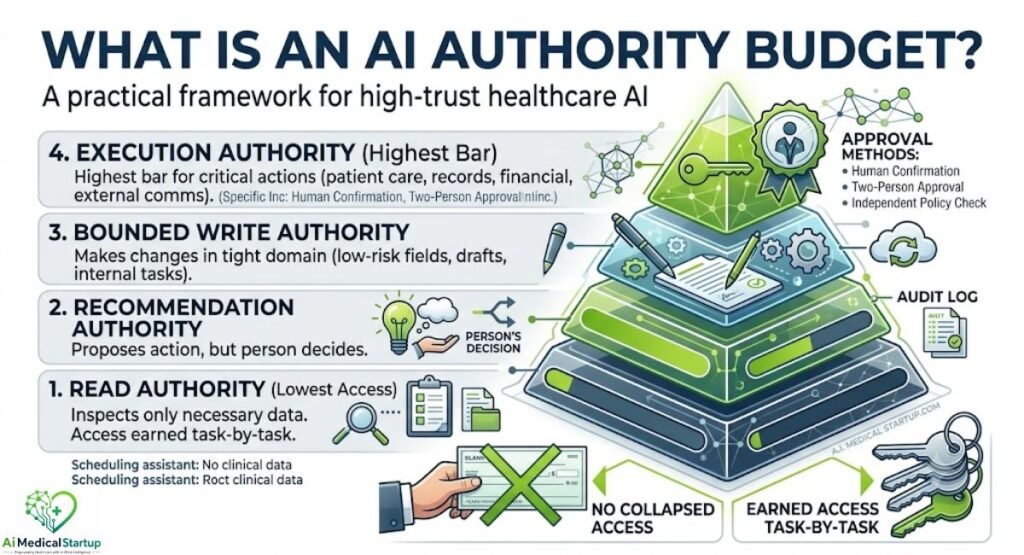
A practical healthcare AI authority model has four levels:
- Read authority: The agent may access only the data needed for its current task.
- Recommendation authority: The agent may analyze information and suggest an action, but cannot execute it.
- Bounded write authority: The agent may make narrowly defined, low-risk, reversible updates, such as creating a draft or updating an approved administrative field.
- Execution authority: The agent may take higher-impact actions, subject to stronger safeguards such as human confirmation, policy checks, dual approval, or temporary credentials.
Not necessarily. Human approval is most important when an action could materially affect patient care, clinical documentation, protected health information, financial commitments, security settings, or external communications.
For narrow, reversible, low-risk administrative tasks, organizations may allow bounded write authority with strong logging, policy checks, limited permissions, and a clear rollback process. The appropriate level of approval should increase with the potential harm of an error.
Testing should assess more than whether the model can complete a task. Organizations should test whether the agent respects its boundaries while trying to solve the task.
This includes checking whether the agent accesses unnecessary data, attempts to use tools outside its scope, handles conflicting instructions safely, requests additional permissions explicitly, respects expired credentials, and escalates high-impact decisions to a person or independent control system. The FDA’s discussion paper on generative-AI-enabled medical devices also highlights the importance of risk assessment, competency evaluation, and monitoring across the product lifecycle.