
AI-Powered Adaptive BMR Calculator

AI-Powered Adaptive BMR & Metabolic Adaptation Calculator
Precision energy expenditure modeling that adapts to metabolic slowdown, weight loss history, and dynamic body composition shifts—medically validated for exact calorie targeting.
*Accounting for thermic dampening and adaptive thermogenesis during energy restriction.
Losing weight is rarely as predictable as a calorie calculator suggests. At first, your calorie deficit may produce steady progress. Then the scale slows, even when your routine looks unchanged. An AI-Powered Adaptive BMR & Metabolic Adaptation Calculator offers a different way to understand this shift. Instead of relying only on age, height, weight and activity, it considers factors such as calorie restriction, diet duration and previous weight loss. The result can show your estimated baseline TDEE alongside a modeled adapted TDEE and potential metabolic slowdown. This helps you explore how adaptive thermogenesis may influence changing energy needs without confusing an estimate with a direct measurement of your metabolism or a medical diagnosis.
What Is an AI-Powered Adaptive BMR & Metabolic Adaptation Calculator?
The AI-Powered Adaptive BMR & Metabolic Adaptation Calculator builds on the familiar idea behind a BMR calculator. Traditional equations estimate how much energy your body requires at rest using characteristics such as age, sex, height and body weight. The calculator then adds an adaptive modeling layer. That layer considers your reported calorie intake, estimated deficit, diet duration and recent weight history. In other words, it asks a more useful question: what might happen to estimated energy expenditure after sustained energy restriction?
This approach matters because your energy needs do not remain frozen while your body changes. Losing weight generally reduces the energy required to maintain and move a smaller body. Research also describes adaptive thermogenesis, where energy expenditure can change beyond what researchers would expect from changes in body size and composition alone. However, the magnitude varies substantially between individuals and studies. A systematic review of 33 studies involving 2,528 adults found adaptive thermogenesis in many studies but also reported substantial methodological differences. Higher-quality studies sometimes found smaller or nonsignificant effects.
Adaptive AI Calorie & Thermogenesis Calculator
Enter your biometrics and dieting history to estimate your true baseline BMR and account for metabolic adaptation during weight loss.
Your Results
Based on a 12-week calorie restriction with an 8.0 kg weight loss, your body has exhibited approximately 165 kcal/day of adaptive slowdown to preserve energy.
Understanding Standard vs. Adapted Energy Expenditure
Learn how physiological adaptations alter daily caloric output during calorie restriction and how dynamic trajectory modeling predicts weight loss over time.
Standard TDEE
Your estimated total daily energy expenditure before applying the modeled adaptive-thermogenesis adjustment. Calculated using traditional metabolic equations (Mifflin-St Jeor) combined with daily physical activity multipliers.
Adapted TDEE
An estimated daily energy expenditure after applying the calculator’s metabolic-adaptation model. It factors in physiological thermogenic suppression resulting from active calorie deficits and body mass changes.
Estimated Metabolic Slowdown
The numerical difference between standard and modeled adapted energy expenditure. This reflects temporary physiological conservation mechanisms rather than permanent cellular metabolic damage.
Quantifying the Adaptation Differential
Clinical Takeaway: This does not mean that your body has permanently “lost” 210 calories of metabolism. It represents the physiological variance produced by the model under the specific deficit and timeline assumptions entered into the calculator.
Dynamic Weight-Loss Trajectory
The calculator displays how a constant calorie deficit translates into an estimated weight-loss trajectory over time, explicitly illustrating how changing energy expenditure flattens that trajectory as your body adapts.
Real-World Confounding Variables
Actual clinical weight change is non-linear and is continually affected by:
- Body Composition Shifts (Lean Mass vs. Fat Mass)
- Fluctuations in Daily Food Intake & Tracking Accuracy
- Spontaneous Non-Exercise Physical Activity (NEAT)
- Fluid Balance & Glycogen Hydration Variations
- Dietary Adherence, Sleep Hygiene & Stress Levels
- Acute Illness, Prescription Medications & Hormonal Factors
What Is Metabolic Adaptation?
Metabolic adaptation describes changes in energy expenditure associated with altered energy balance and body weight that cannot be explained completely by changes in body composition. The concept is often discussed alongside adaptive thermogenesis and metabolic compensation. Think of your energy system less like a light switch and more like a thermostat. When energy availability changes, several physiological systems can adjust how much energy your body uses, stores or conserves.
The effect is not identical for everyone. Some people may show measurable changes while others show relatively small effects. Study design also matters. A systematic review found adaptive thermogenesis across many studies but emphasized considerable heterogeneity in methods and magnitude. The researchers also reported that the effect could become smaller or disappear after weight stabilization or neutral energy balance in some studies.
Adaptive Thermogenesis Explained
Adaptive thermogenesis refers to changes in energy expenditure that occur beyond the expected effects of altered body size or composition. It can involve resting and non-resting expenditure rather than one isolated component. Researchers describe relationships with energy balance, fat-free mass, leptin, thyroid hormones and nervous-system activity. The practical lesson is simple: metabolic adaptation is a physiological concept with several moving parts, not a single universal calorie penalty.
Why Traditional Harris-Benedict Calculators Miss Metabolic Adaptation
Standard predictive formulas assume continuous static linearity. Explore how physiological adaptation alters true caloric expenditure over extended energy restriction compared to legacy models.
Traditional equations are static snapshots. The shaded region represents Adaptive Thermogenesis—the metabolic conservation gap created when continuous energy restriction suppresses non-exercise movement and thermic expenditure beyond weight loss alone.
Process Flow & Feature Comparison
| Evaluation Factor | Conventional Formula (Harris-Benedict) | AI-Powered Adaptive Model |
|---|---|---|
| Primary Formula Flow | BMR → Activity Multiplier → Static TDEE | Baseline → Restriction Duration → Physiological Adaptation → Modeled Expenditure |
| Metabolic Tracking | Static point-in-time calculation | Dynamic, continuous metabolic shift modeling |
| Accounts for Diet Deficit Depth? | ✗ No | ✓ Yes (Scales with deficit size) |
| Diet Duration Factors | Ignored | Integrated restriction timeline tracking |
| Plateau Interpretation | Incorrectly assumes lack of calorie compliance | Identifies thermogenic dampening & adaptive slowdown |
Clinical Context: Weight Plateaus ≠ “Metabolic Damage”
Observing a slower rate of weight loss over time does not mean your metabolism is broken or permanently damaged. Real-world weight change is heavily affected by body composition shifts, spontaneous physical movement (NEAT), daily tracking variance, fluid balance, glycogen fluctuation, sleep hygiene, and hormonal stress factors.
Adaptive Thermogenesis: Hormonal & Expenditure Breakdown
Explore how prolonged calorie restriction alters the core components of Total Daily Energy Expenditure (TDEE) through regulatory pathways involving Thyroid (T3) signaling and Leptin suppression.
Components of Daily Energy Expenditure & Adaptive Shifts
Comparing Baseline Expenditure vs. Diet-Adapted Metabolic Shifts
Triiodothyronine (T3) & Thyroid Signaling
Metabolic Rate RegulatorDuring prolonged energy restriction, circulating triiodothyronine (T3) levels downregulate to conserve baseline tissue energy usage.
Adipose Leptin Signaling
Energy Storage CommunicationLeptin produced by fat tissue decreases as fat stores shrink. Lower central leptin signaling signals the brain to increase appetite and reduce involuntary physical movement (NEAT).
Summary: Hormonal Drivers of Adaptive Thermogenesis
| Physiological Pathway | Primary Biological Origin | Weight Loss Signal | Metabolic Impact |
|---|---|---|---|
| Thyroid Hormones (T3) | Thyroid Gland / Peripheral Deiodination | Downregulated T4 → T3 conversion | Reduces resting tissue expenditure & mitochondrial activity |
| Leptin | Adipocytes (Fat Tissue) | Proportional drop with fat loss | Increases appetite, suppresses hypothalamic drive & NEAT |
| Sympathetic Nervous System | Central Nervous System | Reduced Norepinephrine tone | Dampens spontaneous physical activity & thermic response |
How the AI-Powered Adaptive BMR Calculator Works
Rather than relying on a single static formula, our AI model applies a layered, multi-variable approach—synthesizing baseline biological metrics, activity levels, diet duration, deficit depth, and weight history to project your adapted energy expenditure.
Estimate Baseline BMR With Mifflin-St Jeor
The baseline resting energy requirement is calculated using the established Mifflin-St Jeor predictive equations:
Men: BMR = (10 × weightkg) + (6.25 × heightcm) − (5 × ageyrs) + 5
Women: BMR = (10 × weightkg) + (6.25 × heightcm) − (5 × ageyrs) − 161
This provides an initial predictive benchmark for baseline resting expenditure in healthy individuals before factoring in movement or energy restriction.
Estimate Total Daily Energy Expenditure (TDEE)
Activity multipliers map lifestyle habits (sedentary desk job vs. athletic training) to scale BMR into Standard TDEE.
While multipliers simplify real-world physical variation into workable averages, they remain fixed estimates rather than real-time continuous expenditure tracking.
Assess Current Calorie Deficit Depth
The model evaluates average daily intake against estimated expenditure. The physiological response to a mild 10% deficit differs drastically from severe, sustained energy restriction.
Note on Tracking Error: Uncounted cooking oils, label variances, and dining out create silent logging errors that can skew perceived deficit depth.
Account for Diet Duration Timeline
Duration provides essential physiological context. An individual three days into a deficit experiences minimal metabolic signaling compared to someone sustaining energy restriction for six months.
Clinical research confirms that extended periods of negative energy balance compound thermogenic down-regulation over time.
Include Previous Weight & Loss History
Current scale weight alone is insufficient. By factoring in recent weight-loss history, the model distinguishes a weight-stable individual from someone who recently shed significant body mass.
This helps account for altered tissue maintenance costs and lean mass changes during rapid weight drops.
Apply the Modeled Adaptive Adjustment
The AI engine synthesizes deficit depth and duration factors to calculate an Adapted TDEE and an estimated expenditure gap.
What Information Does the Adaptive BMR Calculator Need?
Energy expenditure depends on more than body weight alone. The calculator synthesizes foundational biological metrics, daily activity patterns, and metabolic context to build a comprehensive individual profile.
| Calculator Input | Category | Why It Matters |
|---|---|---|
| Age | Baseline | Contributes to the baseline BMR equation as metabolic rate naturally shifts over time. |
| Sex | Baseline | Determines specific physiological constants used by predictive equations. |
| Height | Baseline | Helps estimate resting energy requirements and total tissue surface area. |
| Current Weight | Baseline | Serves as the core input for baseline BMR estimation. |
| Activity Level | Movement | Scales resting BMR to estimate Total Daily Energy Expenditure (TDEE). |
| Avg. Daily Intake | Context | Describes current real-world energy consumption relative to expenditure. |
| Estimated Deficit | Context | Provides critical energy-restriction context driving down-regulation signaling. |
| Diet Duration | Context | Tracks chronological timeline—longer restriction compounds adaptive effects. |
| Previous Weight | Context | Adds weight-loss velocity history to distinguish stable mass from recent drops. |
What Results Does the AI Adaptive Calculator Show?
The calculator translates complex metabolic variables into four actionable metric outputs. Select an output below to examine how each metric is constructed and interpreted.
Dynamic Weight-Loss Trajectory
A dynamic trajectory demonstrates why weight loss rarely follows a perfectly straight line over time. As body mass decreases, energy expenditure naturally shifts, narrowing the theoretical calorie deficit gap.
Real-World Considerations: Actual scale weight varies daily due to non-fat factors including fluid balance, glycogen stores, intestinal contents, sodium intake, sleep quality, and physical stress. A trajectory line provides a theoretical benchmark—your body remains far more dynamic than a linear graph.
Adaptive BMR Calculator Example: Understanding a 210-Calorie Difference
To understand how modeled metabolic adjustments work in real-world scenarios, examine this hypothetical baseline comparison.
Estimated baseline expenditure before adaptation
Modeled metabolic adaptation adjustment
Projected actual daily energy requirement
| Calculation Result | Example Output Value | Interpretation |
|---|---|---|
| Standard TDEE | 2,350 kcal/day | Baseline expenditure based on BMR & activity multiplier |
| Modeled Adapted TDEE | 2,140 kcal/day | Adjusted target after factoring diet duration & deficit depth |
| Estimated Difference | −210 kcal/day | Theoretical reduction in daily energy expenditure |
Crucial Distinction: What the 210-Calorie Gap Really Means
× What It DOES NOT Mean
The 210-calorie difference does not prove that your metabolism is permanently damaged or slowed by exactly that amount. It is not clinical proof of permanent metabolic decline.
✓ What It DOES Mean
It represents a modeled mathematical estimate based on your entered parameters (deficit depth, duration, weight history). It is an educational projection designed to help adjust expectations.
Why Weight Loss Slows Even When You Keep Eating the Same Calories
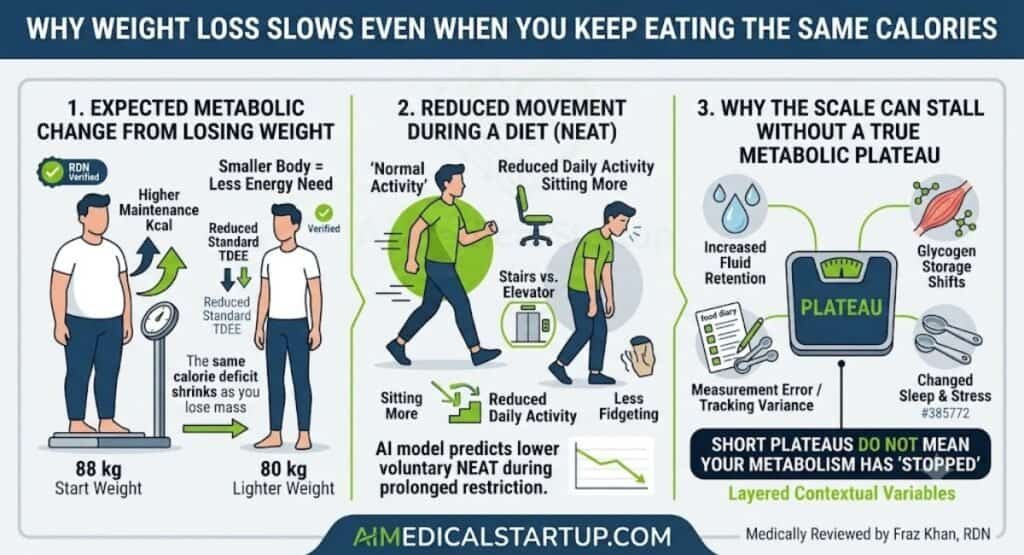
The scale can become surprisingly stubborn during a long diet. Part of the explanation is straightforward: a lighter body generally requires less energy to maintain and move. That means the same calorie intake can produce a smaller deficit after substantial weight loss. This predictable change should be separated from adaptive thermogenesis, which refers to additional expenditure changes beyond those explained by altered body composition.
Behavior can complicate the picture even further. You may continue exercising but walk less during the rest of the day. You may also experience changes in appetite, sleep, routine or adherence. Fluid retention can temporarily hide fat loss. Glycogen changes can shift body water. Consequently, a short plateau cannot establish that your metabolism has suddenly “stopped.”
Adaptive Thermogenesis vs. Normal Weight-Loss Metabolic Changes
Understanding the distinction between predictable tissue-based reductions and additional metabolic compensation prevents unnecessary alarm during a weight loss journey.
Expected Weight-Loss Change
Losing weight inherently lowers energy expenditure. A lighter body contains less total tissue to maintain at rest and requires less mechanical energy to move during physical activity.
Adaptive Thermogenesis
Describes an additional reduction in energy expenditure beyond what is fully explained by changes in fat-free mass and body composition. Researchers continue to study its magnitude and clinical duration.
| Physiological Feature | Expected Weight-Loss Change | Adaptive Thermogenesis |
|---|---|---|
| Smaller Body Mass | Common | May Coexist |
| Lower Movement Cost | Expected | May Coexist |
| Body Composition Shifts | Common | Key Interpretation Factor |
| Energy Expenditure Below Prediction | Not Required | Central Concept |
| Individual Variation | Present | Often Substantial |
| Research Measurement | Can Be Estimated | Requires Careful Methodology |
| Universal Calorie Value | No | No |
How Accurate Is an AI-Powered Metabolic Adaptation Calculator?
An AI-powered metabolic adaptation calculator can be mathematically consistent without being physiologically exact. While deterministic models provide steady estimates, individual physiological variance means real-world results differ.
Predictive Equation Error Margins
Equations rely on population averages. Individual metabolic rates naturally deviate due to muscle quality, organ mass, and genetics.
Research Measurement Heterogeneity
A review of 33 studies (2,528 adults) showed significant variance. Higher-rigor studies often found smaller or non-significant adaptive effects.
Indirect Calorimetry vs. AI Estimates
Lab-grade indirect calorimetry measures actual breath oxygen/CO2 exchange, whereas AI models provide mathematical estimation, not clinical diagnosis.
Population Variance vs. Predictive AI Models
Visualizing metabolic variance across individuals vs. deterministic AI estimates
Is an AI Metabolic Calculator considered a clinical diagnostic tool?
No. An AI metabolic adaptation calculator is an educational estimation tool. While mathematically consistent based on population formulas, true metabolic rate can only be diagnosed using clinical equipment like indirect calorimetry.
AI-Powered Adaptive BMR Calculator vs. Traditional Calorie Calculator
The main difference lies in the amount of context each model considers. While traditional calculators estimate expenditure based on baseline physical traits, adaptive calculators factor in your diet history, calorie deficits, and duration to model dynamic metabolic shifts.
Traditional Calorie Calculator
Focuses primarily on static physiological traits (age, sex, height, weight) and general activity multipliers to estimate standard resting expenditure and TDEE.
AI-Powered Adaptive Calculator
Adds contextual variables such as caloric intake, deficit depth, diet duration, and weight history to project metabolic adaptation alongside standard baseline figures.
| Feature / Parameter | Traditional Calculator | Adaptive Calculator |
|---|---|---|
| Age | Yes | Yes |
| Sex | Yes | Yes |
| Height | Yes | Yes |
| Current Weight | Yes | Yes |
| Activity Level | Usually | Yes |
| Calorie Intake | Usually Not | Yes |
| Estimated Calorie Deficit | Usually Not | Yes |
| Diet Duration | Usually Not | Yes |
| Previous Weight | Usually Not | Yes |
| Modeled Metabolic Adaptation | No | Yes |
| Adapted TDEE | No | Yes |
| Dynamic Weight-Loss Trajectory | Sometimes | Yes |
| Direct Metabolic Measurement | No | No |
FAQs
Everything you need to know about BMR, metabolic adaptation, and energy expenditure.
An adaptive BMR calculator is a calorie-estimation tool that attempts to account for metabolic adaptation in addition to conventional factors such as age, sex, height, weight, and activity level. Our calculator applies a mathematical model to estimate how sustained calorie restriction and diet duration could influence energy expenditure. The result is an estimate, not a direct measurement of metabolism.
Research supports the existence of adaptive thermogenesis in at least some people and circumstances, particularly during or after weight loss. However, its magnitude varies substantially, and studies use different methods to measure it. A systematic review found evidence across many studies while also emphasizing considerable methodological heterogeneity.
There is no single number that applies to everyone. Studies have reported different magnitudes depending on the population, amount of weight lost, duration of dieting, measurement method, and definition of adaptive thermogenesis. One controlled study reported estimates ranging from approximately 65 to 230 kcal/day depending on the analytical approach.
The Harris-Benedict equation is a predictive equation for estimating energy expenditure from characteristics such as body size, age, and sex. It does not directly measure an individual’s adaptive response to prolonged calorie restriction. This is why an adaptive calculator may add a separate modeling layer.
Both are predictive equations rather than direct measurements. The Mifflin-St Jeor equation was developed from measured resting energy expenditure in healthy individuals and is widely used in nutritional practice. However, no predictive equation can perfectly determine an individual’s actual energy expenditure.
No. A plateau can occur for many reasons, including reduced body weight, lower energy requirements, changes in physical activity, inaccurate calorie estimates, changes in water balance, and physiological adaptation. A plateau alone does not establish metabolic damage.
A maintenance period may be useful within some structured weight-management approaches, but it should not be described as a guaranteed metabolic reset. Research suggests that adaptive thermogenesis can be attenuated after periods of weight stabilization in some circumstances, but individual responses vary.
The calculator’s adapted TDEE is an estimate, not a medical prescription. It should be interpreted alongside your actual weight trend, dietary intake, activity, body composition, and overall health. If you are unsure how to interpret the result, particularly during significant weight loss, consult a qualified healthcare professional.
No. The calculator cannot diagnose a metabolic disorder, thyroid condition, hormonal disorder, or other medical condition. It provides a mathematical estimate based on the information entered by the user.
BMR refers to the estimated energy required to support basic physiological functions at rest. TDEE represents total daily energy expenditure and includes resting expenditure plus physical activity and other components of energy use. In practice, the terms BMR and resting energy expenditure are sometimes used interchangeably in consumer calculators, although they are not technically identical measurements.
Key Takeaways: Understanding Your Adapted Energy Needs
Navigating energy balance requires looking beyond simple numbers. Here are the foundational principles for interpreting adaptive metabolic modeling in practice.
Context Beyond Baseline Measurements
The AI-Powered Adaptive BMR Calculator adds crucial context to standard estimates. By considering your calorie intake, estimated deficit, diet duration, and weight history, it illustrates how prolonged energy restriction dynamically influences daily expenditure.
Nuanced Physiology vs. “Slow Metabolism”
Metabolic adaptation is far more complex than simple labels suggest. Losing body mass naturally reduces energy requirements. While additional adaptive changes occur in some individuals, research shows substantial variation in both methodology and individual magnitude.
A Predictive Model, Not a Diagnostic Verdict
Treat mathematical tools as educational models rather than clinical absolutes. Your actual scale trends, activity patterns, nutrition quality, sleep, and overall health context matter most. The goal is clarity, not forcing your body into a static spreadsheet.
Get Your Personalized Metabolic Recovery Plan
Calorie needs aren’t static during weight loss. Compare conventional estimates against adaptive modeling to interpret plateaus accurately without aggressive dietary cuts.
What Your Detailed PDF Includes:
- Baseline & TDEE Analysis: Standard vs. modeled adapted expenditure.
- Metabolic Trends: Estimated slowdown & dynamic calorie targets.
- Trajectory & Timing: Projected weight path & maintenance-period timing.
- Action Frameworks: 14-day diet-break guide & long-term adjustment rules.
Download Your Free Report



Registered & Licensed Dietitian Nutritionist AHPC | Public Health Nutrition • Gut Care & Fitness | Member: PNDS, SIGNS International, The Nutrition Society (UK), PEN®