jumvo-breakthrough-parkinsons-disease-treatment

AbbVie’s JUVMO Joins Parkinson’s Disease Treatment Arsenal

Healthcare AI & Biopharma Update

AbbVie’s JUVMO (Tavapadon): A New PARKINSON’S DISEASE TREATMENT, Competitors, and Pipeline Outlook

PARKINSON’S DISEASE TREATMENT is evolving as researchers explore better ways to manage motor symptoms and improve everyday function. On September 28, 2026, ABBVIE announced US FDA APPROVAL OF JUVMO (tavapadon), an oral dopamine D1/D5 receptor agonist designed to offer a different approach to dopamine signaling. The JUVMO PARKINSON’S DISEASE TREATMENT enters a field where levodopa and established dopamine agonists remain important, while researchers investigate therapies that may target underlying disease biology.

This article examines tavapadon’s clinical evidence, safety considerations and position against existing PARKINSON’S DISEASE TREATMENT OPTIONS. It also reviews the PARKINSON’S DISEASE DRUG PIPELINE and MARKET OUTLOOK across the United States, United Kingdom and European Union.

JUVMO Enters the PARKINSON’S DISEASE Treatment Arena: Efficacy, Mechanism, and Pipeline Outlook

Evaluating AbbVie’s novel selective D1/D5 receptor agonist against traditional therapies, clinical trial evidence, and global availability across the USA, UK, and EU.

What Is JUVMO (Tavapadon) & FDA Approval?

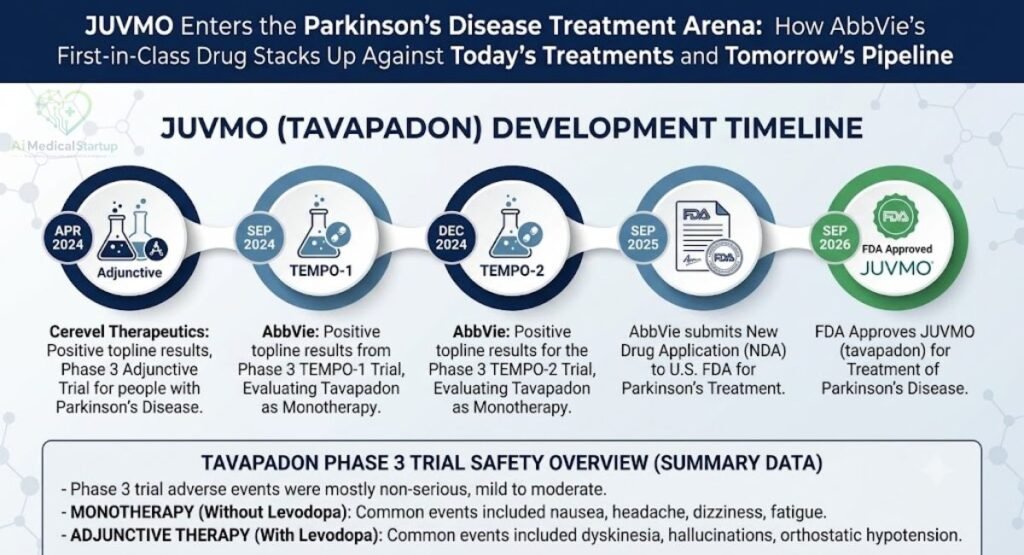
JUVMO is the brand name for tavapadon, a once-daily oral Selective D1/D5 receptor agonist developed by AbbVie for adults with PARKINSON’S DISEASE. Following results from the Phase 3 TEMPO clinical program, the US FDA APPROVAL OF JUVMO was announced on September 28, 2026. The announcement confirms USA authorization; it does not automatically mean that JUVMO has approval in the UK or EU.

Mechanism & TEMPO Clinical Trials

Tavapadon stimulates D1/D5 receptors rather than predominantly D2/D3 approaches used by older drugs. The Phase 3 trials included TEMPO-1, TEMPO-2, and TEMPO-3. Detailed evaluations like TEMPO-2 results and TEMPO-3 results provide essential clinical insight into motor fluctuations and symptom management.

Efficacy, Safety, and Global Outlook

In TEMPO-1, JUVMO improved everyday functioning scores measured by MDS-UPDRS Part II. These results support symptomatic benefit. Common adverse events include nausea, dizziness, and fatigue. Regulatory milestones vary globally; an initial FDA decision does not immediately guarantee regional availability across the UK or EU.
Therapeutic Comparison

Competing Within Its Class: JUVMO vs. D2/D3 DOPAMINE AGONISTS

Evaluating how AbbVie’s novel selective D1/D5 agonist compares against traditional options like PRAMIPEXOLE, ROPINIROLE, ROTIGOTINE, and APOMORPHINE.

JUVMO vs. PRAMIPEXOLE (MIRAPEX)

PRAMIPEXOLE, marketed as MIRAPEX and widely available as GENERIC MEDICATIONS, target D2/D3 receptors. While JUVMO introduced selective D1/D5 activation, both required careful consideration of adverse events like PATIENT TOLERABILITY, sleepiness, and blood pressure changes.

JUVMO vs. ROPINIROLE (REQUIP)

ROPINIROLE (REQUIP) features extended and immediate-release options. JUVMO offers once-daily oral dosing under its FDA approval. Choosing between them depends on PATIENT TOLERABILITY, cost, and overall response to PARKINSON’S DISEASE TREATMENT OPTIONS.

JUVMO vs. ROTIGOTINE (NEUPRO)

ROTIGOTINE (NEUPRO) delivers medication via a transdermal patch, ideal for patients with swallowing difficulties. JUVMO provides a once-daily oral route, making administration choices dependent on individual patient requirements and lifestyle.

JUVMO vs. APOMORPHINE (APOKYN / ONAPGO)

APOMORPHINE (including APOKYN injections and ONAPGO continuous infusions) targets acute or severe motor fluctuations. These delivery methods serve distinct clinical functions compared to JUVMO's once-daily maintenance therapy.

Comparison Matrix: JUVMO vs. Established Dopamine Agonists

Broad comparative framework highlighting receptor profiles, administration routes, and access considerations across the USA, UK, and EU.

Feature JUVMO (tavapadon) Pramipexole (MIRAPEX) Ropinirole (REQUIP) Rotigotine (NEUPRO)
Main Receptor Profile Selective D1/D5 agonist D2/D3-family agonist D2/D3-family agonist D2/D3-family agonist
Route Oral Oral Oral Transdermal patch
Administration Once daily under US labeling Formulation-dependent Formulation-dependent Usually once daily
Evidence Base Phase 3 TEMPO PROGRAM Extensive established use Extensive established use Established clinical use
Generic Access Market-specific; verify status Generics widely available Generics widely available Availability varies by market
Key Consideration New receptor mechanism Established efficacy profile Formulation & patient response Patch delivery & skin tolerability

Safety & PATIENT TOLERABILITY

Selective activation offers a compelling scientific framework, but does not guarantee superior safety over D2/D3 DOPAMINE AGONISTS. Adverse events such as dizziness, low blood pressure, and hallucinations still require close monitoring by clinicians.

Cost, Market Access & GENERIC MEDICATIONS

As a PREMIUM BRANDED THERAPY, JUVMO enters a landscape with affordable GENERIC MEDICATIONS. Payer coverage, step therapy, and regional guidance across the USA, UK (NICE), and EU will determine long-term adoption.

Therapeutic Alternatives

Competing Across Classes: Approved Alternatives to JUVMO for PARKINSON’S DISEASE

Exploring how standard benchmarks, enzymatic inhibitors, and advanced delivery systems compare with JUVMO in comprehensive PARKINSON’S DISEASE TREATMENT plans.

LEVODOPA, CARBIDOPA & Extended Options

LEVODOPA and CARBIDOPA remain the cornerstone of PARKINSON’S DISEASE TREATMENT OPTIONS. Extended-release and novel delivery formulations like RYTARY, CREXONT, DHIVY, and inhaled INBRIJA provide tailored choices for managing motor fluctuations and intermittent "off" episodes.

MAO-B INHIBITORS & COMT INHIBITORS

MAO-B INHIBITORS like AZILECT (rasagiline) and XADAGO (safinamide) reduce dopamine breakdown. Meanwhile, COMT INHIBITORS such as ONGENTYS (opicapone) and entacapone prolong LEVODOPA action to help patients experiencing wearing-off symptoms.

Specialty & Advanced Infusion Therapies

Targeted adjuncts like NOURIANZ (istradefylline) and extended-release GOCOVRI address specific symptoms like dyskinesia. For advanced stages, continuous infusion options like VYALEV and DUOPA or surgical interventions offer alternative management pathways.

JUVMO vs. LEVODOPA & Specialist Selection

Neither JUVMO nor LEVODOPA is universally superior; their mechanisms differ. Neurologists in the USA and globally evaluate individual motor symptoms, disease stage, and PATIENT QUALITY OF LIFE to build safe, effective, and balanced treatment strategies.

juvmo-development-timeline

Pipeline Outlook

The PARKINSON’S DISEASE Pipeline: Emerging Therapies That Could Challenge Today’s Landscape

Exploring next-generation drug candidates, non-dopaminergic mechanisms, alpha-synuclein targets, and disease-modifying innovations shaping the future of NEUROLOGY.

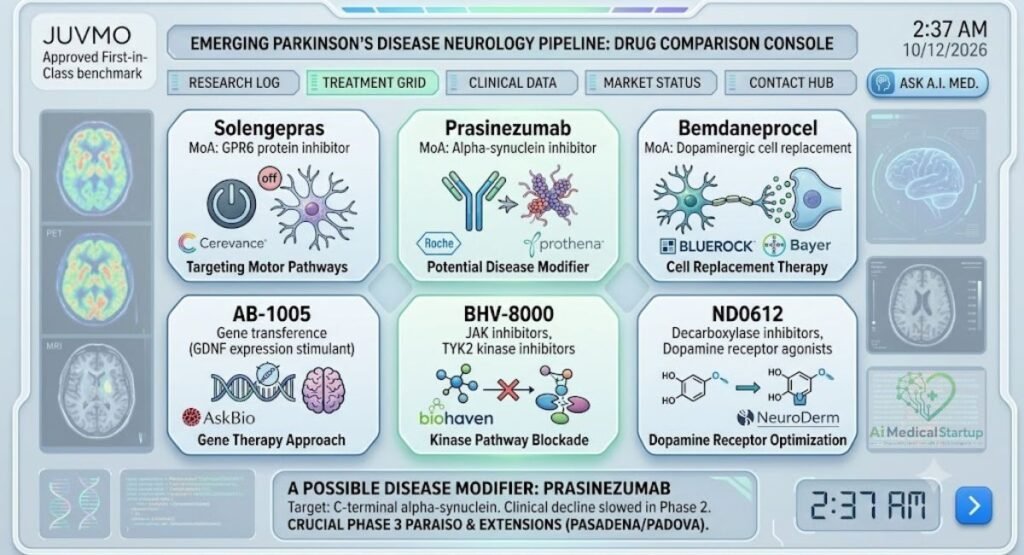
Solengepras: Non-Dopaminergic GPR6 Inhibitor

Solengepras, developed by Cerevance, targets the brain’s indirect movement pathway. On October 7, 2026, Cerevance announced positive topline findings from the ARISE PHASE 3 TRIAL, showing a significant reduction in daily "off" time and improved motor function.

Prasinezumab: Targeting Alpha-Synuclein

Developed by Roche and Prothena, prasinezumab is an investigational antibody targeting alpha-synuclein pathology for potential disease modification. Following earlier evaluations like PASADENA and PADOVA, Roche has initiated the PARAISO Phase 3 trial.

Bemdaneprocel & Cell-Based Replacements

Bemdaneprocel by BlueRock Therapeutics (Bayer) uses stem cell-derived dopamine neurons to replace lost cells. It is currently being evaluated in the exPDite-2 trial, a PHASE 3 STUDY featuring a sham-surgery control.

Gene Therapies & Diverse Candidates

Programs like AskBio's AB-1005 explore GDNF GENE THERAPY to support neuronal function across the BLOOD-BRAIN BARRIER. Other diverse candidates including ND0612, P2B001, and AAV-GAD continue progressing through CLINICAL DEVELOPMENT pipelines.

Disease Modification vs. Symptom Management

Distinguishing between symptomatic relief and DISEASE MODIFICATION is vital. Researchers investigate mechanisms such as NEUROINFLAMMATION, protein aggregation, and LYSOSOMAL FUNCTION (including GCASE pathways). However, robust CLINICAL TRIAL ENDPOINTS and independent peer reviews remain essential before confirming long-term alteration of disease progression.

emerging-parkinsons-disease-neurology-pipeline

Future Outlook & Analytics

JUVMO vs. the PARKINSON’S DISEASE Pipeline: What Does the Future Hold?

Analyzing how JUVMO’s selective D1/D5 mechanism compares with emerging non-dopaminergic therapies, disease-modifying candidates, and global regulatory milestones across the USA, UK, and EU.

Live Pipeline & Therapeutic Efficacy Tracker

Approved Status USA (FDA Approved) JUVMO active commercial availability rollout.
Target Mechanism Selective D1/D5 Agonist Differentiated from traditional D2/D3 agonists.
Pipeline Expansion PHASE 3 / Emerging Active trials comparing non-dopaminergic options.

Symptom Control vs. Disease Modification

JUVMO is engineered to improve motor symptoms through targeted dopamine receptor activation. Meanwhile, emerging therapies explore non-dopaminergic pathways, alpha-synuclein biology, and cell replacements. Disease-modifying claims require rigorous long-term evidence beyond short-term motor improvements.

Non-Dopaminergic Therapies & Solengepras

Non-dopaminergic candidates like Solengepras offer alternative pathways for patients who struggle with conventional drugs. While positive PHASE 3 topline findings mark an encouraging development, direct comparative studies against JUVMO remain essential in real-world clinical practice.

Long-Term Safety & Post-Approval Monitoring

The TEMPO clinical program confirms short- to medium-term efficacy, but ongoing post-approval monitoring is vital. Clinicians require broader real-world data regarding uncommon adverse events, treatment persistence, and outcomes in complex patient populations outside controlled trials.

Regulatory Milestones in USA, UK & EU

Following USA launch availability, European assessment via the EU regulatory framework and independent UK decisions will dictate regional access. National reimbursement policies and pricing frameworks will ultimately shape how rapidly JUVMO integrates into global care.

Market Analysis & Forecast

PARKINSON’S DISEASE Market Insights, Epidemiology, and Market Forecast

Analyzing global prevalence trends across the USA, UK, and EU alongside commercial growth drivers, pricing, reimbursement, and pipeline innovation.

Real-Time Market & Epidemiology Metrics

Global Patient Burden 8.5M+

Living with Parkinson's globally (WHO Report).

Market Value (2026) $6.3 Billion

Projected to reach $14.2B by 2033.

Annual US Diagnoses ~90,000

New cases diagnosed each year in the USA.

Prevalence in the USA, UK, and EU

PARKINSON’S DISEASE epidemiology shows a growing burden as populations age. The World Health Organization reported more than 8.5 million people living with Parkinson’s globally in 2019. In the United States, the Parkinson’s Foundation estimates that around 1.1 million people live with the condition with nearly 90,000 diagnosed annually.

Therapeutic Growth & PARKINSON’S DISEASE MARKET FORECAST

According to market data, a responsible Parkinson’s disease market forecast values the global PARKINSON’S DISEASE TREATMENT market at $5.6 billion in 2025, reaching $6.3 billion in 2026 and projecting growth up to $14.2 billion by 2033. Rising diagnosis rates and aging demographics accelerate long-term demand.

Commercial Opportunity & PHARMACEUTICAL MARKET COMPETITION

JUVMO enters a landscape defined by GENERIC MEDICATIONS and PREMIUM BRANDED THERAPY options. Commercial success depends on proving superior value over older agonists like pramipexole and ropinirole, as well as navigating complex HEALTHCARE REIMBURSEMENT frameworks across payers.

Reimbursement, Access & Emerging Disruptions

Access depends on formularies in the USA, health technology assessments in the UK (NICE), and national decisions in the EU. Future market shifts may also occur through PARKINSON’S DISEASE REGENERATIVE MEDICINE, PARKINSON’S DISEASE STEM CELL THERAPY, and PARKINSON’S DISEASE GENE THERAPY.

Got Questions?

Frequently Asked Questions About JUVMO and PARKINSON’S DISEASE

Find clear, expert answers regarding JUVMO (tavapadon), FDA APPROVAL OF JUVMO, efficacy, side effects, and comparisons with existing PARKINSON’S DISEASE TREATMENT OPTIONS.

JUVMO is a prescription medicine for adults with PARKINSON’S DISEASE in the United States. It is intended to help manage symptoms by stimulating dopamine D1/D5 receptors. It may be used on its own or with levodopa according to the US-approved indication. It does not cure PARKINSON’S DISEASE, and patients should discuss its potential benefits and risks with their healthcare professional.

Yes. AbbVie announced that the US FDA approval was granted on September 28, 2026. The approval was supported by the Phase 3 TEMPO PROGRAMME, which assessed tavapadon in early disease and as an adjunct to levodopa. The decision applies to the UNITED STATES; regulatory status and commercial access in other countries must be confirmed separately.

The generic name of JUVMO is tavapadon. JUVMO is the brand name, while tavapadon identifies the active medicine. The drug belongs to the selective D1/D5 dopamine receptor agonist class. Product availability, approved labeling, and prescribing requirements can vary by country, so clinicians should consult local product information.

JUVMO stimulates selected dopamine receptors, known as D1/D5 receptors, that are involved in movement-related brain circuits. PARKINSON’S DISEASE damages dopamine-producing neurons, disrupting the signals that help control movement. Tavapadon aims to improve these signals through a different receptor profile from many traditional D2/D3 DOPAMINE AGONISTS.

LEVODOPA enters the brain and is converted into dopamine. JUVMO instead stimulates selected dopamine receptors directly. Both approaches aim to improve motor symptoms, but they act at different points in the dopamine pathway. LEVODOPA remains a central benchmark, while tavapadon offers an additional option.

There is not enough direct comparative evidence to conclude that JUVMO is superior to PRAMIPEXOLE or ROPINIROLE for every patient. Tavapadon has a distinct D1/D5 mechanism, while established medicines mainly target D2/D3-family receptors. Differences in efficacy, adverse effects, convenience, and cost must be assessed individually.

Yes. The US approval announcement states that JUVMO can be used with or without oral LEVODOPA therapy. TEMPO-3 specifically evaluated tavapadon as an add-on treatment for adults experiencing motor fluctuations while taking LEVODOPA.

Reported adverse events include nausea, headache, dizziness, fatigue, altered taste, vomiting, dry mouth, and anxiety when used as monotherapy. When combined with LEVODOPA, reported effects also included dyskinesia, hallucinations, and orthostatic hypotension. PATIENT TOLERABILITY varies by individual.

JUVMO is used for MOTOR SYMPTOM MANAGEMENT; it has not been established as a DISEASE MODIFICATION treatment. Improvement in motor scores or daily function does not prove that a medicine slows underlying neurodegeneration.

The confirmed authorization is the US FDA decision announced on September 28, 2026. As of October 12, 2026, an EU authorization was not identified in public EMA medicine information. UK regulatory status must be checked separately as authorization and HEALTHCARE REIMBURSEMENT operate under independent frameworks.

Investigational candidates include solengepras (targeting GPR6), prasinezumab (an antibody targeting alpha-synuclein), and bemdaneprocel (PARKINSON’S DISEASE STEM CELL THERAPY). Advanced PARKINSON’S DISEASE GENE THERAPY programs are also under clinical trial review.

The market will be shaped by population aging, demand for improved symptom control, and commercial expansion. While GENERIC MEDICATIONS pressure pricing, novel therapies must prove clinical value to secure insurance coverage and global market adoption.

Final Overview

Conclusion: What JUVMO Means for PARKINSON’S DISEASE TREATMENT

Role of JUVMO in Modern Care

The approval of AbbVie’s JUVMO (tavapadon) marks an important development in the PARKINSON’S DISEASE TREATMENT landscape. Its selective D1/D5 mechanism gives clinicians a new option, and the TEMPO PROGRAMME supports its use for MOTOR SYMPTOM MANAGEMENT in adults under the US-approved indication. Its value will become clearer as clinicians gain experience, longer-term safety data accumulate, and real-world outcomes are reported. For now, it should be viewed as an additional PARKINSON’S DISEASE TREATMENT OPTIONS choice rather than a complete replacement for established therapies.

Looking Ahead Across Global Markets

The wider field is also moving forward. Solengepras, prasinezumab, bemdaneprocel, and other investigational programmes reflect different approaches to symptom control and the search for PARKINSON’S DISEASE DISEASE-MODIFYING TREATMENTS. Across the USA, UK, and EU, future adoption will depend on clinical evidence, regulatory decisions, access, and HEALTHCARE REIMBURSEMENT. Patients should work with a qualified healthcare professional to choose a treatment plan suited to their symptoms and goals.

⚠️

Medical Disclaimer

This article is for educational purposes only and does not replace professional medical advice, diagnosis, or treatment. Do not start, stop, or change PARKINSON’S DISEASE medication without consulting a qualified healthcare professional.

siRNA vs. Antisense Oligonucleotides: Commercial Potential & Market Outlook 2026

NEXT-GEN RNA THERAPEUTICS siRNA vs. Antisense Oligonucleotides: Which RNA Technology Has Greater...

Top 7 Breakthrough Drugs for Ulcerative Colitis Treatment Oct 2026 Updates

Medical Insights & Innovations Drugs for Ulcerative Colitis Treatment Ulcerative colitis can...

What Happens When AI Connects your Wearables

What Happens When AI Connects Your Wearables, Blood Tests, and Health Data? For years, health...
Dr. Kanza Sarfraz

Dr. Kanza Sarfraz, M.B.B.S., is a medical doctor and graduate of Allama Iqbal Medical College, Lahore. She brings nearly seven years of clinical experience across tertiary-care hospitals, medical headquarters, and healthcare facilities in both the public and private sectors. Her clinical experience provides a practical perspective on healthcare delivery, emerging medical technologies, and the evolving role of artificial intelligence in medicine.

View All Post

Leave a Reply

Your email address will not be published. Required fields are marked *