sirrna-vs-aso-commercial-potential

siRNA vs. Antisense Oligonucleotides: Commercial Potential & Market Outlook 2026

NEXT-GEN RNA THERAPEUTICS

siRNA vs. Antisense Oligonucleotides: Which RNA Technology Has Greater Commercial Potential?

RNA therapeutics are changing how pharmaceutical companies approach genetic and chronic diseases. Instead of targeting proteins alone, RNA-based therapeutics can influence the instructions cells use to produce them.

This has created new opportunities for RNA-targeted drugs, attracting investment from biotechnology companies and major pharmaceutical developers across the USA, UK and EU. However, commercial success depends on more than scientific innovation. Clinical efficacy, delivery, safety, treatment convenience and reimbursement all influence the commercial potential of RNA drugs.

The debate over siRNA vs antisense oligonucleotides centers on two different approaches to controlling gene expression. Small interfering RNA (siRNA) uses RNA interference therapy to silence selected messenger RNA, while Antisense oligonucleotides (ASOs) can degrade RNA or change how it is processed. Both are forms of oligonucleotide therapeutics, but they have different strengths. Understanding those differences helps explain the siRNA commercial potential, the evolving antisense oligonucleotide market and the future of pharmaceutical RNA technology.

Commercial Impact

Evaluating market reach across USA, UK, and EU regulatory landscapes.

Mechanism Comparison

Contrasting RNA interference therapy (siRNA) with ASOs gene processing.

RNA PLATFORM MECHANISMS

siRNA vs. ASO: Same Goal, Very Different Machinery

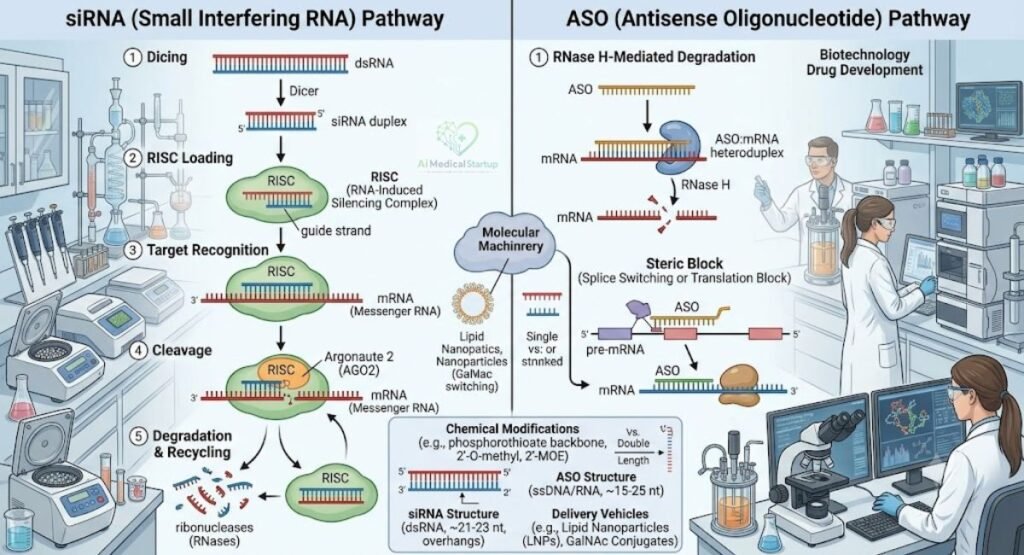
The main difference between siRNA vs ASO lies in their RNA interference mechanism and antisense mechanism of action. Both use sequence recognition to interact with a target RNA, but they recruit different cellular machinery. These differences affect gene expression modulation, tissue delivery, treatment duration and which diseases each platform can address. Consequently, the best technology depends on the biological target rather than the platform's popularity.

How siRNA Works: The Catalytic Silencer

Small interfering RNA (siRNA) is a short RNA molecule designed to guide cellular machinery towards a complementary Messenger RNA (mRNA) sequence. This gene silencing technology can reduce production of a disease-related protein. Through RISC-mediated gene silencing, the cell can repeatedly target matching RNA molecules, supporting sustained effects for some medicines. This mechanism has helped establish siRNA as an important part of modern RNA therapeutics.

The Role of the RISC Complex and Argonaute 2

The RNA-induced silencing complex (RISC) contains proteins that help identify and target RNA. Its key component, Argonaute 2, can cleave complementary messenger RNA, allowing cytoplasmic RNA degradation and reducing protein production. This mechanism gives siRNA its therapeutic precision, although sequence selection and Off-target effects remain important considerations during development.

GalNAc Conjugation and Lipid Nanoparticle Delivery

GalNAc conjugation connects siRNA to a molecule that helps deliver it to liver cells. This approach supports Liver-targeted drug delivery and has enabled several effective liver-targeted RNA therapeutics. Lipid nanoparticle delivery offers another route for protecting RNA and helping it enter cells. However, achieving reliable Tissue-specific delivery outside the liver remains a major challenge for many siRNA programs.

How Antisense Oligonucleotides Work: The Versatile Modulator

Antisense oligonucleotides (ASOs) are usually single-stranded molecules that bind selected RNA sequences. Their chemistry determines whether they promote RNA degradation, influence gene processing or block an interaction. Some use a Phosphorothioate backbone to improve stability and interactions with biological systems. This flexibility gives antisense drug development opportunities across genetic, neurological and cardio metabolic diseases.

RNase H1-Mediated RNA Degradation

Some ASOs recruit RNase H1, an enzyme that cleaves RNA within a suitable RNA–DNA hybrid. This RNase H1-mediated RNA degradation reduces the target RNA and can lower production of the associated protein. Other ASOs act as Steric-blocking oligonucleotides, binding RNA without recruiting RNase H1. The mechanism depends on the molecule's design and the intended therapeutic effect.

Splice Switching and Exon Skipping

Splice modulation changes how pre-messenger RNA is processed before it becomes mature RNA. Splice-switching oligonucleotides can alter exon inclusion, while Exon skipping may help restore a more useful protein-reading frame in selected genetic conditions. Phosphorodiamidate morpholino oligomers (PMOs) are one chemistry used in Exon-skipping therapy for specific Duchene muscular dystrophy mutations. Their benefits depend on the mutation and the clinical evidence for each treatment.

The Commercial Translation

siRNA often benefits from durable liver targeting, while ASOs offer flexibility in RNA degradation and splicing. Some ASOs require Intrathecal administration to reach the central nervous system, making Central nervous system drug delivery an important part of treatment planning. Both technologies rely on Oligonucleotide chemical modifications to improve performance. These differences influence RNA drug dosing frequency, patient convenience, manufacturing and commercial differentiation.

sirna-aso-pathways

MARKET ANALYSIS & COMMERCIAL PERFORMANCE

The Commercial Scorecard: What the Approved Drugs Tell Us

The approved RNA therapeutics provide stronger evidence of commercial progress than early laboratory findings. However, sales figures must be interpreted carefully because companies may report product revenue, royalties and collaboration payments separately. The wider siRNA therapeutics market and antisense oligonucleotide market also include medicines with different indications, prices and patient populations. Comparing these businesses fairly requires clinical evidence alongside financial performance.

siRNA: A Blockbuster Pipeline in the Making

The siRNA platform has produced medicines for rare genetic disorders and broader conditions involving cholesterol and other metabolic pathways. Alnylam Pharmaceuticals has played a central role in commercializing RNA interference medicines, while partners such as Novartis and Sanofi have helped extend the platform's reach. These Commercial drug launches demonstrate how research partnerships can translate molecular innovation into products.

Approved siRNA Drugs and Their Target Diseases

Examples include AMVUTTRA (vutrisiran) and ONPATTRO (patisiran) for transthyretin amyloidosis, GIVLAARI (givosiran) for acute hepatic porphyria and OXLUMO (lumasiran) for primary hyperoxaluria type 1. LEQVIO (inclisiran) targets PCSK9 to lower LDL cholesterol. QFITLIA (fitusiran) targets antithrombin in hemophilia A or B, while REDEMPLO (plozasiran) targets APOC3 for familial chylomicronemia syndrome and RIVFLOZA (nedosiran) targets LDHA in primary hyperoxaluria type 1. Check current labels in each jurisdiction before publication.

Alnylam's Role in Commercializing RNA Interference

Alnylam Pharmaceuticals reported approximately $2.99 billion in net product revenue for 2025, up from about $1.65 billion in 2024. Its annual report highlighted growth in its transthyretin franchise, including AMVUTTRA and ONPATTRO.

These figures demonstrate real RNA therapeutics commercial revenue, but they should not be confused with the entire RNAi market or with revenue earned by commercial partners.

Inclisiran and the Opportunity in Cardiovascular Medicine

LEQVIO (inclisiran) illustrates the potential of Cardiovascular RNA therapeutics in large patient populations. By reducing PCSK9 production, it helps lower LDL cholesterol and offers infrequent maintenance treatment. However, Biomarker reduction is not the same as proving fewer heart attacks or strokes. Cardiovascular outcomes trials and appropriate clinical evidence remain essential when evaluating Cardiovascular risk reduction.

Revenue Potential, Pricing, and Market Access

The siRNA therapeutics market may expand as new indications reach approval, but sales depend on price, eligible patients and payer decisions. Drug pricing and reimbursement differ across the US, UK and EU. Health technology assessments, national healthcare budgets and local prescribing rules can affect Pharmaceutical market access. Therefore, Peak global sales and Blockbuster drug potential should be treated as forecasts, not guaranteed outcomes.

Antisense: The Pioneer With a Strong Second Act

ASOs have a long development history and a diverse range of approved applications. Ionis Pharmaceuticals has helped establish the platform through research, licensing and commercial partnerships. Other companies, including Biogen, Sarepta Therapeutics, Roche, AstraZeneca, Sanofi, Arrowhead Pharmaceuticals, Silence Therapeutics, Amgen, Eli Lilly and GSK, contribute to the broader RNA drug development landscape through different platforms and partnerships. Their roles and individual assets should be verified before attributing a product to a company.

Established ASO Drugs and Their Commercial Track Records

SPINRAZA (nusinersen) treats spinal muscular atrophy. The EXONDYS 51 (eteplirsen), VYONDYS 53 (golodirsen), AMONDYS 45 (casimersen) and VILTEPSO (viltolarsen) products target specific Duchenne muscular dystrophy mutations. TRYNGOLZA (olezarsen) treats familial chylomicronemia syndrome, while DAWNZERA (donidalorsen) prevents hereditary angioedema attacks. WAINUA (eplontersen) treats hereditary transthyretin amyloidosis with polyneuropathy, and QALSODY (tofersen) treats SOD1-related amyotrophic lateral sclerosis. Labels and indications vary by jurisdiction.

Ionis Pharmaceuticals and the Antisense Business Model

Ionis Pharmaceuticals illustrates how a biotechnology company can generate value through research, product development and partnerships. Pharmaceutical licensing partnerships can provide funding and commercial reach, but royalties and shared responsibilities affect the revenue a company retains. As a result, comparing Global net sales across ASO and siRNA companies requires attention to who owns, manufactures and markets each medicine.

Nusinersen and the Value of a Clinically Established Platform

SPINRAZA (nusinersen) is an important example of ASO treatment for Spinal muscular atrophy (SMA). It changes SMN2 RNA splicing to increase production of functional SMN protein. The treatment has helped establish ASOs in Neuromuscular disease therapies, but it requires repeated Intrathecal administration. Its clinical history also shows why diagnosis, specialist access and ongoing care influence Treatment adherence and real-world value.

Revenue Concentration, Competition, and Lifecycle Management

The antisense oligonucleotide market includes products with different commercial maturity, pricing and treatment requirements. Companies must manage competition, new indications, patent life and alternative therapies. Strong Annual product revenue from one medicine does not automatically prove that an entire platform is commercially superior. Product-level results, development costs and retained royalties provide a more useful picture of the RNA therapeutics competitive landscape.

RNA DRUG PIPELINE 2026 ANALYSIS

The RNA DRUG PIPELINE 2026: Blockbuster Potential and Clinical Setbacks

The RNA drug pipeline 2026 contains opportunities across cardiovascular, metabolic, neurological and rare genetic diseases. Still, an early scientific signal is not equivalent to a successful treatment. RNA drug clinical trials, Regulatory milestones and Confirmatory clinical trials determine whether a candidate can become a commercially viable medicine. Investors should distinguish approved products from active Late-stage clinical assets and discontinued programs.

Emerging siRNA Drugs: The Next Wave Aims at Mass Markets

The siRNA pipeline 2026 includes candidates targeting lipid pathways and hypertension. Medicines for common chronic diseases could reach larger patient populations than some rare-disease products. However, larger markets also bring more competition and demanding evidence requirements. RNA therapeutics investment will depend on whether these candidates show meaningful clinical benefits, manageable risks and practical dosing.

Cardiovascular Disease and Lipid Management

Lipoprotein(a) [Lp(a)] is an inherited cardiovascular risk factor and an active target for RNA medicines. Investigational candidates include Olpasiran, Lepodisiran and Zerlasiran. These Lipoprotein(a) lowering therapies have shown potential to reduce the biomarker, but cardiovascular outcomes remain central to determining their clinical and commercial value. The OCEAN(a)-Outcomes trial studies olpasiran, while the ACCLAIM-Lp(a) trial studies lepodisiran. Clinical trial information should be checked for the latest updates.

Obesity, Metabolic Disease, and Liver-Related Disorders

RNA medicines may offer new approaches to Cardiometabolic disease drugs, lipid disorders and selected liver conditions. Severe hypertriglyceridemia and Familial chylomicronemia syndrome (FCS) illustrate how targeting a specific pathway may benefit patients with substantial unmet needs. However, not every metabolic target has an approved RNA medicine. Commercial forecasts must reflect each candidate's actual stage, safety profile and clinical results.

Expanding siRNA Beyond the Liver

A major challenge is delivering siRNA reliably to tissues beyond the liver. Central nervous system penetration and other extrahepatic applications require effective cellular uptake and escape from intracellular compartments. Better Tissue-specific delivery could create new Biotechnology commercial opportunities, but it remains a scientific challenge rather than a guaranteed advantage. Mivelsiran, for example, should be discussed only with its latest verified indication and development status.

Key siRNA Candidates to Watch in 2026

Zilebesiran targets angiotensinogen and is being developed for Hypertension. Nucresiran targets transthyretin, while olpasiran, lepodisiran and zerlasiran target Lp(a). Cemdisiran targets complement component C5. These names belong in a pipeline discussion only with current sponsor, trial-stage and regulatory information attached. Candidates may change status as new results emerge, so the final article should verify each program against company announcements and trial registries.

Emerging Antisense Drugs: Big Wins and Big Setbacks in 2026

The ASO pipeline 2026 covers cardiovascular risk, rare genetic conditions, neurological disorders and chronic infections. Some programs may offer new treatments for diseases with limited options, while others may encounter Clinical endpoint failure or safety concerns. A fair assessment of RNA therapeutics safety requires the specific trial results, population and drug chemistry rather than broad assumptions about all ASOs.

Cardiovascular ASOs and High-Prevalence Diseases

Pelacarsen is an ASO designed to lower Lp(a). Its Lp(a)HORIZON trial has been a key cardiovascular outcomes study. The registry reported the trial as completed in August 2026, but its status alone does not establish the outcome. Check the official trial record before stating whether the treatment reduced cardiovascular events. Cardiovascular outcomes trials are crucial because lower Lp(a) levels do not, by themselves, prove reduced clinical risk.

Neurological Disorders and Rare Genetic Diseases

ASOs can be useful when a disease is linked to a specific RNA or when altering splicing may improve protein production. QALSODY (tofersen) targets SOD1 messenger RNA in SOD1-related amyotrophic lateral sclerosis (ALS), while nusinersen treats SMA through splicing modulation. These examples show how Rare genetic disease treatments can benefit from targeted approaches. Some candidates require spinal administration, making treatment infrastructure and patient burden important commercial factors.

The Alexander Disease Milestone and Other Recent Developments

In September 2026, the US FDA approved Zilganersen as ZANVASTRO, the first approved treatment for Alexander disease. The medicine directly targets the disease's underlying molecular cause, marking a significant milestone for rare neurological disorders. This US decision does not automatically establish UK or EU authorization. FDA announcement provides the regulatory details. The commercial outlook will also depend on access, administration, safety monitoring and the size of the eligible population.

Clinical Failures, Discontinued Programs, and Safety Signals

Not every candidate reaches approval. Some programs stop after safety findings, while others fail to meet their primary clinical endpoint or lose commercial priority. Researchers must distinguish Safety and tolerability issues from weak efficacy, study-design limitations and funding decisions. Accelerated approval may rely on an intermediate measure in certain circumstances, but Confirmatory clinical trials can still be required. These distinctions help readers judge setbacks accurately.

ASO Candidates to Watch in 2026

Bepirovirsen is an investigational ASO for Chronic Hepatitis B. Pelacarsen remains important to the cardiovascular field, while other candidates may address rare neurological or metabolic conditions. Zilganersen should now be treated as an approved US medicine rather than an investigational asset. The ESSENCE trial, ZENITH Phase 3 trial, TRITON-CM trial, TRITON-PN trial, CARDIO-TTRansform trial, HELIOS-B Phase 3 trial, SHASTA-3 trial and SHASTA-4 trial should be included only when their relevance to the article's named drugs and outcomes is confirmed. Trial names alone do not demonstrate success.

COMMERCIAL MARKET DATA & REVENUE ANALYSIS

2025 Revenue of Approved siRNA Drugs: Performance Breakdown

Analyzing commercial adoption across leading AI-driven RNA therapeutics analytics reveals distinct market uptake trajectories. The following visual summary breaks down verified net revenues across major siRNA assets, highlighting dominant market shares led by Alnylam Pharmaceuticals and commercial collaborators like Novartis and Sanofi.

AMVUTTRA led the group at $2,314M, accounting for over half of the total commercial revenue generated across approved portfolios.

Novartis' LEQVIO followed closely at about $1,200M, accelerated by twice-yearly maintenance dosing protocols in chronic cholesterol management.

Alnylam retained leadership breadth with four marketed products (AMVUTTRA, GIVLAARI, OXLUMO, and ONPATTRO) capturing nearly 71% of aggregate sales. Meanwhile, Sanofi's QFITLIA remains positioned in early launch phases around $10M.

FINAL ANALYSIS & SUMMARY

The Commercial Verdict: Who Has the Greater Potential?

The commercial potential of RNA drugs depends on a combination of clinical efficacy, delivery, patient numbers, treatment frequency and reimbursement. siRNA has established strengths in liver-targeted gene silencing, while ASOs can degrade RNA or modify splicing. Neither approach guarantees a blockbuster. The RNA therapeutics market growth will depend on whether future medicines provide meaningful benefits that justify their costs and treatment demands.

siRNA vs. ASO: Head-to-Head Commercial Comparison

Factor siRNA ASOs
Main mechanism RISC-mediated RNA silencing RNA degradation or splicing modulation
Established strength Liver-targeted gene silencing Mechanistic flexibility and selected CNS applications
Dosing Often infrequent for some medicines Depends on chemistry, route and indication
Major challenge Delivery beyond the liver Tissue delivery and administration burden
Commercial opportunity Cardiovascular and metabolic markets Neurological, genetic and cardio metabolic diseases

This comparison reflects broad tendencies rather than rules for every medicine. Individual products may differ in delivery, durability and clinical outcomes.

Which Platform Offers the Stronger Blockbuster Opportunity?

siRNA may benefit from expansion into large chronic-disease markets, especially when long-lasting effects reduce treatment frequency. ASOs may generate strong sales when they address serious diseases with few effective alternatives. Blockbuster RNA drugs will require more than a promising mechanism: they need robust evidence, reliable manufacturing and sustainable access. Peak sales forecasts should therefore be treated as estimates rather than guaranteed commercial results.

What Pharmaceutical Investors and Biotech Companies Should Watch

Investors should monitor Phase 3 outcomes, regulatory decisions, safety updates, manufacturing capacity and reimbursement. RNA therapeutics clinical development also depends on intellectual property and partnerships that support global launches. Pharmaceutical market expansion is more likely when a medicine demonstrates clear benefits over existing care. These factors shape the commercial outlook for both platforms.

Final Verdict: siRNA vs. Antisense Oligonucleotides

The evidence does not support a universal winner in siRNA vs. antisense oligonucleotides. siRNA has built a strong commercial position in liver-targeted medicines, while ASOs retain important advantages where RNA degradation or splicing changes suit the disease biology. Future leadership will depend on successful clinical trials, better delivery and patient access. The strongest platform will be the one that delivers meaningful outcomes for each target disease.

FREQUENTLY ASKED QUESTIONS & SOURCES

FAQs

siRNA generally uses the RISC pathway to silence target messenger RNA. ASOs bind directly to RNA and may trigger degradation, alter splicing or block specific interactions. The best approach depends on the target and disease.

Neither technology is universally more effective. Clinical efficacy depends on the target, delivery method, disease biology, dose and outcome measured in trials. Comparisons should use evidence from relevant clinical studies.

siRNA has established commercial strengths in liver-targeted medicines. ASOs offer a wider range of mechanisms and have important neurological and rare-disease applications. Future commercial success will depend on clinical outcomes and market access.

Alnylam is a major RNAi developer. Novartis and Sanofi commercialize partnered products, while other biotechnology companies continue to develop RNAi medicines. Company roles should be checked for each asset.

Ionis Pharmaceuticals is a major ASO developer, with medicines and partnerships spanning several disease areas. Other companies participate through research, licensing and commercialization. Leadership varies by indication and development stage.

Safety depends on the individual medicine, chemistry, target, delivery route and patient population. Both technologies require careful evaluation of adverse effects, off-target activity and long-term outcomes.

Some siRNA medicines produce durable gene silencing, allowing longer intervals between doses. However, dosing schedules differ across products and indications. Not every siRNA medicine offers the same duration.

Yes. Inclisiran is used to lower LDL cholesterol, while investigational RNA medicines target conditions such as hypertension and elevated Lp(a). Approval and proven clinical benefit must be assessed for each product.

Important challenges include tissue delivery, off-target effects, safety, manufacturing, clinical trial design and reimbursement. Delivering medicines beyond the liver remains a major obstacle for many siRNA programs.

It is too early to predict one universal winner. Both platforms may grow in different disease areas. Clinical outcomes, delivery advances, regulatory decisions and healthcare access will shape their commercial position by 2030.

References

Source Why it matters
Alnylam 2025 annual report Product revenue and company performance
FDA: ZANVASTRO approval Alexander disease approval
FDA: DAWNZERA ASO indication and dosing
FDA: TRYNGOLZA Indication and clinical-trial context
ClinicalTrials.gov: Lp(a)HORIZON Current trial status and endpoints

Nutrigenomics

AI-Powered Nutrition & Genomics Is Nutrigenomics the Future of Healthcare or Just a Wellness...

Osteosarcoma Treatment

AI Healthcare Insights Osteosarcoma Treatment: Current Options, Approved Drugs and Emerging...

Top 7 Breakthrough Drugs for Ulcerative Colitis Treatment Oct 2026 Updates

Medical Insights & Innovations Drugs for Ulcerative Colitis Treatment Ulcerative colitis can...

Dr. Kanza Sarfraz

Dr. Kanza Sarfraz, M.B.B.S., is a medical doctor and graduate of Allama Iqbal Medical College, Lahore. She brings nearly seven years of clinical experience across tertiary-care hospitals, medical headquarters, and healthcare facilities in both the public and private sectors. Her clinical experience provides a practical perspective on healthcare delivery, emerging medical technologies, and the evolving role of artificial intelligence in medicine.

View All Post

Leave a Reply

Your email address will not be published. Required fields are marked *