
FGFR Inhibitors in Cancer: Approved Drugs, Clinical Trials & Future

FGFR Inhibitors: How a Once-Overlooked Target Became Precision Oncology’s Next Big Story
FGFR INHIBITORS in cancer are helping oncologists treat selected tumors based on their genetic features. These medicines target FIBROBLAST GROWTH FACTOR RECEPTORS, proteins that can drive cancer growth when altered. By identifying these changes, doctors can offer BIOMARKER-DRIVEN TREATMENT rather than relying only on a tumor’s location.
This approach is part of PRECISION ONCOLOGY, where treatment decisions reflect the molecular profile of an individual cancer. Approved medicines now address certain FGFR2-ALTERED BILE DUCT CANCERS and FGFR3-ALTERED UROTHELIAL CANCERS. Meanwhile, clinical researchers are testing newer drugs that may overcome resistance or improve treatment options. Approval and availability differ across the USA, UK and EU, so patients should check local guidance and discuss their results with an ONCOLOGY SPECIALIST.
Molecular Profiling
Targeted genomic alterations driving next-generation cancer therapeutics.
The Weight of the Wild Card: Why FGFR-Driven Cancers Leave Patients With So Few Options
Cancer cells can develop genomic alterations in cancer that make the FGFR signaling pathway unusually active. These changes may help tumors grow, survive and spread. Although FGFR-targeted therapy offers a treatment route for selected patients, only a subset of people with cancer have an alteration that matches an approved medicine.
Cholangiocarcinoma: A Rare Cancer With a Heavy Toll
Intrahepatic cholangiocarcinoma begins in the bile ducts inside the liver. Some tumors contain FGFR2 gene fusions or FGFR2 rearrangements, which can make them sensitive to targeted treatment. For people with metastatic cholangiocarcinoma or unresectable cholangiocarcinoma, these findings may create options after previous systemic therapy.
Urothelial Cancer and Beyond: FGFR3 Takes Center Stage
FGFR3 alterations occur in some cases of urothelial carcinoma, including bladder and upper urinary tract cancers. “Erdafitinib” is an approved targeted option for eligible adults with certain advanced or metastatic FGFR3-altered disease. However, its use depends on the approved indication, prior treatment and molecular test results.
The Hidden Burden: Living With the Treatment
Targeted medicines can shrink tumors, but they may also cause treatment-related adverse effects. Patients can experience changes in phosphate levels, nail problems, mouth inflammation or ocular toxicity. Regular blood tests, eye examinations and communication with the care team help manage risks while preserving the therapeutic window between treatment benefit and toxicity.
From Proof of Concept to Standard of Care: The Approved FGFR Inhibitors in Cholangiocarcinoma
For selected patients with FGFR2-altered bile duct cancer, oral FGFR kinase inhibitors can offer a treatment option after previous therapy. In the US, key medicines include “pemigatinib”, “futibatinib” and, since September 2026, “lirafugratinib”. Their eligibility criteria and regulatory status should be checked against current prescribing information.
Incyte’s PEMAZYRE (pemigatinib): The Pioneer That Opened the Door
Pemigatinib, marketed as PEMAZYRE by Incyte, helped establish FGFR2-targeted treatment in previously treated advanced cholangiocarcinoma. The FIGHT-202 study evaluated patients with FGFR2 fusions or rearrangements and supported its initial US approval. Pemigatinib is a selective oral inhibitor, but treatment requires monitoring for phosphate abnormalities and eye-related complications.
Taiho Oncology’s LYTGOBI (futibatinib): The Irreversible Challenger
Futibatinib, sold as LYTGOBI by Taiho Oncology, is an irreversible FGFR inhibitor that binds its target through covalent inhibition. The pivotal FOENIX-CCA2 study examined previously treated patients with FGFR2-altered intrahepatic cholangiocarcinoma. Futibatinib offers another molecularly guided option, but it does not eliminate the need for toxicity monitoring or assessment of disease progression.
Elevar’s LYRFIGTU (lirafugratinib): The Newest Name in the Class
Lirafugratinib, marketed as LYRFIGTU by Elevar Therapeutics, received “US FDA approval on September 23, 2026”, for adults with previously treated, unresectable, locally advanced or metastatic cholangiocarcinoma containing an FGFR2 fusion or other rearrangement. The approval was based on the single-arm REFOCUS trial, which reported an objective response rate (ORR) of 46% and a median duration of response (DOR) of 11.8 months. These results describe the study population and do not guarantee an individual response.
What the Approved Trio Tells Us
These drugs show how biomarker-guided treatment can turn a molecular finding into a practical treatment decision. Yet the medicines are not interchangeable for every patient. Their indications, mechanisms, schedules, evidence and adverse-effect profiles differ. Clinicians should also confirm whether a medicine is authorized and available in the relevant country.

The Next Wave: Emerging FGFR Therapies That Could Rewrite the Playbook
Next-generation FGFR inhibitors aim to improve selectivity, address resistance mutations or target different receptors. Other researchers are exploring antibody-drug conjugates (ADCs), which deliver a cell-killing payload to cancer cells through an antibody. These approaches remain under investigation and should not be presented as established treatments without regulatory approval.
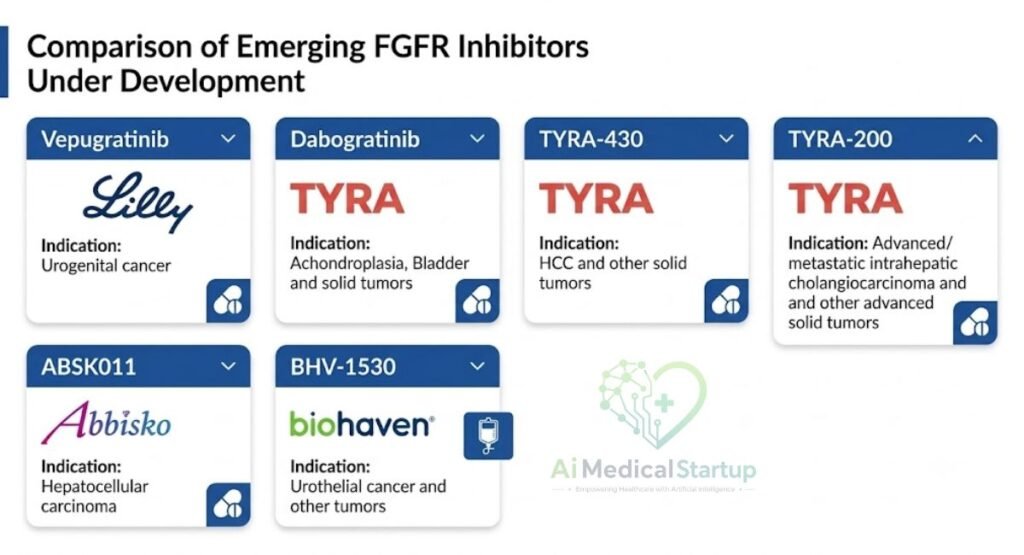
Eli Lilly’s Vepugratinib: Taking FGFR3 Into the Frontline
Vepugratinib, also known as LY3866288 and LOXO-435, is an investigational FGFR3 inhibitor being studied in urinary tract cancers. The FORAGER-1 programme evaluates it in cancers with “FGFR3” changes, while FORAGER-2 investigates its use in a urinary tract cancer treatment setting. Studies of combinations with existing therapies may help determine whether it can improve outcomes, but trial participation is not proof of effectiveness or approval.
“Tyra Biosciences”: A Three-Pronged Precision Portfolio
Using its SNÅP platform to develop targeted candidates, Dabogratinib, formerly known as TYRA-300 in its oncology programme, is an investigational FGFR3 inhibitor. TYRA-200 targets FGFR1, FGFR2 and FGFR3, including selected FGFR2 resistance alterations. TYRA-430 is an investigational FGFR4/3-biased inhibitor studied in FGF19-associated liver cancer and other solid tumors. The studies SURF303, SURF302, SURF201 and SURF431 are associated with different development programmes; their current status should be checked in trial registries.
Abbisko Therapeutics’ ABSK011 and ABSK061
Abbisko Therapeutics has investigated candidates including ABSK011, also called irpagratinib, and ABSK061, also called lavengratinib. These names belong to an investigational drug-development landscape, not a list of standard approved FGFR cancer medicines. Their precise targets, indications, recruitment status and results should be verified from current company disclosures and trial records before making clinical claims.
“Biohaven’s BHV-1530”: Rethinking FGFR3 With an Antibody-Drug Conjugate
Developing BHV-1530, an investigational FGFR3-directed antibody-drug conjugate designed to deliver a Topoisomerase I payload to target-expressing cells. Unlike small-molecule kinase inhibitors, an ADC uses an antibody to deliver a drug payload. Early-stage trials are assessing safety and preliminary activity, including research involving cemiplimab (LIBTAYO). These results remain preliminary and require further clinical evaluation.
How FGFR Alterations Drive Cancer: The Biology Behind the Target
The fibroblast growth factor receptors are receptor tyrosine kinases involved in cell growth, repair and survival. The four main receptors, FGFR1 to FGFR4, have different roles across tissues. When specific FGFR gene mutations, FGFR gene amplification or gene fusions disrupt normal control, the resulting signals can contribute to cancer.
What Are Fibroblast Growth Factor Receptors?
FGFR proteins sit on cell surfaces and respond to fibroblast growth factors. Once activated, they relay signals into the cell. Depending on the tumor, these signals may affect cell division, survival and blood-vessel development. Targeted medicines block selected parts of this process.
FGFR Mutations, Fusions, Amplifications, and Overexpression
FGFR alterations are not all equivalent. A fusion joins part of FGFR to another gene, while a mutation changes the DNA sequence. FGFR gene amplification increases gene copies, and overexpression raises protein levels. Treatment evidence depends on the precise alteration, tumor type and drug studied.
How FGFR Signaling Promotes Tumor Growth
Abnormal FGFR activity can influence RAS–MAPK signaling, PI3K–AKT signaling and PLCγ signaling. These pathways regulate cell growth and survival. Other cancer drivers, including epidermal growth factor receptor (EGFR), ALK and KRAS, affect related networks. Blocking one signal may not stop a tumor if other pathways remain active.
Which Cancers Can Be Treated With FGFR Inhibitors?
The strongest clinical uses of FGFR inhibitors depend on a specific molecular alteration and an authorized indication. Some cancers have established targeted options, while others remain research areas. The presence of an FGFR change alone does not establish that a particular drug will help.
FGFR2-Altered Cholangiocarcinoma
Selected patients with FGFR2 fusion- or rearrangement-positive cholangiocarcinoma may qualify for an approved FGFR inhibitor after previous treatment. These medicines are relevant to certain advanced cases, not every bile duct cancer. Molecular testing is essential before a treatment decision.
FGFR3-Altered Bladder and Urothelial Cancer
Erdafitinib is a targeted option for eligible adults with advanced or metastatic urothelial cancer and susceptible FGFR3 alterations. Researchers are also studying FGFR3-directed medicines in non-muscle-invasive bladder cancer (NMIBC), muscle-invasive bladder cancer and low-grade upper tract urothelial cancer (LG-UTUC). These research settings should not be confused with the drug’s approved indication.
FGFR-Driven Endometrial, Gastric, Breast, and Other Cancers
FGFR alterations also appear in endometrial, gastric, breast and other solid tumors. However, the evidence varies by cancer type and alteration. A patient may need a clinical trial if no approved targeted treatment applies to their diagnosis.
FGFR4 and FGF19-Associated Liver Cancer
The FGF19 protein can activate FGFR4-related signalling in some liver cancers. FGF19 overexpression is being studied as a biomarker in hepatocellular carcinoma. FGFR4-selective inhibitors and dual-target candidates are investigational in this setting; as of the cited pipeline information, no biomarker-selected FGFR4 inhibitor was established as an approved standard for this indication.
Molecular Testing: How Doctors Identify Patients Who May Benefit
Comprehensive molecular testing can identify molecularly defined patient populations who may benefit from a targeted drug or trial. Oncologists often use molecular profiling early enough to inform treatment planning. The right test depends on the cancer, the suspected alteration and the requirements of the medicine being considered.
Next-Generation Sequencing (NGS) and Tumor Genomic Profiling
Next-generation sequencing (NGS) examines multiple genes at once and may identify mutations, fusions or other changes. Some treatment indications require a specific validated test or an FDA-approved diagnostic test. A result should be interpreted alongside pathology, clinical history and the drug’s eligibility criteria.
Tissue Biopsy Versus Liquid Biopsy
A tissue biopsy examines material taken from the tumor. A liquid biopsy looks for tumor-derived DNA in blood. Each method has limitations: tissue can be difficult to obtain, while blood tests may miss alterations when little tumor DNA circulates. A negative liquid biopsy does not always rule out a targetable change.
Companion Diagnostics and Biomarker Eligibility
A companion diagnostic helps identify patients likely to meet a medicine’s molecular eligibility criteria. Doctors should confirm the exact gene change, test method and treatment indication. Testing is particularly important because two alterations in the same gene may not respond to the same drug.
FGFR Inhibitor Resistance: Why Targeted Treatments Can Stop Working
Cancer can evolve under treatment pressure. Some tumors develop acquired resistance mutations in the FGFR2 kinase domain, which reduce a drug’s ability to block its target. Others use alternative growth signals. As a result, an initial response may not last indefinitely.
On-Target Resistance Mutations and Molecular Changes
Resistance can arise when the drug-binding site changes or the cancer develops additional alterations. Some irreversible FGFR inhibitors may retain activity against selected mutations, but no single medicine covers every resistance mechanism. The relevant evidence depends on the specific mutation and drug.
Bypass Signaling and Tumor Heterogeneity
Tumor heterogeneity means that cancer cells within the same person may carry different molecular features. Some cells may also activate alternative pathways, such as RAS–MAPK or PI3K–AKT. These changes can help the tumor survive even when the original FGFR target is blocked.
How Next-Generation FGFR Inhibitors Aim to Overcome Resistance
New compounds are designed to address selected resistance mutations or improve receptor selectivity. Researchers may use repeat biopsies or blood-based profiling to understand why treatment stopped working. These strategies are promising research directions, but clinical benefit must be demonstrated in appropriately designed studies.
Safety, Side Effects, and Monitoring During FGFR-Targeted Therapy
The safety profile depends on the specific drug, dose and patient. Common concerns with several oral FGFR inhibitors include raised phosphate levels, nail changes, dry mouth, diarrhea and mouth inflammation. Patients should report new symptoms promptly and follow their prescribed monitoring schedule.
Hyperphosphatemia and the FGFR1 Connection
Hyperphosphatemia, or high blood phosphate, is a recognised class effect of many FGFR inhibitors. It is linked to disruption of FGFR signalling involved in phosphate regulation, particularly pathways involving FGFR1. Clinicians may use blood tests, dietary guidance, phosphate-lowering treatment or dose changes when appropriate.
Eye Toxicity, Nail Changes, Skin Reactions, and Stomatitis
Eye problems can include retinal pigment epithelial detachment (RPED) or other visual changes. Ocular toxicity, nail disorders, skin reactions and stomatitis may also occur. Patients should report blurred vision, eye discomfort or other new symptoms immediately and attend eye examinations recommended for their medicine.
Dose Modifications and Long-Term Treatment Management
Dose interruptions or reductions can help manage toxicity while treatment continues. Some medicines also carry warnings for soft tissue mineralization and embryo-fetal toxicity. Pregnancy prevention advice may be necessary. Treatment decisions should follow the prescribing information and the oncology team’s assessment, not self-directed dose changes.
How to Evaluate FGFR Inhibitor Clinical Trials
A clinical trial tests whether a medicine is safe and whether it produces meaningful benefits. To interpret clinical trial outcomes, readers should consider the study design, number of participants, previous treatments, biomarker eligibility and duration of follow-up. A promising early result does not necessarily predict success in a larger trial.
Understanding Objective Response Rate and Duration of Response
The objective response rate (ORR) measures the proportion of participants whose tumors shrink by a defined amount. Duration of response (DOR) measures how long that response lasts. Both are useful, but neither alone establishes that a treatment improves survival or quality of life.
Progression-Free Survival and Overall Survival
Progression-free survival (PFS) measures the time until cancer worsens or a patient dies, according to the study definition. Overall survival measures time until death from any cause. These outcomes provide different information and should be interpreted alongside response rates, side effects and study limitations.
Why Phase 1, Phase 2, and Phase 3 Evidence Matter
A dose-escalation study in Phase 1 usually examines safety, tolerability and dosing, including the maximum tolerated dose (MTD) and recommended Phase 2 dose (RP2D) where relevant. Phase 2 studies explore activity in a defined group. Phase 3 trials may compare treatment with standard care and can provide stronger evidence for clinical benefit. A randomized, double-blind, placebo-controlled trial is one possible design, though not every cancer trial uses placebo or blinding. A registrational study is intended to support a regulatory application.
How to Find FGFR Inhibitor Clinical Trials
Patients and clinicians can search ClinicalTrials.gov and the EU’s Clinical Trials Information System. Search by cancer type, FGFR alteration, medicine name, country and recruitment status. A trial team can explain eligibility, travel, costs, alternatives and whether the study includes standard treatment or an investigational drug.
FGFR Inhibitors Versus Other Targeted Cancer Therapies
Targeted cancer therapy focuses on particular molecular features, while chemotherapy acts on dividing cells more broadly. The best approach depends on the tumor’s biology, previous treatment, patient health and available evidence. FGFR-targeted treatment is one part of a larger cancer-care plan.
FGFR Inhibitors Versus EGFR Inhibitors
FGFR and EGFR inhibitors act on different receptor proteins. Although both belong to the receptor tyrosine kinase family, they are not interchangeable. A medicine is selected according to the cancer’s specific molecular drivers and the evidence for that treatment in the relevant disease.
FGFR Inhibitors Versus Immunotherapy
Immune checkpoint inhibitors help the immune system recognise or attack cancer cells. Examples include pembrolizumab and atezolizumab, which target the PD-1 or programmed death-ligand 1 (PD-L1) pathway, respectively. Cemiplimab (LIBTAYO) is another checkpoint inhibitor used in specific cancer settings. These treatments work differently from FGFR inhibitors, and eligibility depends on the diagnosis and clinical circumstances.
FGFR Inhibitors in Combination With Other Cancer Treatments
Researchers are testing combination cancer therapy, including FGFR inhibitors with immunotherapy or other anticancer medicines. In urothelial cancer, treatments such as enfortumab vedotin and pembrolizumab have established roles in specific settings, while combinations involving investigational FGFR3 agents remain under study. Chemoimmunotherapy is another approach used for certain cancers. No combination should be assumed beneficial without suitable clinical evidence.
FAQs About FGFR Inhibitors
FGFR inhibitors block selected fibroblast growth factor receptors that help certain cancers grow. They are used when a patient’s cancer has a relevant molecular alteration and the medicine is approved for that disease. Some other uses remain limited to clinical trials.
Examples include pemigatinib (PEMAZYRE) and futibatinib (LYTGOBI) for eligible FGFR2-altered cholangiocarcinoma, erdafitinib for certain FGFR3-altered advanced urothelial cancers, and lirafugratinib (LYRFIGTU) for eligible previously treated FGFR2-altered cholangiocarcinoma as of September 2026. The exact indication and current label should always be checked.
FGFR2 inhibitors are used in selected cancers with relevant FGFR2 alterations, particularly some bile duct cancers. FGFR3 inhibitors include erdafitinib for eligible urothelial cancer. The receptor, alteration and cancer type determine whether a medicine may be appropriate.
Actionable changes occur in some cholangiocarcinomas and urothelial cancers. FGFR alterations are also investigated in endometrial, gastric, breast and liver cancers. A finding is actionable only when sufficient evidence and an appropriate approved treatment or clinical trial exist.
Doctors may use tumor tissue testing, NGS or selected molecular assays. Blood-based liquid biopsies can sometimes help. The correct test depends on the cancer and the treatment’s requirements. A specialist should interpret the result.
Side effects vary by medicine but can include high phosphate levels, nail problems, diarrhea, mouth inflammation, dry skin and eye problems. Regular laboratory tests and eye monitoring may be required. Patients should follow the specific medicine’s prescribing information.
Yes. Tumors may develop resistance mutations, activate alternative pathways or contain cell populations that respond differently. When a treatment stops working, the oncologist may reassess the disease, consider repeat molecular testing and review other treatments or clinical trials.
Reversible FGFR inhibitors bind their target without permanently attaching to it, while irreversible FGFR inhibitors form a lasting covalent bond with the target protein. The difference can affect drug activity, but it does not by itself establish which medicine will work best for an individual patient.
Some FGFR inhibitors are approved for specific cancers, while candidates such as vepugratinib, dabogratinib, TYRA-200, TYRA-430 and BHV-1530 remain investigational in the cited programmes. Availability depends on the drug, indication, regulatory region and current trial status.
Search ClinicalTrials.gov or the EU Clinical Trials Information System using the cancer diagnosis and FGFR alteration. Ask the oncology team to review eligibility, trial phase, location, potential benefits, known risks and standard-treatment alternatives before deciding whether to enrol.



Dr. Kanza Sarfraz, M.B.B.S., is a medical doctor and graduate of Allama Iqbal Medical College, Lahore. She brings nearly seven years of clinical experience across tertiary-care hospitals, medical headquarters, and healthcare facilities in both the public and private sectors. Her clinical experience provides a practical perspective on healthcare delivery, emerging medical technologies, and the evolving role of artificial intelligence in medicine.