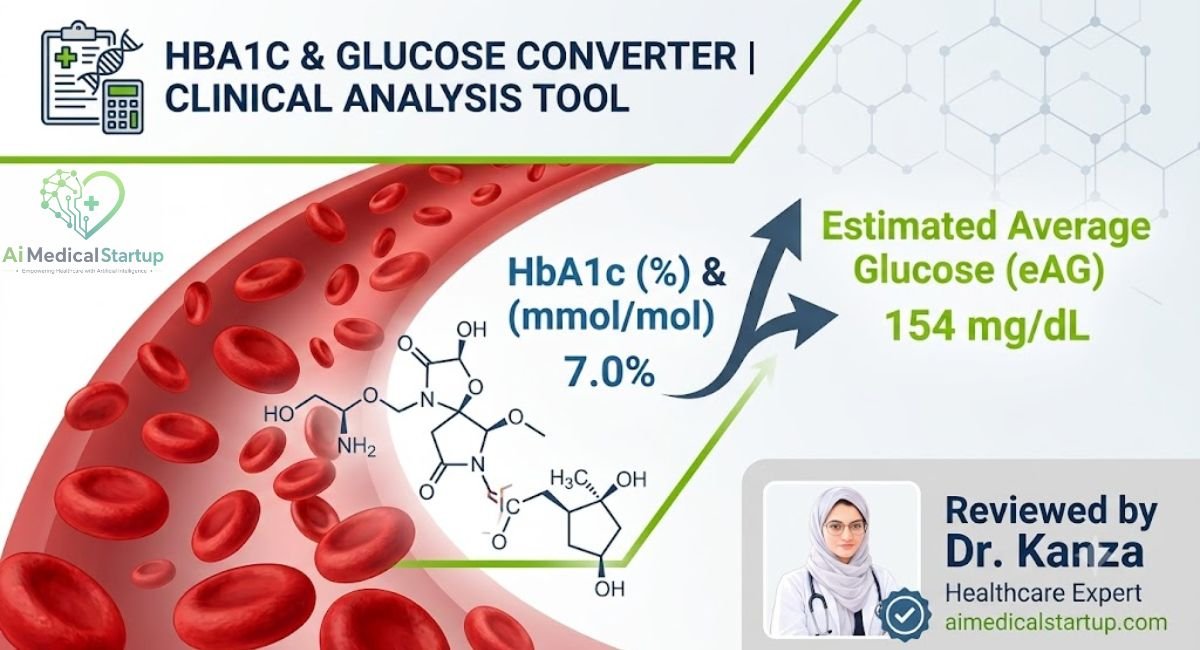
HbA1c & Glucose Converter

HbA1c & Glucose Converter
Convert between HbA1c (%, mmol/mol) and Estimated Average Glucose (eAG)
View HbA1c to eAG Reference Chart
| HbA1c (%) | HbA1c (mmol/mol) | eAG (mg/dL) | eAG (mmol/L) |
|---|---|---|---|
| 5.0 | 31 | 97 | 5.4 |
| 6.0 | 42 | 126 | 7.0 |
| 7.0 (Target) | 53 | 154 | 8.6 |
| 8.0 | 64 | 183 | 10.2 |
| 9.0 | 75 | 212 | 11.8 |
| 10.0 | 86 | 240 | 13.4 |
Medical Disclaimer: Designed & reviewed by Dr. Kanza, Healthcare Expert. This converter uses official American Diabetes Association (ADA) ADAG formulas to calculate estimated average glucose. It is intended for educational purposes and should not replace clinical diagnosis or direct capillary blood glucose monitoring.
Understanding the HbA1c to Glucose Conversion
The HbA1c & Glucose Converter enables patients and clinicians to translate glycated hemoglobin percentages into Estimated Average Glucose (eAG) values.
Finger-Prick & CGMs
Reflect real-time blood sugar variations at a single point in time.
HbA1c Test
Measures the percentage of hemoglobin proteins coated with sugar over the 2- to 3-month lifespan of red blood cells.
Mathematical & Clinical Formulas
This calculator employs the standard A1C-Derived Average Glucose (ADAG) trial equations to convert values between HbA1c, eAG, and international units:
HbA1c (%) to eAG (mg/dL)
eAG (mg/dL) = (28.7 × HbA1c) − 46.7
eAG Conversion (mg/dL to mmol/L)
eAG (mmol/L) = eAG (mg/dL) ÷ 18.0155
NGSP (%) to IFCC (mmol/mol) Standard Conversion
HbA1c (mmol/mol) = (HbA1c % − 2.15) × 10.929
Glucose to HbA1c Calculation
HbA1c (%) = (eAG (mg/dL) + 46.7) ÷ 28.7
ADA Diagnostic Thresholds
Frequently Asked Questions
Find clinical answers regarding blood glucose tracking, eAG calculations, and diagnostic units.
Daily blood glucose readings from finger-prick meters or CGMs capture exact glucose levels at a specific moment in time. Estimated Average Glucose (eAG) reflects your overall average blood sugar trends over the past 60 to 90 days, derived directly from your laboratory HbA1c test score.
Your Continuous Glucose Monitor (CGM) measures interstitial fluid glucose rather than venous blood glucose. Additionally, red blood cell turnover rate, hemoglobin variants, or underlying conditions like anemia can create slight discrepancies between your CGM average and your HbA1c-derived eAG score.
According to ADA guidelines, a standard target for non-pregnant adults with diabetes is an HbA1c of < 7.0% (an eAG of roughly 154 mg/dL or 8.6 mmol/L). However, individual targets should always be personalized in consultation with your primary physician.
NGSP (%) is the standard unit used in the United States and Canada, while IFCC (mmol/mol) is the international standard used across the UK, Europe, Australia, and many global laboratories. This calculator automatically converts between both formats.
Designed & Reviewed by Clinical Experts
Designed and reviewed by Dr. Kanza, Healthcare Expert, this tool streamlines glycemic analysis using clinical equations established by the American Diabetes Association (ADA).


Dr. Kanza Sarfraz, M.B.B.S., is a medical doctor and graduate of Allama Iqbal Medical College, Lahore. She brings nearly seven years of clinical experience across tertiary-care hospitals, medical headquarters, and healthcare facilities in both the public and private sectors. Her clinical experience provides a practical perspective on healthcare delivery, emerging medical technologies, and the evolving role of artificial intelligence in medicine.