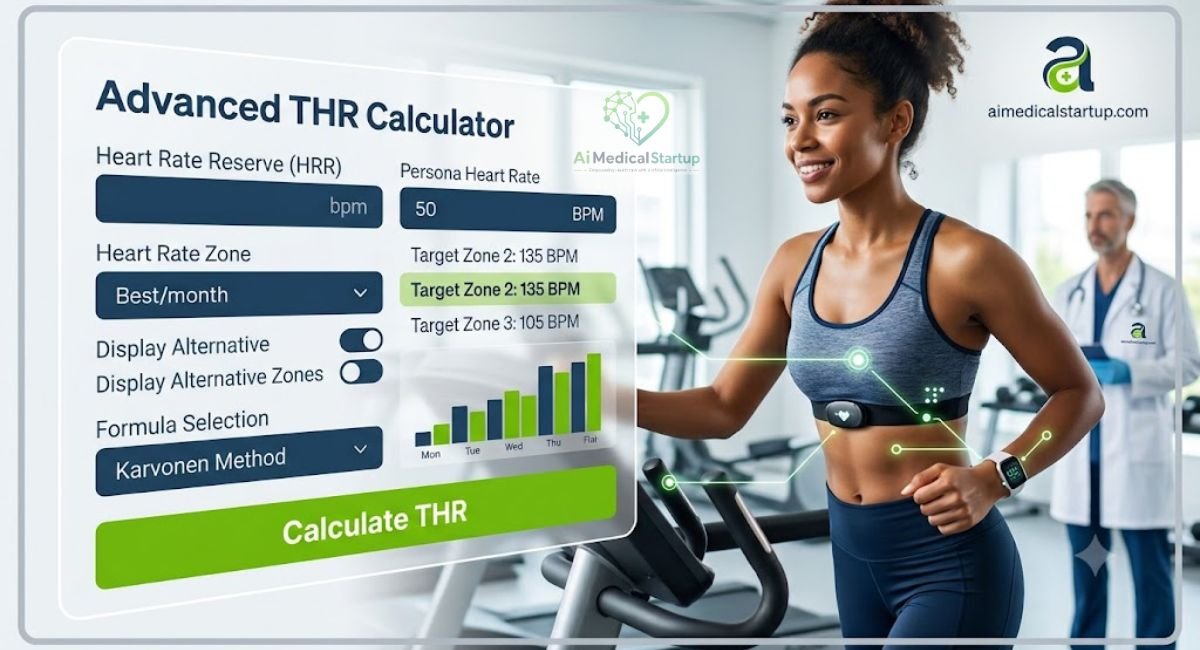
THR Calculator

Target Heart Rate (THR) Calculator
THR Calculator allows athletes, fitness enthusiasts, and cardiac patients to optimize cardiovascular exercise intensity based on individual physiologic baselines.
THR Calculator
Calculate exercise & aerobic intensity zones using the Karvonen formula
Promotes tissue repair, active recovery, and warm-up/cool-down.
Builds aerobic base, mitochondrial density, and fat oxidation.
Improves cardiovascular efficiency, capillary density, and stamina.
Increases high-intensity speed endurance and lactate threshold.
Short interval bursts; maximal anaerobic power ($VO_2$ max).
Medical Disclaimer: Designed & reviewed by Dr. Kanza, Healthcare Expert. Target heart rate calculations serve as fitness guidelines. Individuals with cardiovascular conditions or those taking heart rate-modulating medications (such as beta-blockers) must consult their cardiologist for personal workout targets.
How the Target Heart Rate (THR) Calculator Works
The Target Heart Rate (THR) Calculator allows athletes, fitness enthusiasts, and cardiac patients to optimize cardiovascular exercise intensity based on individual physiologic baselines. Training at specific heart rate percentages ensures workouts remain within desired physiological energy systems, ranging from low-intensity aerobic base building to high-intensity anaerobic threshold work.
Physiologic Baselines
Calculates target zones using individual baseline metrics for maximum precision.
Energy Systems
Targets exact metabolic pathways from aerobic base building to anaerobic threshold work.
Optimized Intensity
Ensures safe, efficient exercise tailored for performance or cardiac rehabilitation.
Mathematical Formulas Implemented
Maximum Heart Rate (HRmax) Calculations
While the traditional Fox formula (220 − Age) is widely known, this calculator defaults to the Tanaka formula due to its higher accuracy across adult age groups:
HRmax = 208 - (0.7 × Age)
HRmax = 207 - (0.7 × Age)
HRmax = 220 - Age
Heart Rate Reserve (HRR)
Heart Rate Reserve represents the difference between maximum heart rate and resting heart rate (HRrest), reflecting total functional cardiac range:
HRR = HRmax - HRrest
Karvonen Target Heart Rate Equation
By factoring in resting heart rate, the Karvonen method customizes heart rate zones according to individual aerobic fitness levels:
Target Heart Rate (BPM) = (HRR × Intensity %) + HRrest
Frequently Asked Questions
Age-only formulas (220 − Age) assume everyone of the same age has identical exercise heart rate ranges. The Karvonen formula incorporates your personal Resting Heart Rate (HRrest). Because cardiovascular training lowers resting heart rate over time, the Karvonen formula dynamically adapts your target heart rate zones as your athletic fitness improves.
For maximum precision, measure your heart rate immediately upon waking in the morning while still lying in bed. Count your radial or carotid pulse for 60 seconds (or use an accurate chest-strap monitor) over 3 consecutive mornings, and use the average value.
Zone 2 (60% to 70% of HRR) is optimal for fat oxidation and aerobic base building. At this lower intensity, your body primarily metabolizes lipids (fats) rather than carbohydrates for energy, while strengthening mitochondrial capacity without causing excessive central nervous system fatigue.
Cardiovascular medications such as beta-blockers lower both resting and peak maximum heart rate. If you take heart rate-modulating therapy, standard age-based calculations will overestimate your target heart rates. Always obtain tailored target exercise ranges directly from your physician or cardiologist.
Medical Review & Expertise
Designed and reviewed by Dr. Kanza , Healthcare Expert, this calculator integrates both traditional age-predicted protocols and the advanced Karvonen formula for accurate exercise prescription.



Dr. Kanza Sarfraz, M.B.B.S., is a medical doctor and graduate of Allama Iqbal Medical College, Lahore. She brings nearly seven years of clinical experience across tertiary-care hospitals, medical headquarters, and healthcare facilities in both the public and private sectors. Her clinical experience provides a practical perspective on healthcare delivery, emerging medical technologies, and the evolving role of artificial intelligence in medicine.