Alcohol Unit & Calorie Calculator Guide: Formulas & UK Guidelines

Alcohol Unit & Calorie Calculator Guide: Formulas & UK Guidelines
Easily estimate pure alcohol grams, convert volume and ABV into standard UK units, calculate energy from alcohol calories, and track your intake against the official 14-unit weekly health threshold.
Alcohol Unit & Calorie Calculator
Accurately calculate UK alcohol units, estimate alcohol calories, and track your weekly intake against health guidelines.
1. Add a Drink
Automatic estimates use alcohol energy density (~7 kcal/g). Total beverage calories may be higher if sugar/mixers are present.
Drink
2. Current Session
3. Weekly Tracker
Understanding the Alcohol Unit & Calorie Calculator
It can be surprisingly difficult to tell how much alcohol you are actually drinking. A pint, glass, bottle, or cocktail can contain very different amounts of alcohol depending on its serving size and alcohol by volume (ABV).
1. What Is a UK Alcohol Unit & ABV?
The Alcohol Unit & Calorie Calculator helps you estimate the amount of pure alcohol in a drink, convert it into UK alcohol units, estimate calories supplied by alcohol, and keep a simple record of your intake across the week.
What Is a UK Alcohol Unit?
A UK alcohol unit is a standard way of expressing the quantity of pure alcohol in a drink. One UK unit contains approximately 10 ml or 8 g of pure alcohol (NHS).
The number of units in a drink depends mainly on two things: the amount you drink and the drink’s ABV. That means a large glass of a lower-strength drink can contain fewer units than a smaller serving of a stronger drink. Size alone does not tell you how much alcohol you have consumed.
What Does ABV Mean?
ABV stands for alcohol by volume. It tells you what percentage of the liquid is pure alcohol by volume.
For example, a drink labelled 5% ABV contains alcohol equal to 5% of its total volume. You will normally find the ABV printed on a bottle, can, or other alcoholic drink packaging.
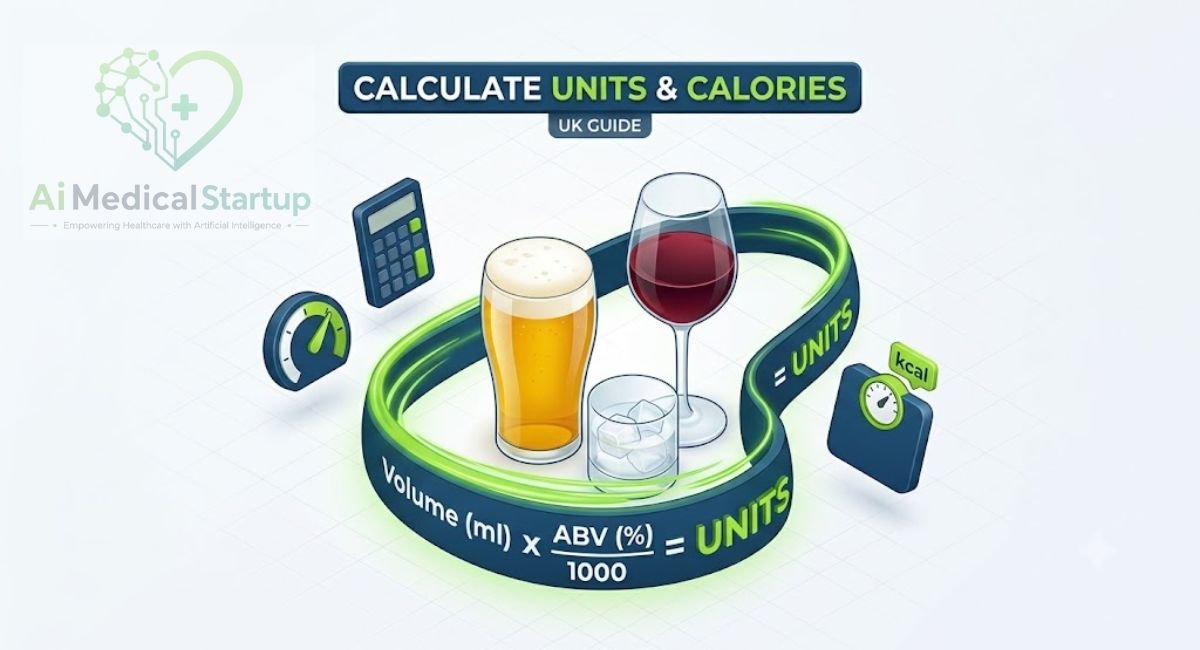
2. How Alcohol Units & Grams Are Calculated
The calculator applies standardized mathematical equations used by public health bodies like the NHS to establish exact alcohol metrics.
Real-World Calculation Examples
568 ml × 5 ÷ 1,000 = 2.84 UK Units
Contains approximately 2.84 units of pure alcohol.
175 ml × 13 ÷ 1,000 = 2.28 UK Units
A standard 175 ml glass yields approximately 2.28 units.
25 ml × 40 ÷ 1,000 = 1.00 UK Unit
Demonstrates why small high-strength pours match larger low-strength drinks (NHS).
What Does “Pure Alcohol” Mean?
The calculator also estimates the amount of pure alcohol in grams. Because one UK unit contains approximately 8 g of pure alcohol, the calculator uses:
For example: 2.84 units × 8 = 22.7 g of pure alcohol. This number describes the alcohol itself rather than the total weight or volume of the liquid.
3. Estimating Alcohol Calories vs. Total Calories
Alcohol provides approximately 7 kcal per gram (NHS). Using the estimated amount of pure alcohol, the calculator determines alcohol energy as follows:
This distinction matters. The calculator’s automatic calorie estimate represents the energy supplied by alcohol itself. It does not necessarily represent the complete calorie content of the drink.
Beer, cider, wine, cocktails, liqueurs, mixers, fruit juices, syrups, sugar, and other ingredients can contribute additional calories (NHS).
When you know the actual calorie value from a product label or reliable nutrition information, you can enter the calories per 100 ml or the total calories for the drink. The calculator will then use the value you provide rather than estimating calories from alcohol alone.
4. The 14-Unit Weekly Reference & Tracker
What Is the 14-Unit Weekly Reference?
UK health guidance advises adults who drink regularly to not regularly drink more than 14 units of alcohol per week. If you regularly drink as much as 14 units, the guidance recommends spreading this intake over 3 or more days rather than consuming it all at once (NHS).
Fourteen units is a low-risk reference level, not a target and not a completely safe amount of alcohol. The NHS states that there is no completely safe level of drinking and that, generally, the less alcohol you drink, the lower your health risks (NHS).
The weekly tracker therefore uses 14 units as a reference point to help you understand your recorded intake. It should not be interpreted as an amount you should aim to consume.
How the Weekly Tracker Works
The weekly tracker lets you save completed drinking sessions and see how your recorded intake adds up from Monday through Sunday. When you save a session, the calculator records:
- Total UK Units: The combined alcohol units from all drinks in that session.
- Estimated Alcohol Calories: The combined calories calculated or manually entered for those drinks.
- Drinking Days: The number of days during the current week on which you have saved alcohol intake.
The visual chart gives you an overview of your intake across the week, making it easier to spot patterns that may be difficult to notice when looking at individual drinks. All tracking data is stored locally in your browser rather than being sent to external servers.
5. Serving Sizes, Cocktails & Low-Alcohol Drinks
Why Drink Size and Strength Both Matter
One of the easiest mistakes when estimating alcohol intake is to focus only on the type of drink. A bottle of beer is not automatically equivalent to another bottle of beer. A 330 ml beer at 4% ABV contains a different amount of alcohol from a 500 ml beer at 6% ABV.
The calculator accounts for both factors. Increasing the serving size while keeping the same ABV increases the units. Increasing the ABV while keeping the same serving size also increases the units. Checking the actual volume and ABV on the label provides a much more accurate result than relying on a generic drink category.
What About Low- or No-Alcohol Drinks?
Low- and no-alcohol products are not necessarily identical. Some products contain very little or no alcohol (0.0%–0.05%), while others can contain up to 0.5% ABV or more.
For the most accurate result, enter the drink’s actual volume and ABV shown on the label rather than assuming every low- or no-alcohol product contains zero alcohol.
What About Cocktails?
Cocktails can be particularly difficult to estimate because their total alcohol content depends on spirits, liqueurs, wine, mixers, serving size, and specific recipes.
A cocktail’s finished volume does not automatically tell you how much alcohol it contains. Whenever possible, use the actual alcohol content or recipe information. When neither is known, the calculated result should be treated as an approximation rather than an exact measurement.
6. Calculator Accuracy & Practical Example
How Accurate Is the Calculator?
The UK unit calculation is mathematically exact, provided that the volume and ABV entered are accurate. However, real-world estimates vary because:
- Serving sizes and home pours are often difficult to measure precisely.
- ABV varies between products, craft batches, and brands.
- Cocktails contain multiple spirits of differing strengths.
- Calorie content varies based on residual sugars and carbohydrates.
For best results, use the actual serving size, actual ABV, and nutrition information shown on product packaging.
A Simple Example: 500 ml Beer @ 5% ABV
| 1. Volume & ABV | 500 ml bottle at 5.0% ABV |
| 2. Unit Calculation | 500 × 5 ÷ 1,000 = 2.50 Units |
| 3. Pure Alcohol (g) | 2.50 × 8 = 20.0 g |
| 4. Alcohol Calories | 20.0 g × 7 kcal = ~140 kcal |
Note: Actual calorie content may be higher if carbohydrates or sugars are present.
7. Why Track & When to Seek Professional Advice
Why Tracking Alcohol Can Be Useful
Keeping track of alcohol is not about turning every drink into a complicated calculation. The main benefit is awareness.
When you record serving sizes, ABV, units, and drinking days, you can see how individual choices add up across several days. What feels like “just a couple of drinks” on one evening can become a much larger weekly total when repeated regularly. A simple record helps you understand your drinking pattern and make informed health decisions.
When to Seek Professional Medical Advice
This calculator is designed as an educational tracking tool and is not a diagnostic instrument. It does not determine whether a particular amount of alcohol is safe for you or replace advice from a qualified healthcare professional.
Consider speaking with a doctor or healthcare professional if you are concerned about your alcohol use, regularly drink more than you intend, experience withdrawal symptoms when you stop drinking, or find it difficult to cut down.
Alcohol advice can vary for specific medical conditions, medications, pregnancy, age, or personal health circumstances. For personalized guidance, speak with your doctor or a specialist healthcare provider.
Frequently Asked Questions
Find quick answers about UK alcohol units, calorie calculations, weekly limits, and tracking privacy.
How many UK units are in a drink?
It depends on the drink’s volume and ABV. Use the formula volume in ml × ABV ÷ 1,000 to calculate the approximate number of UK units.
How many units are in a pint of beer?
It varies according to the beer’s strength. For example, a 568 ml pint at 5.2% ABV contains about 2.95 units.
How many calories are in one unit of alcohol?
One UK unit contains approximately 8 g of pure alcohol, and alcohol provides around 7 kcal per gram, giving roughly 56 kcal from alcohol per unit. Actual drink calories can be higher.
Is 14 units a safe amount of alcohol?
No. The UK’s 14-unit figure is a low-risk reference level, not a completely safe amount. The NHS states that there is no completely safe level of drinking and that lower alcohol consumption generally means lower health risks.
Does the calculator store my drinking information online?
No. The calculator is designed to store tracking information locally in your browser. Clearing the calculator’s saved data or browser storage will remove the stored tracking information.
Can I use this calculator for cocktails?
Yes, but cocktail results may be less precise because recipes and alcohol quantities vary considerably. Use the actual volume and ABV when you know them.
Does the calorie result represent the complete calories in my drink?
Not always. When you choose the automatic estimate, the calculator estimates calories supplied by alcohol. Sugars, carbohydrates, mixers, and other ingredients may add further calories.
No matching questions found for ““.

Registered & Licensed Dietitian Nutritionist AHPC | Public Health Nutrition • Gut Care & Fitness | Member: PNDS, SIGNS International, The Nutrition Society (UK), PEN®