How to Build an AI-Ready Healthcare App: A Step-by-Step Guide

The rise of artificial intelligence has opened up new avenues for healthcare application development including patient engagement, automated clinical documents, predictive analytics, and customized treatment plans. However, integrating AI and machine learning tools into existing healthcare applications is not just about connecting the trained model to the application.
Healthcare organizations need to have a strong data infrastructure, secure integration, architecture that supports scaling, and reliable clinical data protection before implementing the intelligent functionalities.
This guide describes how to create a healthcare application that is ready for AI implementation and what state-of-the-art technical solutions, stages of development, and implementation strategies should be used.
What Qualifies a Healthcare App as AI-Ready?
A healthcare application can be considered AI-ready if it has been built to incorporate artificial intelligence features without needing a complete overhaul of its infrastructure.
In contrast to conventional healthcare software that generally acts as a repository for patient data, ai-ready apps have to not only provide automated processing capabilities but have also to provide support for working with the structured data, integrating models, continuous monitoring, and adapting to changing laws and regulations.
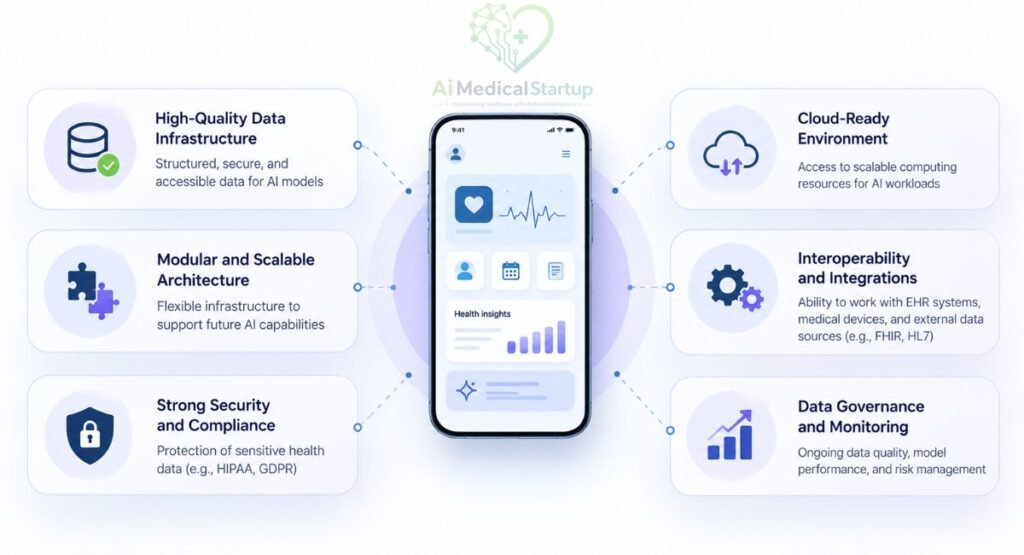
Essential Features of AI-Compatible Healthcare Software
Healthcare software equipped for the future must integrate robust technical foundations to seamlessly support advanced AI diagnostics, machine learning models, and clinical workflows.
Organized Data Administration
Reliable, correct, and obtainable medical information structured specifically for deep analysis and real-time processing by clinical artificial intelligence algorithms.
Interconnectivity & EHR Integration
Seamless capacity to connect securely with electronic health records (EHR), laboratory programs, and legacy medical systems.
Scalable Architecture Design
High-performance infrastructure engineered to process exponentially growing datasets and intensive computational workloads without latency.
Security and Regulatory Compliance
Advanced cryptographic and access-control instruments designed for safeguarding confidential patient health information under HIPAA and medical standards.
Modularity of AI Introduction
Flexible architecture allowing dynamic deployment and swapping of machine learning models and AI systems without interrupting core administrative or clinical business processes.
Getting these core abilities established at the initial stage of developing a healthcare solution enables fast, frictionless implementation of artificial intelligence capabilities in subsequent development phases.
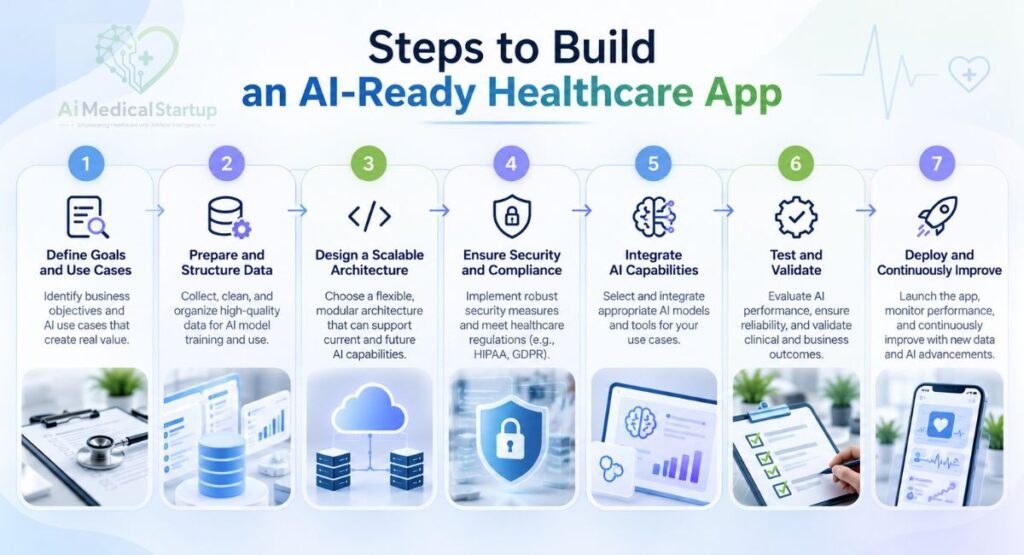
Steps to Create an Artificial Intelligence-Ready Application in Healthcare
Developing an AI-ready healthcare application requires careful multidisciplinary planning across data engineering, software development, cybersecurity, and clinical workflows. Collaborating with an experienced AI-assisted development partner can help healthcare organizations streamline development and ensure full readiness for future AI integration.
The following seven steps guide organizations in building a secure, scalable application ready for both present and future functionalities.
Define Business Goals and AI Use Cases
Focus initially on the specific healthcare problems your solution must solve. AI capabilities must deliver a measurable impact on clinical goals and business objectives rather than serving as mere technological novelties.
- Automated clinical documentation and medical transcription.
- Timeline setting and administrative assistance for patients.
- Predictive analytics for operational management.
- Remote patient monitoring and anomaly detection.
- Clinical decision-making support processes.
Example: Prioritize document automation to reduce administrative workload before tackling complex diagnostic algorithms.
Create a Scalable Application Architecture
Future-proof healthcare software requires an extensible architecture that supports continuous updates, third-party integrations, and expanding computational workloads.
- Front End: Patient portals, clinician dashboards, and mobile interfaces.
- Back End: Core business logic, patient administration, scheduling, and identification.
- Data Layer: Secure data storage, information organization, and validation pipelines.
- Integration Layer: APIs linking EHR systems to laboratories and medical devices.
- AI Services Layer: Model prediction processing, monitoring, and advanced capabilities.
Separating AI features from clinical workflows ensures models can be updated safely without endangering core services.
Build a Dependable Healthcare Data Framework
The efficiency of AI models relies directly on data quality, homogeneity, and correctness. Healthcare data flows from diverse sources, including EHR platforms, wearables, and lab results.
Data standardization, record validation, duplicate elimination, and missing value management are vital to establishing data provenance. Robust data governance defines data access rights, retention periods, and permissions for AI training.
Enable Interoperability With Healthcare Systems
Modern healthcare applications must exchange data securely across hospitals, laboratories, and insurance networks. Utilizing standardized protocols ensures seamless communication.
- HL7 FHIR (Fast Healthcare Interoperability Resources) for standardized data exchange.
- Modern APIs providing secure access to patient records, appointments, and medication histories.
- Legacy HL7 solution compatibility for older hospital infrastructure.
Build Security and Compliance Into the Architecture
Because healthcare apps handle sensitive health records, security must be embedded throughout development. Compliance with HIPAA in the United States and GDPR in Europe is mandatory.
- End-to-end data encryption in transit and at rest.
- Role-based access control and strict authentication mechanisms.
- Comprehensive audit trails for confidential information.
- Secure API connections and monitoring.
- Robust backup and disaster recovery plans.
Prepare the Application for AI Model Integration
Once infrastructure and data frameworks are complete, developers can integrate machine learning and generative AI models using modular services.
Organizations must evaluate model accuracy, explainability, latency, and operating costs. Utilizing RAG (Retrieval-Augmented Generation) connects language models to trusted organizational knowledge bases while maintaining human review and escalation protocols for clinical workflows.
Test, Deploy, and Continuously Monitor
Testing AI-enabled healthcare applications extends beyond standard feature verification. Prior to launch, development teams must perform rigorous evaluations:
- Functional and integration testing.
- Penetration testing for cybersecurity resilience.
- Scientific evaluation and clinical validation where applicable.
- Rigorous bias testing and mitigation checks.
Post-launch continuous monitoring is essential for identifying system malfunctions, drift, or anomalies caused by deployed AI solutions.
Looking for an expert AI-assisted development partner to guide your healthcare project? Connect with our Healthcare AI specialists today.
Final Thoughts
Creating a healthcare application that incorporates advanced artificial intelligence involves more than simply executing complex algorithms. You need to have high-quality infrastructure, efficient data management, collaboration between systems, effective cybersecurity, and ethical policies related to artificial intelligence.
Because of this, health organizations need to first create a robust infrastructure and outline a clear list of use cases before they start working with highly complicated algorithms. Thus, it will be easier to implement smart capabilities but keep operational effectiveness and safety of patients in line.
The right technical strategy and experience allow the development of an adaptive digital platform used in changing conditions of the healthcare environment and new innovations.


Yuliya Melnik is a technical marketing writer at Cleveroad with 7+ years of experience creating engaging, research-driven content on software development, AI, cloud computing, and digital transformation. She specializes in turning complex technical concepts into clear, accessible insights for business and technology audiences, focusing on emerging technologies, enterprise software, and IT modernization trends.