AI Dermatologist Explained: Accuracy & Limits – 2026 Guide

Quick answer
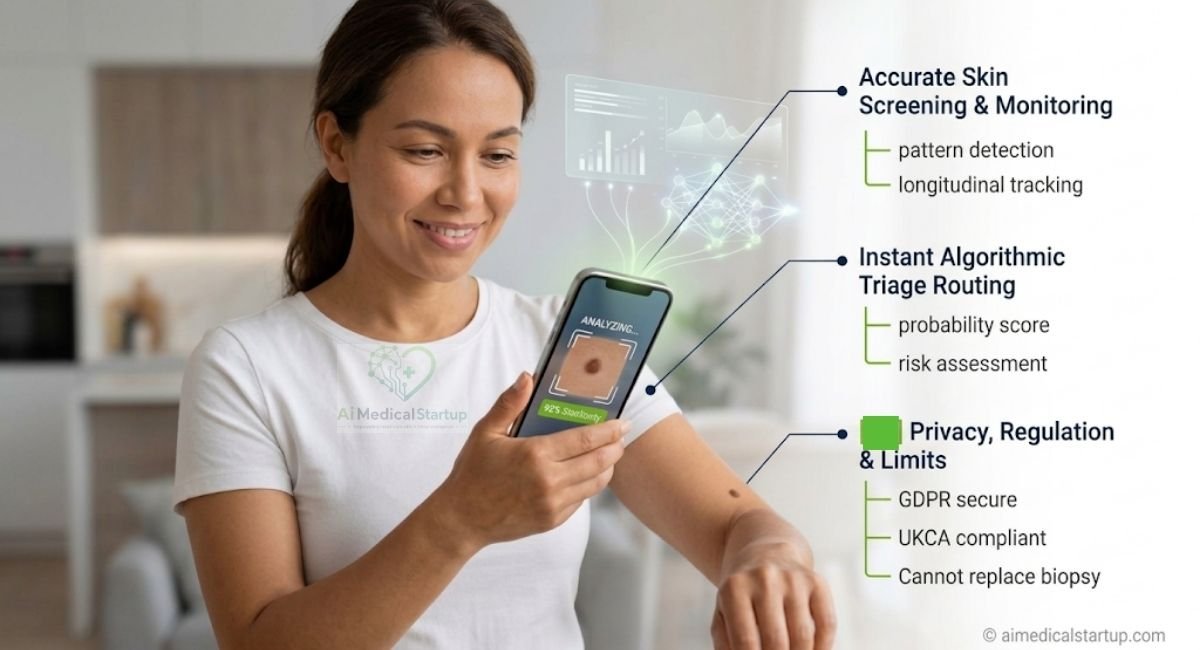
An AI dermatologist is a smartphone-based tool that screens visible skin concerns using image recognition models trained on massive dermatology photo datasets. You snap a picture of a spot or rash, and the software flags visual patterns for skin screening and monitoring rather than delivering a medical diagnosis. It helps you decide whether to watch a spot at home or book a doctor, reflecting broader advancements in AI in Healthcare.
Key takeaways
Modern AI skin analysis tools achieve 88% to 95% sensitivity for melanoma detection in controlled studies, yet they never replace dermoscopy or a biopsy. Your image quality (lighting, focus, framing) directly shapes the algorithmic screening result. Use these apps for fast triage routing between appointments, and always see an in-person dermatologist for rapidly changing or worrying symptoms—especially given the Risks of AI in Healthcare.
What is an AI dermatologist?
Think of an AI dermatologist as a smart first-aid mirror on your phone rather than a licensed physician. It is software that scans pixels to spot patterns linked to common skin conditions across the US, UK and EU. Because it lacks a medical license, it cannot legally diagnose disease or write prescriptions, a foundational concept explored in our guide on AI in Healthcare.
Under the hood, most platforms rely on three connected engines to process your photo safely. A computer-vision model—often a convolutional neural network (CNN) or a vision transformer—analyzes the visual texture of your skin. Before that happens, a quality-control layer filters out blurry shots, while a triage layer translates raw math into plain-language guidance. Clinicians also leverage tools like AI for Doctors to augment workflow efficiency.
AI dermatologist vs human dermatologist vs tele dermatology
Choosing the right skin check depends on your budget, your timeline and how worried you feel. In the US, specialist copays can be steep, while UK and EU patients often face months-long NHS or public waitlists. An AI dermatologist gives you instant feedback for free or a low fee, whereas teledermatology connects you with a human specialist via asynchronous photo review within 24 to 72 hours.
| Feature | AI Dermatologist | Teledermatology | In-Person Dermatologist |
|---|---|---|---|
| Speed | Instant (under 30 seconds) | 24 to 72 hours | Weeks to months |
| Cost | Free or low-cost subscription | Moderate consultation fee | High (or covered by insurance/NHS) |
| Diagnostic Power | Screening and triage only | Clinical opinion and prescriptions | Gold standard (dermoscopy and biopsy) |
| Best Use Case | Monitoring pigmented spots | Non-urgent rashes or acne | Any urgent or changing lesion |
How does AI skin analysis work?
You start by taking a sharp, well-lit photo of your skin concern with your phone camera. The software compares your image against thousands of labeled examples to generate a probability distribution across supported conditions. Instead of handing you a final verdict, it gives you context and dated photo tracking so you can monitor changes over time—a workflow made possible by modern architecture explained in how to build an AI-ready healthcare app.
“AI skin tools act like a smoke detector for your skin—they alert you when something looks off so a human doctor can investigate.”
Step 1 — Image quality check
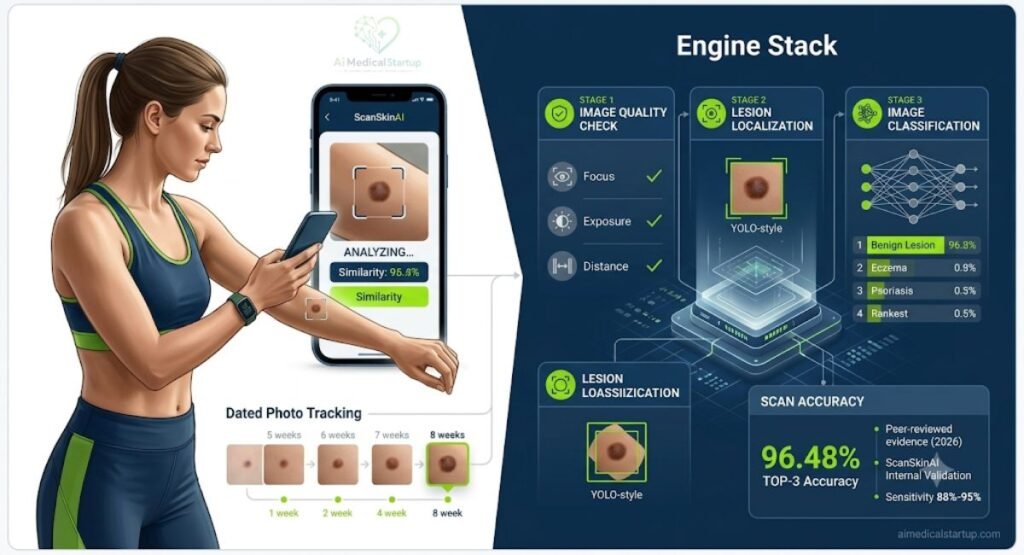
Before any analysis begins, a lightweight model measures Laplacian variance to check focus, exposure and camera distance. If your hand shook or the room was too dark, the app asks you to retake the shot. This simple gatekeeper prevents most errors caused by poor photography rather than flawed software.
Step 2 — Lesion localization
Next, a YOLO-style object detector scans the frame to perform lesion localisation. It draws a tight boundary around the mole or rash so the system ignores surrounding hair, clothing or background clutter. Focusing strictly on the target area keeps the math clean and accurate.
Step 3 — Classification
Once cropped, the image moves into image classification to score visual similarities against known conditions, using computer-vision principles similar to the best AI tools in radiology. The model evaluates patterns for benign lesions, eczema, psoriasis, acne, fungal infection and sun damage. It outputs a ranked list of possibilities rather than a single rigid label.
Step 4 — Triage and explanation
Finally, the triage layer converts those raw percentages into clear next steps and red-flag warnings. You might see advice to monitor the spot at home, book a GP within four weeks or seek urgent care. This same engine powers both a mole checker and a rash checker.
What can users check with ScanSkinAI?
You can use ScanSkinAI to screen pigmented spots for ABCDE warning signs like asymmetry, irregular borders or shifting colors. It also evaluates everyday flare-ups including eczema, psoriasis, acne and fungal infection. Having a structured visual log helps you spot subtle changes you might otherwise miss in the mirror.
For example, consider a 34-year-old outdoor runner in Manchester who noticed a new spot on her shoulder. She used dated photo tracking over eight weeks and noticed the border expanding slightly. Bringing those timestamped photos to her GP helped speed up her referral for a proper clinical examination.
How accurate is AI skin analysis?
Understanding screening metrics vs. diagnostic accuracy is the secret to using these tools wisely. Researchers measure sensitivity and specificity to see how well an app catches dangerous spots without triggering too many false alarms. High sensitivity means the tool rarely misses a real threat, while high specificity means it correctly clears harmless benign lesions.
Real-world accuracy always depends on the photo you upload at home. A studio-quality clinical image yields much higher precision than a dim bathroom selfie. Therefore, you should treat every algorithmic screening result as a helpful clue rather than an absolute truth.
The published evidence
Peer-reviewed studies in 2026 show that top AI skin analysis models reach 88% to 95% sensitivity for melanoma detection in standardized datasets. That performance rivals general practitioners, though specificity usually trails by a few percentage points.
ScanSkinAI internal validation
In tests against held-out dermatology image sets, ScanSkinAI achieved 96.48% top-3 accuracy across supported conditions. It also reached 95.3% concordance with dermatologist labels on triage routing, proving it reliably guides users toward the right level of care.
What that means in practice
Use high accuracy numbers to decide when to book a doctor, never to cancel an appointment you already need.
Who should use an AI dermatologist?
Anyone facing long specialist waitlists in the UK, EU or rural US benefits from a fast, objective second opinion between visits.
What it cannot do
Software cannot perform dermoscopy, take a biopsy or feel a lump, and it struggles with lookalikes such as amelanotic melanoma versus pink papules or cellulitis versus contact dermatitis.
Privacy, security and regulation
ScanSkinAI protects your uploads under strict GDPR / UK-GDPR privacy rules, keeping every photo encrypted in transit and at rest. The platform follows medical device regulation (UKCA Class I, ISO 13485) standards, aligning with 2026 EU MDR and US FDA transparency guidelines detailed in our guide on Rules for Healthcare AI.
Common myths about AI dermatologists
Many people assume an AI dermatologist will replace human doctors or that a low-risk score means you can ignore a changing mole. In reality, false negatives happen—a critical safety parameter analyzed under Risks of AI in Healthcare—and while modern tools train on diverse Fitzpatrick skin types, darker skin tones still benefit from a human check.
How individuals can use ScanSkinAI
Snap a clear photo of a mole or rash, review the ABCDE warning signs breakdown and save dated images to share at your next clinic visit.
How ScanSkinAI works
Follow a simple three-step loop: scan your skin in natural light, track changes over weeks and review the plain-language guidance to plan your next move.
Who is this useful for?
Parents checking sudden childhood rashes, outdoor workers monitoring sun damage and frequent travelers between check-ups all gain peace of mind from quick screening.
When should you seek professional advice?
Book an in-person dermatologist immediately if you notice bleeding, oozing, a non-healing sore, a fever alongside a rash or a mole changing in size or color.
What AI skin analysis cannot do
It cannot diagnose cancer, prescribe creams or replace a hands-on clinical examination, so always trust your instincts if a spot feels wrong.
Frequently asked questions
First-time users often wonder how automated skin tools fit into real medical care. These quick answers clear up the most common questions about safety, cost and photo habits, aligning with our principles on AI medical ethics.
Combining fast AI skin analysis with human clinical judgment gives you the safest path forward. Read through the details below before running your first scan.
It is a smartphone-based tool that uses image recognition models to screen visible skin concerns from photos and suggest whether you should see a doctor.
Published studies show 88% to 95% sensitivity for melanoma detection, though your home image quality (lighting, focus, framing) heavily influences the final output.
No, because it is strictly a screening and triage routing tool that cannot perform dermoscopy, take a biopsy or prescribe medication.
Yes, as long as you treat it as a second opinion and never use a low-risk score to ignore a worrying or fast-changing spot.
Modern models train on diverse Fitzpatrick skin types, yet 2026 studies show slightly lower sensitivity on darker skin, making clinician review extra important.
Yes, your images remain encrypted in transit and at rest under GDPR / UK-GDPR privacy laws and are never sold to third parties.
Save your dated photo, stay calm and book a GP or in-person dermatologist within four weeks so a specialist can examine it properly.
Yes, basic mole checker and rash checker scans are free, with optional paid plans available for long-term dated photo tracking.
An AI dermatologist gives an instant algorithmic result, whereas teledermatology connects you with a licensed human doctor for paid asynchronous photo review.
Yes, you can screen visible marks on children, but always follow up with a pediatrician or GP because kids’ rashes evolve rapidly.
Take a sharp close-up in bright natural daylight from 15 to 20 cm away, keeping the camera parallel to your skin without flash glare or filters.

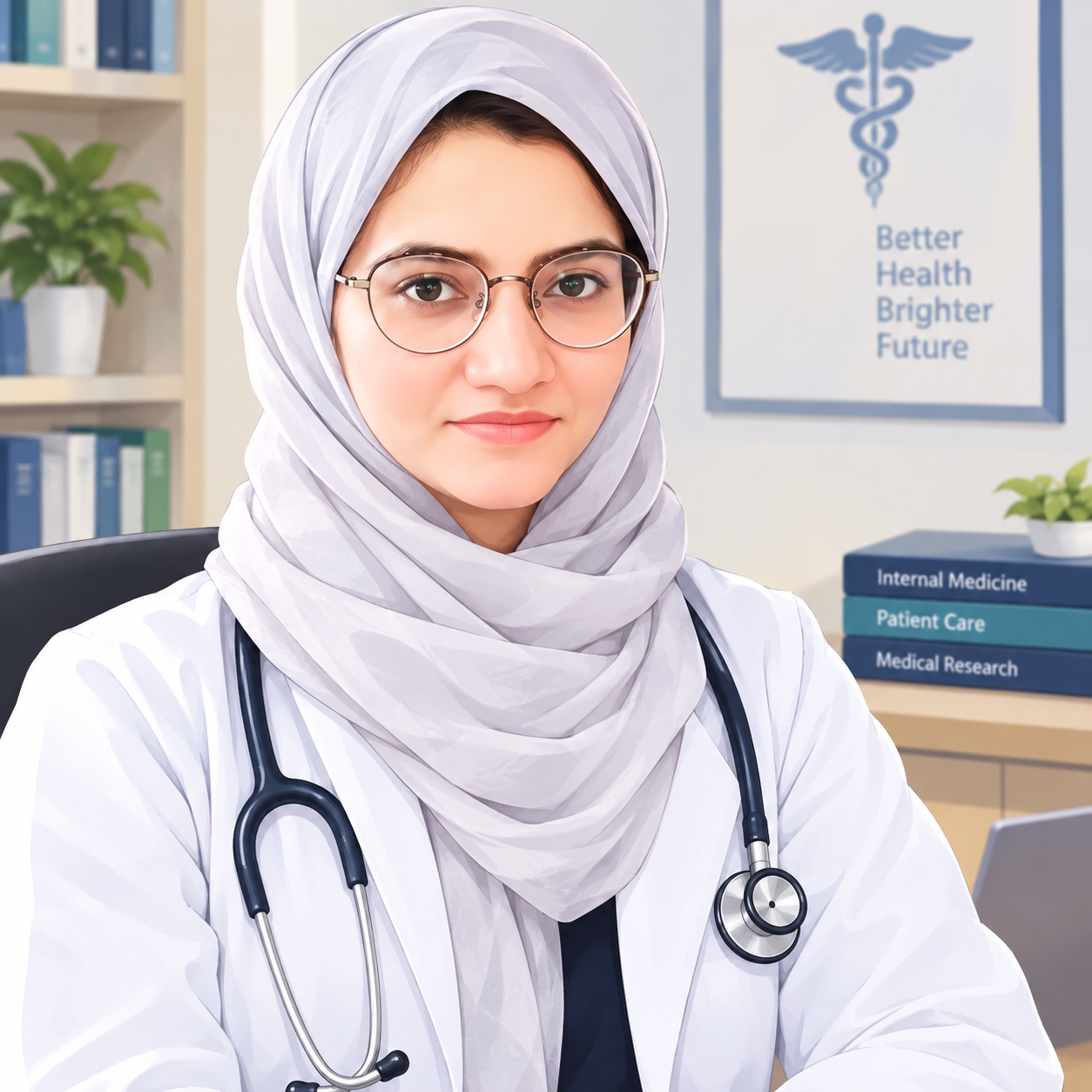
Dr. Kanza Sarfraz, M.B.B.S., is a medical doctor and graduate of Allama Iqbal Medical College, Lahore. She brings nearly seven years of clinical experience across tertiary-care hospitals, medical headquarters, and healthcare facilities in both the public and private sectors. Her clinical experience provides a practical perspective on healthcare delivery, emerging medical technologies, and the evolving role of artificial intelligence in medicine.