MedTech News | Laza Medical, Medtronic, SetPoint Medical

MedTech News | Laza Medical, Medtronic, SetPoint Medical
The healthcare industry continues to move forward as medical technology companies introduce new devices, diagnostic tools and treatment approaches. Recent MedTech News highlights important developments in artificial intelligence (AI), cardiovascular care, neurological treatment and medical device innovation. These advances could influence how healthcare professionals diagnose diseases and manage complex conditions.
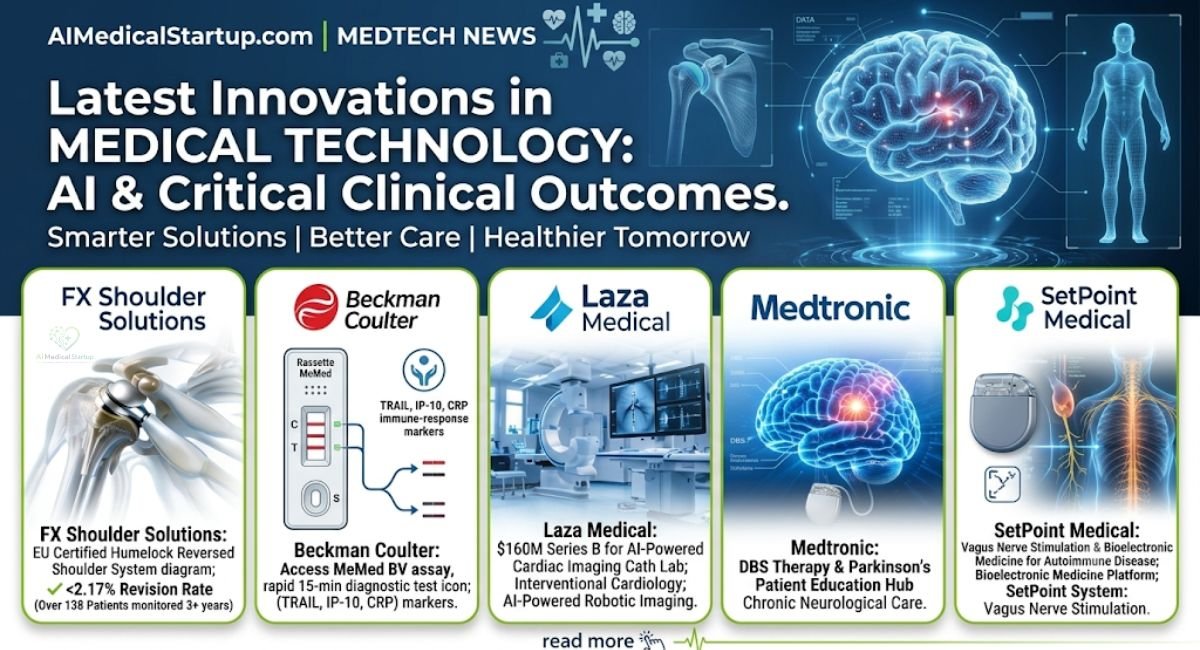
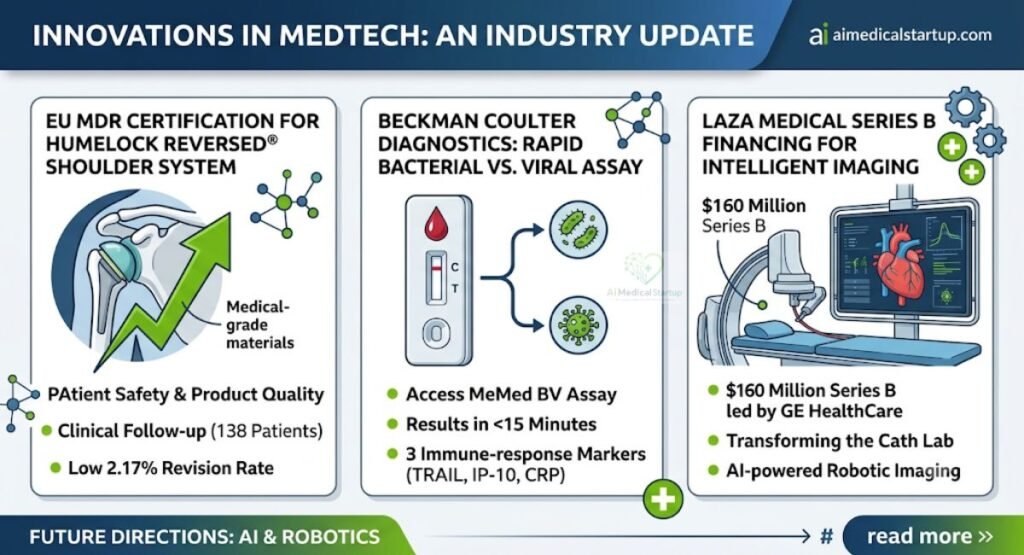
FX Shoulder Solutions, Inc. Achieved EU MDR Certification for Humelock Reversed® Shoulder System
European medical device regulations play an important role in maintaining patient safety and product quality. On November 3, 2026, FX Shoulder Solutions, Inc. announced EU MDR certification for its Humelock Reversed® Shoulder System under European Union Medical Device Regulation 2017/745. The milestone supports the company’s international expansion strategy and its plans to harmonize product availability, surgical instruments and implant configurations across global markets.
The Humelock Reversed Shoulder System forms part of the company’s reverse shoulder replacement portfolio, which addresses complex shoulder conditions requiring shoulder arthroplasty. Its post-market clinical follow-up included 138 patients monitored for at least three years. Researchers reported a 2.17% overall implant revision rate, including 1.45% device-related revisions. No implant migration and subsidence cases were reported. According to CEO Baptiste Martin, this certification represents an important step toward a unified international portfolio of shoulder reconstruction devices.
Beckman Coulter Diagnostics Received U.S. FDA Clearance for Rapid Bacterial vs. Viral Assay Providing Results in as Little as 15 Minutes for Adults and Children
Fast diagnosis can make a meaningful difference when bacterial and viral infections produce similar symptoms. On November 3, 2026, Beckman Coulter Diagnostics announced U.S. FDA clearance for its Access MeMed BV assay, developed with MeMed.
This rapid blood-based diagnostic test measures three immune-response markers: TRAIL protein, IP-10 protein and C-reactive protein (CRP). It supports bacterial vs. viral infection detection in adults and patients aged 90 days and older. Results can arrive in as little as 15 minutes on the DxI 9000 analyzer. The assay also works with the Access 2 immunoassay analyzer, helping laboratories integrate testing into existing emergency department diagnostic workflows.
The test provides clinicians with additional information for antibiotic prescribing decisions rather than replacing clinical assessment. This distinction matters because unnecessary antibiotics contribute to antimicrobial resistance. By supporting antimicrobial stewardship, the assay may help reduce avoidable antibiotic use and healthcare costs. Published economic modelling estimated approximately 1,129 fewer antibiotic days per 1,000 patients with community-acquired pneumonia when the test formed part of diagnostic care. The company also reported that the assay received a European CE mark in April 2026.
Laza Medical Raised Up to $160 Million in Series B Financing Led by GE HealthCare to Advance Intelligent Imaging for Transforming the Cath Lab
Artificial intelligence is opening new possibilities for cardiovascular procedures. On November 5, 2026, Laza Medical, Inc. announced up to $160 million Series B financing, led by GE HealthCare investment. Existing investors Unorthodox Ventures, PA MedTech and AMED also participated. The funding will support AI-powered robotic imaging designed to improve visibility and procedural consistency inside the cardiac catheterization laboratory. GE HealthCare executive Jyoti Gera highlighted the potential of artificial intelligence and robotics to create more integrated imaging workflows.
The technology targets challenges in interventional cardiology, where specialists often navigate complex anatomy using several imaging modalities. Through AI in medical imaging and cardiac imaging integration, Laza aims to simplify procedures and reduce dependence on limited imaging expertise. Its longer-term vision includes robotic-assisted cardiovascular procedures and improved catheterization laboratory workflow. However, investors should distinguish development funding from regulatory approval: the Laza Medical System remains under development and is not approved for commercial sale in any geography.
Medtronic and Michael J. Fox Foundation Partnered to Help More People with Parkinson’s Understand Deep Brain Stimulation
Access to reliable treatment information can help people make more confident healthcare decisions. On November 4, 2026, Medtronic and The Michael J. Fox Foundation for Parkinson’s Research announced an educational partnership focused on deep brain stimulation (DBS). The initiative introduces an online education hub, practical guides and interactive webinars. These resources explain deep brain stimulation therapy, its potential benefits and risks, DBS surgical preparation and post-implantation care. Medtronic brings more than 30 years of experience with this neuromodulator technology and has served over 200,000 people with movement disorders and other conditions globally.
DBS uses implanted electrodes to deliver electrical stimulation to specific brain regions involved in movement control. For selected patients, this approach can help manage certain Parkinson’s symptoms alongside medication. However, it does not cure Parkinson’s or stop disease progression.
The new Parkinson’s patient education initiative aims to help patients and caregivers discuss treatment suitability with their clinical teams. Sohini Chowdhury of the Foundation emphasized the importance of practical information and informed participation in treatment decisions.
Medtronic Symplicity Blood Pressure Procedure Showed Significant Blood Pressure Drops in SPYRAL AFFIRM Real-World Study
Uncontrolled hypertension remains a major cardiovascular risk, particularly when medication alone fails to achieve adequate blood pressure control. On November 3, 2026, Medtronic reported six-month findings from its SPYRAL AFFIRM post-approval study, evaluating the Symplicity Spyral renal denervation system. The procedure uses radiofrequency energy to disrupt selected renal nerves involved in blood pressure regulation. Presented at Transcatheter Cardiovascular Therapeutics 2026, the findings also appeared in Circulation.
The study reported significant reductions across three blood pressure measurements. Importantly, participants did not increase their average antihypertensive medication use during the six-month period.
The findings also covered people with chronic kidney disease, isolated systolic hypertension and Type 2 diabetes. However, the study used a prospective single-arm design rather than a sham-controlled comparison. Therefore, its results provide useful real-world evidence but require careful interpretation when assessing long-term benefits and major adverse cardiovascular events. The composite safety endpoint occurred in 2.1% of patients. Approximately 86.1% of evaluable participants experienced a defined clinical benefit.
SetPoint Medical Announces First SetPoint® System Procedures in New Mexico, Performed at University of New Mexico Hospital
A new approach to rheumatoid arthritis treatment is expanding beyond traditional medication-based care. On November 3, 2026, SetPoint Medical announced its first New Mexico procedures using the SetPoint System at University of New Mexico Hospital in Albuquerque, New Mexico. Neurosurgeon Dr. Botros performed the procedures with specialist involvement. The SetPoint Medical FDA-approved system uses an implantable neurostimulator to stimulate the left vagus nerve, engaging the body’s natural anti-inflammatory pathways through neuroimmune modulation.
The treatment is indicated for adults with moderately to severely active rheumatoid arthritis who have not responded adequately to, lost response to or cannot tolerate one or more biological and targeted synthetic DMARDs. These medicines are also known as disease-modifying antirheumatic drugs (DMARDs).
By connecting nervous system activity with immune regulation, this approach represents an emerging application of bioelectronic medicine in chronic autoimmune diseases. Its expansion also adds another development to the vagus nerve stimulators market, although individual treatment suitability requires specialist assessment.
FAQs about FX Shoulder Solutions
What does EU MDR certification mean for FX Shoulder Solutions?
It indicates that the Humelock Reversed® Shoulder System has achieved certification under the European Union’s Medical Device Regulation. This is an important regulatory milestone supporting the company’s European market strategy. However, certification should not be confused with a blanket approval for every product in its portfolio.
What makes the Humelock Reversed® Shoulder System different?
It belongs to the reverse shoulder arthroplasty category, which changes the usual ball-and-socket arrangement of the shoulder joint. This design can help surgeons address certain complex shoulder conditions, including cases involving significant rotator cuff damage. Its clinical suitability depends on the patient’s anatomy and medical assessment.
PRIMARY SOURCES FOR FACT-CHECKING
The article’s key announcements can be checked against the original sources: FX Shoulder Solutions, Beckman Coulter, Laza Medical, Medtronic DBS partnership, SPYRAL AFFIRM findings and FDA SetPoint approval.
Laza Medical’s financing announcement was published on November 5, 2026, rather than November 4. The SetPoint System received FDA approval in July 2025; the November 2026 announcement concerns its first procedures in New Mexico.



Dr. Kanza Sarfraz, M.B.B.S., is a medical doctor and graduate of Allama Iqbal Medical College, Lahore. She brings nearly seven years of clinical experience across tertiary-care hospitals, medical headquarters, and healthcare facilities in both the public and private sectors. Her clinical experience provides a practical perspective on healthcare delivery, emerging medical technologies, and the evolving role of artificial intelligence in medicine.