BMI & Ideal Body Weight Calculator

BMI & Ideal Body Weight Calculator
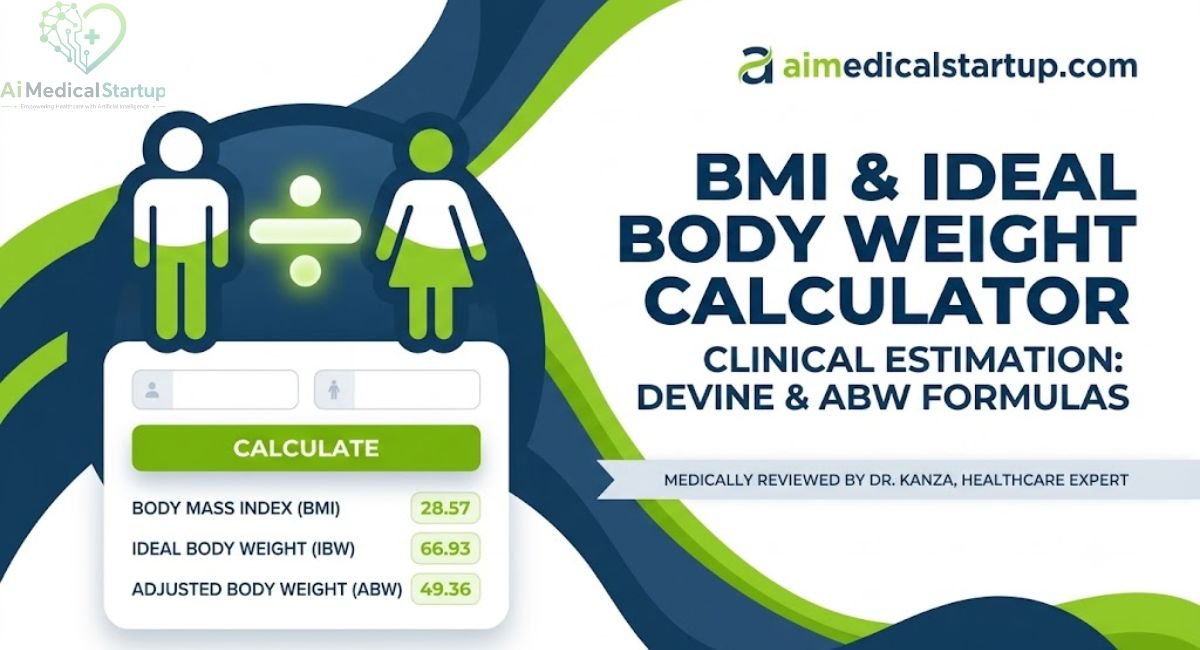
Clinical estimation of Body Mass Index, Devine Ideal Body Weight, and Adjusted Body Weight
Medical Disclaimer: This clinical calculator is intended for informational and screening purposes on aimedicalstartup.com. BMI does not directly measure body composition, muscle mass, or metabolic health. Consult a licensed medical professional before beginning any weight-management plan or altering medical treatments.
Clinical Understanding of BMI & Ideal Body Weight
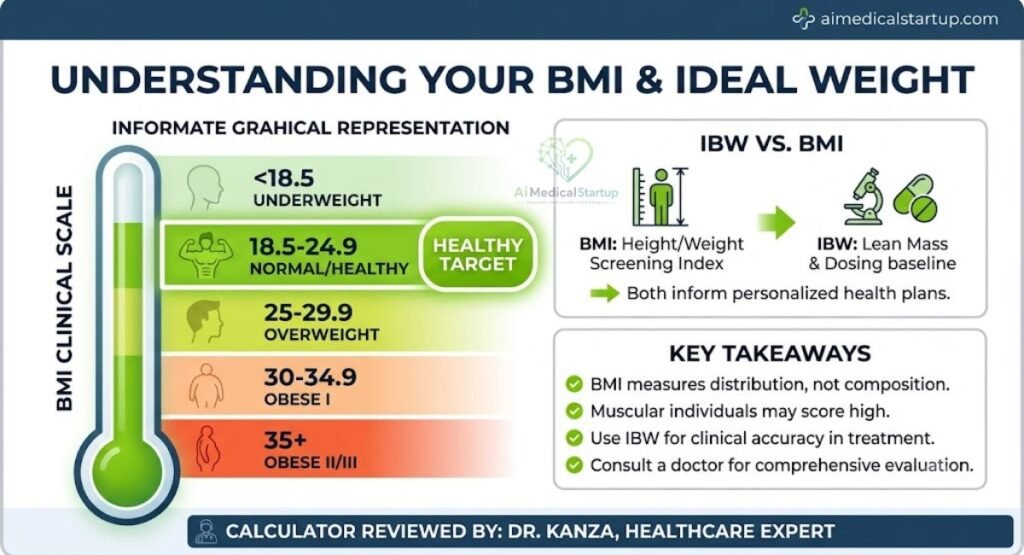
Body Mass Index (BMI) and Ideal Body Weight (IBW) are essential clinical anthropometric measurements used across healthcare settings. BMI screens for weight categories that may lead to health risks, while IBW serves as a crucial baseline for clinical nutrition, respiratory tidal volume settings in mechanical ventilation, and pharmacological dosing.
Key Clinical Formulas
Body Mass Index (BMI)
BMI estimates body fatness based on height and weight.
Devine Formula for Ideal Body Weight (IBW)
Developed by Dr. Ben J. Devine in 1972, standard for medical clearance and dosing calculations:
Adjusted Body Weight (ABW)
Used in clinical settings when actual weight exceeds 120% of IBW to prevent over-dosing:
Healthy Weight Range
Calculated using standard BMI boundaries ($18.5 \text{ to } 24.9 \text{ kg/m}^2$):
Frequently Asked Questions (FAQs)
BMI is a general screening index that categorizes weight relative to height into ranges (underweight, normal, overweight, obesity). Ideal Body Weight (IBW) calculates a specific target weight optimized for lean tissue mass, widely used in clinical medicine for medication dosing and lung tidal volume determination.
Biological sex affects muscle-to-fat distribution and bone tissue density. On average, males possess a higher proportion of lean muscle tissue per unit of height, which is why the Devine formula incorporates a baseline difference ($50 \text{ kg}$ for males vs. $45.5 \text{ kg}$ for females).
Yes. BMI does not differentiate between lean muscle mass and adipose (fat) tissue. Muscular athletes may have a high BMI placing them in the "overweight" or "obese" category despite having very low body fat percentages.
Adjusted Body Weight is used by clinicians when a patient is significantly overweight or obese. Because fat tissue metabolizes drugs differently than lean mass, dosing certain narrow-therapeutic-index medications using actual body weight could lead to toxicity. ABW provides a safer, intermediate weight standard.
Reviewed by Dr. Kanza
This calculator, formula implementation, and clinical article were designed and medically reviewed by Dr. Kanza, Healthcare Expert for aimedicalstartup.com.

Dr. Kanza Sarfraz, M.B.B.S., is a medical doctor and graduate of Allama Iqbal Medical College, Lahore. She brings nearly seven years of clinical experience across tertiary-care hospitals, medical headquarters, and healthcare facilities in both the public and private sectors. Her clinical experience provides a practical perspective on healthcare delivery, emerging medical technologies, and the evolving role of artificial intelligence in medicine.