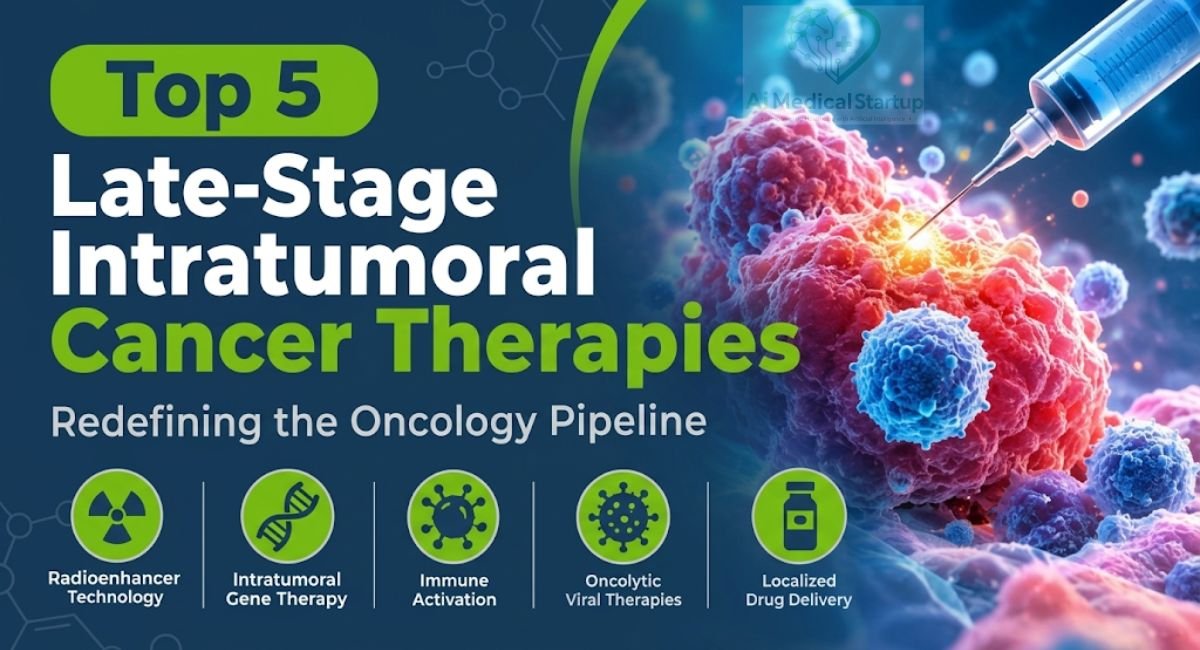
Top 5 Intratumoral Cancer Therapies in Oncology

Top 5 Late-Stage Intratumoral Cancer Therapies Redefining the Oncology Pipeline
Cancer treatment is moving beyond conventional chemotherapy and systemic immunotherapy. Researchers are exploring ways to deliver medicines directly into tumors and activate the body’s own defenses. This approach has brought intratumoral cancer therapies into the spotlight. These treatments aim to destroy cancer cells locally while encouraging immune responses that may also affect distant tumors.
The growing cancer immunotherapy pipeline—increasingly guided by AI in drug discovery and AI tools for oncologists—includes several innovative candidates with different mechanisms. Some enhance radiation damage while others deliver chemotherapy, immune-stimulating proteins, or therapeutic genes. Among the most closely watched candidates are JNJ-1900, INT230-6, NIDLEGY, CAN-2409, and MULTIKINE. Their clinical programs could expand treatment options for patients with difficult-to-treat solid tumors.
Summary: Translating Intratumoral Immunotherapy into Clinical Reality
The main appeal of INTRATUMORAL IMMUNOTHERAPY lies in its ability to concentrate treatment within accessible CANCER LESIONS. Instead of relying entirely on medicines circulating throughout the body, CLINICIANS inject therapeutic agents directly into TUMOR TISSUE. This LOCALIZED DRUG DELIVERY may increase exposure at the disease site while limiting some SYSTEMIC EFFECTS. Researchers also hope to reshape the TUMOR MICROENVIRONMENT (TME), where CANCER CELLS often suppress IMMUNE ACTIVITY and evade treatment.
However, direct injection does not guarantee a lasting response. Some therapies aim to turn immunologically COLD TUMORS into immunologically HOT TUMORS by attracting IMMUNE CELLS and releasing TUMOR ANTIGENS. Others combine local treatment with RADIATION or SYSTEMIC MEDICINES. Guided by insights from AI IN DRUG DISCOVERY and AI TOOLS FOR ONCOLOGISTS, researchers are better predicting which patients respond best. Although established products such as IMLYGIC and newer FDA-APPROVED TUDRIQEV demonstrate regulatory progress, the five candidates discussed here remain INVESTIGATIONAL. Their CLINICAL RESULTS and development timelines must therefore be interpreted carefully.
NANOBIOTIX / Johnson & Johnson’s JNJ-1900 (HENSIFY, NBTXR3)
Radioenhancer Mechanism
RADIOTHERAPY remains a cornerstone of CANCER TREATMENT, but its effectiveness depends partly on how much RADIATION reaches the TUMOR. JNJ-1900, also known as NBTXR3 or HENSIFY, takes a different approach by using HAFNIUM OXIDE NANOPARTICLES to amplify RADIATION EFFECTS. Developed by NANOBIOTIX and partnered with Johnson & Johnson, this INVESTIGATIONAL PRODUCT is injected directly into the TUMOR before RADIATION THERAPY.
HAFNIUM has a high ATOMIC NUMBER, allowing its NANOPARTICLES to absorb more RADIATION ENERGY and increase ENERGY DEPOSITION within the treated tissue. Aided by precision tumor-mapping technologies such as BEST AI TOOLS IN RADIOLOGY, this process aims to enhance RADIATION-INDUCED TUMOR CELL DEATH without requiring a proportional increase in RADIATION EXPOSURE to nearby healthy structures.
Clinical Development and Therapeutic Potential
The most advanced program is NANORAY-312, a global PHASE III study evaluating NBTXR3 with RADIOTHERAPY, with or without CETUXIMAB, in older patients with LOCALLY ADVANCED HEAD AND NECK SQUAMOUS CELL CARCINOMA (HNSCC) who cannot receive PLATINUM-BASED CHEMOTHERAPY. The study remains ongoing and recruiting. Its PRIMARY ENDPOINT is PROGRESSION-FREE SURVIVAL, while secondary measures include OVERALL SURVIVAL, LOCAL CONTROL, and SAFETY. A MAY 2026 PROTOCOL AMENDMENT removed the planned INTERIM ANALYSIS and revised the FINAL ANALYSIS.
Emerging Evidence Beyond Head and Neck Cancer
Beyond its PHASE III program, JNJ-1900 is being investigated in other difficult-to-treat cancers, including thoracic oncology tracked alongside advances in AI IN PULMONOLOGY. A September 2026 PHASE I report in RECURRENT, inoperable NON-SMALL CELL LUNG CANCER (NSCLC) included 24 treated patients. All completed treatment without DOSE-LIMITING TOXICITIES or treatment-related GRADE 3 or higher ADVERSE EVENTS. Among evaluable patients, the reported one-year LOCOREGIONAL CONTROL RATE was 79%, while one-year LOCAL PROGRESSION-FREE SURVIVAL reached 61%. These findings are encouraging but remain early-stage evidence rather than proof of SURVIVAL BENEFIT.
Intensity Therapeutics’ INT230-6
Small Molecule Mechanism
INT230-6 offers another approach to INTRATUMORAL DRUG ADMINISTRATION by combining two established CHEMOTHERAPY MEDICINES with a proprietary CELL-PENETRATION ENHANCER. Its formulation contains CISPLATIN, VINBLASTINE, and SHAO (8-(2-HYDROXYBENZOYL AMINO OCTANOATE)). SHAO helps disperse both CHEMOTHERAPY AGENTS throughout injected TUMOR TISSUE and improves their entry into CANCER CELLS.
Once inside, CISPLATIN damages DNA while VINBLASTINE disrupts MICROTUBULE FORMATION. Together, these actions can trigger CANCER-CELL DEATH and potentially promote IMMUNE RECOGNITION of TUMOR ANTIGENS—a multi-agent synergy increasingly analyzed through AI IN DRUG DISCOVERY and AI TOOLS FOR ONCOLOGISTS.
Clinical Development and Therapeutic Potential
Developed by Intensity Therapeutics, INT230-6 is being studied in patients with SOFT TISSUE SARCOMA (STS) and TRIPLE-NEGATIVE BREAST CANCER (TNBC). Its PHASE III INVINCIBLE-3 trial compares INTRATUMORAL INT230-6 with STANDARD SYSTEMIC TREATMENT in certain LOCALLY RECURRENT, INOPERABLE, or METASTATIC SARCOMA SUBTYPES—complementing broader sarcoma research such as OSTEOSARCOMA TREATMENT.
The study experienced an ENROLLMENT PAUSE in 2025 because of funding constraints. However, new ENROLLMENT ACTIVITIES resumed at selected US sites during the third quarter of 2026. The company is also working toward restarting recruitment across Europe and Canada.
Presurgical Breast Cancer Research
INT230-6 is also being investigated in the PHASE II INVINCIBLE-4 study involving patients with EARLY-STAGE OPERABLE TNBC. Preliminary findings from the first 14 patients reported a PATHOLOGICAL COMPLETE RESPONSE RATE of 71% in the INT230-6 group compared with 42% in the STANDARD-TREATMENT GROUP.
However, these figures come from a very small sample and require confirmation in a larger study. The program also experienced LOCALIZED SKIN IRRITATION, prompting changes to its DOSING APPROACH. Its potential role in COMBINATION CANCER THERAPIES will depend on larger SAFETY and EFFICACY RESULTS.
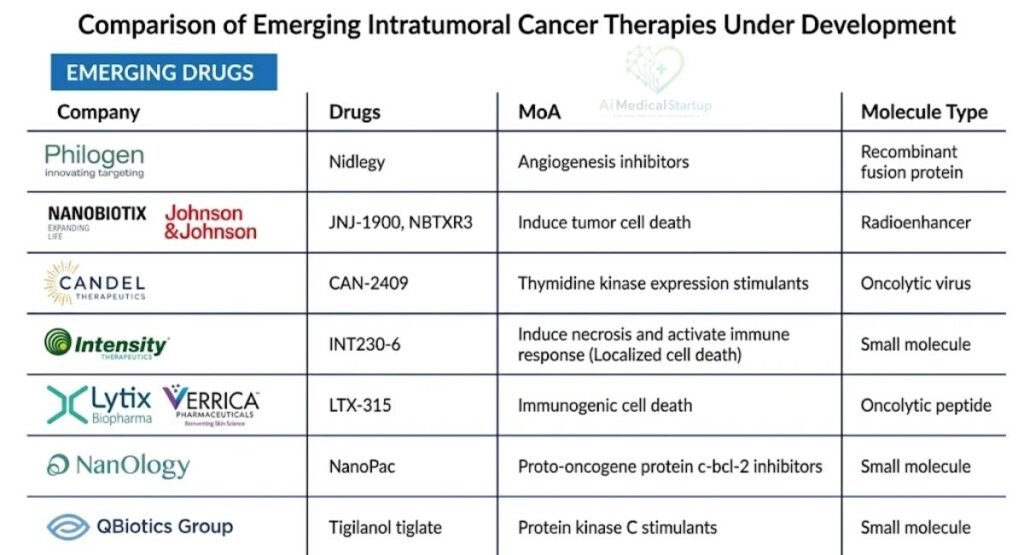
Philogen S.p.A.’s NIDLEGY (DAROMUN)
Recombinant Fusion Protein Mechanism
NIDLEGY, also known as DAROMUN, is an INVESTIGATIONAL COMBINATION of two RECOMBINANT FUSION PROTEINS called L19-IL2 and L19-TNF. Developed by Philogen S.p.A., these IMMUNOCYTOKINES combine an ANTIBODY FRAGMENT targeting EXTRA-DOMAIN B FIBRONECTIN with IMMUNE-STIMULATING CYTOKINES.
This FIBRONECTIN COMPONENT is associated with TUMOR BLOOD VESSELS and the surrounding TUMOR ENVIRONMENT. L19-IL2 delivers INTERLEUKINS that stimulate IMMUNE-CELL ACTIVITY, while L19-TNF promotes LOCAL INFLAMMATION and contributes to TUMOR DESTRUCTION. Together, these agents aim to concentrate IMMUNE STIMULATION around CANCER LESIONS—a targeted biological precision increasingly modeled via AI IN DRUG DISCOVERY and AI TOOLS FOR ONCOLOGISTS.
Clinical Development in Advanced Melanoma
NIDLEGY has been investigated as a NEOADJUVANT INTRALESIONAL CANCER TREATMENT for patients with LOCALLY ADVANCED and RESECTABLE MELANOMA. Its PHASE III PIVOTAL trial enrolled 256 patients and compared INTRALESIONAL DAROMUN followed by SURGERY with UPFRONT SURGERY ALONE.
The study met its PRIMARY ENDPOINT, demonstrating improved RECURRENCE-FREE SURVIVAL. An updated analysis at a MEDIAN FOLLOW-UP of 36.8 months reported a RECURRENCE-FREE SURVIVAL HAZARD RATIO of 0.55 and a DISTANT METASTASIS-FREE SURVIVAL HAZARD RATIO of 0.53. These findings suggest meaningful CLINICAL ACTIVITY, although OVERALL SURVIVAL data remained immature at the analysis cutoff.
Regulatory Progress and Future Applications
Philogen submitted an updated MARKETING AUTHORIZATION APPLICATION (MAA) to the EUROPEAN MEDICINES AGENCY (EMA) on JULY 27, 2026. The application seeks authorization for NEOADJUVANT TREATMENT of adults with LOCALLY ADVANCED, FULLY RESECTABLE MELANOMA.
This followed the withdrawal of an earlier application in June 2025. The resubmission represents an important REGULATORY MILESTONE, not an approval. Further development also explores its potential alongside systemic ANTI-PD-1 THERAPY and in other INJECTABLE SKIN CANCERS—where non-invasive screening tools like AI DERMATOLOGIST EXPLAINED are helping track cutaneous lesions.
Candel Therapeutics’ Aglatimagene besadenovec (CAN-2409) + Valacyclovir
Oncolytic Virus vs. In Situ Cancer Vaccine Mechanism
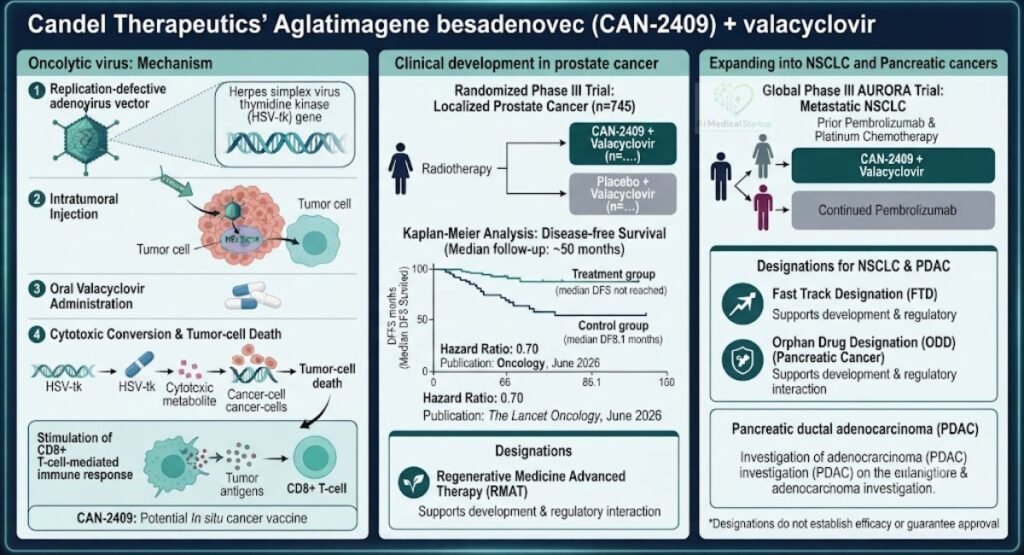
Although CAN-2409 is sometimes grouped with ONCOLYTIC VIRAL THERAPIES, its mechanism deserves a closer look. Developed by Candel Therapeutics, AGLATIMAGENE BESADENOVEC is a REPLICATION-DEFECTIVE ADENOVIRUS carrying the HERPES SIMPLEX VIRUS THYMIDINE KINASE (HSV-TK) gene. After injection into TUMOR TISSUE, the vector delivers this gene into cells.
Patients then receive oral VALACYCLOVIR, which is converted through the HSV-TK PATHWAY into a CYTOTOXIC METABOLITE. This damages CANCER-CELL DNA and promotes TUMOR-CELL DEATH. The resulting release of TUMOR ANTIGENS may stimulate a CD8+ T-CELL-MEDIATED IMMUNE RESPONSE, making the approach a potential IN SITU CANCER VACCINE rather than a conventional replicating ONCOLYTIC VIRUS—a genomic delivery strategy increasingly modeled using AI IN DRUG DISCOVERY and AI TOOLS FOR ONCOLOGISTS.
Clinical Development in Prostate Cancer
CAN-2409 has produced important PHASE III evidence in LOCALIZED PROSTATE CANCER. A randomized trial enrolled 745 men receiving CURATIVE-INTENT RADIOTHERAPY and compared CAN-2409 plus VALACYCLOVIR with placebo plus VALACYCLOVIR.
After a MEDIAN FOLLOW-UP of approximately 50 months, the MEDIAN DISEASE-FREE SURVIVAL was not reached in the treatment group, compared with 86.1 months in the control group. The HAZARD RATIO was 0.70, indicating a lower risk of DISEASE-FREE SURVIVAL EVENTS in the treatment group. The findings were published in THE LANCET ONCOLOGY IN JUNE 2026.
Expanding into Lung and Pancreatic Cancers
Candel is also investigating CAN-2409 in NSCLC and PANCREATIC DUCTAL ADENOCARCINOMA (PDAC), paralleling innovations covered in AI IN PULMONOLOGY. Its global PHASE III AURORA trial began in June 2026 and evaluates CAN-2409 plus VALACYCLOVIR alongside continued PEMBROLIZUMAB in METASTATIC NON-SQUAMOUS NSCLC that has progressed despite prior PEMBROLIZUMAB and PLATINUM CHEMOTHERAPY.
The PRIMARY ENDPOINT is OVERALL SURVIVAL. The company has also received FAST TRACK DESIGNATION (FTD) for NSCLC and PDAC, ORPHAN DRUG DESIGNATION (ODD) for PANCREATIC CANCER, and REGENERATIVE MEDICINE ADVANCED THERAPY (RMAT) designation for LOCALIZED PROSTATE CANCER. These designations support development and regulatory interaction but do not establish EFFICACY or guarantee APPROVAL.
CEL-SCI’s MULTIKINE
Immunotherapy Classification & Formulation
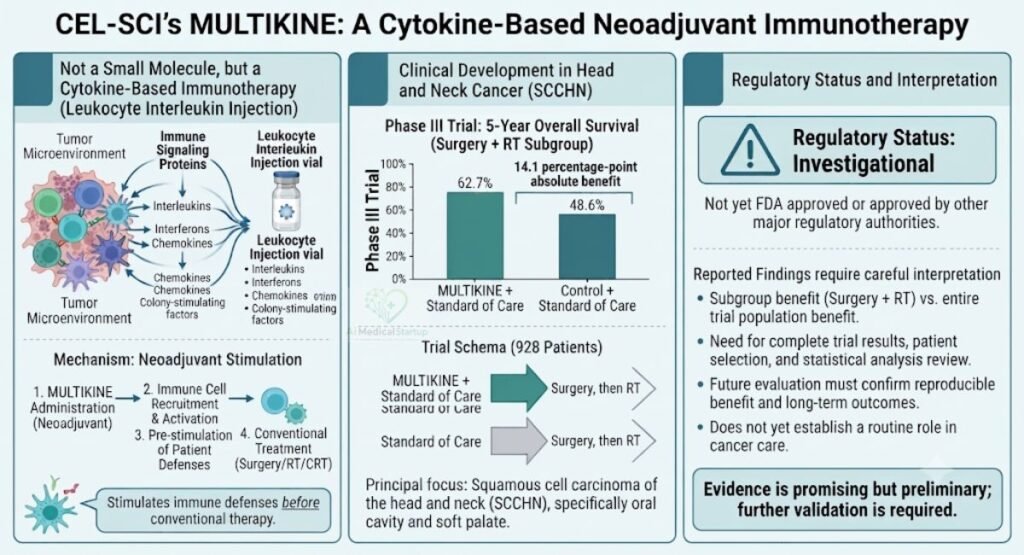
Despite the supplied heading classification, MULTIKINE is not a conventional SMALL MOLECULE drug. Developed by CEL-SCI, it is a CYTOKINE-BASED IMMUNOTHERAPY known as LEUKOCYTE INTERLEUKIN INJECTION. Its formulation contains naturally occurring IMMUNE-SIGNALING PROTEINS, including INTERLEUKINS, INTERFERONS, CHEMOKINES, and COLONY-STIMULATING FACTORS.
These molecules help coordinate IMMUNE-CELL COMMUNICATION, recruitment, and activation. The treatment is designed to stimulate the patient’s immune defenses before conventional cancer treatment begins—increasingly analyzed via AI IN DRUG DISCOVERY. This makes it a form of NEOADJUVANT IMMUNOTHERAPY rather than a standard CYTOTOXIC CHEMOTHERAPY.
Clinical Development in Head and Neck Cancer
MULTIKINE’s principal development program focuses on SQUAMOUS CELL CARCINOMA OF THE HEAD AND NECK (SCCHN)—a complex oncology domain also explored in AI IN OTOLARYNGOLOGY—particularly cancers of the oral cavity and soft palate. Its PHASE III trial enrolled 928 patients and evaluated the treatment before surgery and RADIOTHERAPY or concurrent CHEMORADIOTHERAPY.
CEL-SCI REPORTED a five-year OVERALL SURVIVAL advantage in the subgroup receiving surgery followed by RADIOTHERAPY: 62.7% compared with 48.6% in the control group. The company reported a 14.1-percentage-point absolute difference and a P-VALUE of 0.0236. However, these subgroup findings should not be confused with a demonstrated benefit across the entire trial population.
Regulatory Status and Remaining Questions
MULTIKINE remains INVESTIGATIONAL and has not received REGULATORY APPROVAL from the FDA or another major REGULATORY AUTHORITY. Its reported OVERALL SURVIVAL (OS) findings require careful interpretation alongside the complete trial results, PATIENT SELECTION, and STATISTICAL ANALYSIS.
Future evaluation must establish whether the treatment provides a reproducible benefit and whether its proposed immune effects translate into better long-term outcomes. Backed by rigorous guidelines like RULES FOR HEALTHCARE AI, the reported clinical evidence does not yet establish a routine role in cancer care.
FAQs About Late-Stage Intratumoral Cancer Therapies
These treatments deliver therapeutic agents directly into tumors through injections. Depending on the product, they may destroy CANCER CELLS, stimulate IMMUNE ACTIVITY, or improve the effects of RADIATION. Some also aim to produce SYSTEMIC ANTI-TUMOR IMMUNITY, which could help the body recognize CANCER CELLS beyond the injected lesion—a precision approach guided by AI IN DRUG DISCOVERY.
Potentially, yes. Certain therapies release TUMOR ANTIGENS and stimulate IMMUNE CELLS that may travel beyond the injection site. However, this effect varies between treatments and patients. Researchers are studying whether intratumoral approaches can improve METASTATIC CANCER TREATMENT when combined with SYSTEMIC MEDICINES.
Research currently includes MELANOMA, HEAD AND NECK CANCER, PROSTATE CANCER, LUNG CANCER, PANCREATIC CANCER, BREAST CANCER, and SOFT TISSUE SARCOMA. However, each treatment has its own eligibility criteria. Tumor accessibility, disease stage, and previous treatment history can influence suitability.
Some intratumoral treatments have received REGULATORY AUTHORIZATION for specific indications. However, JNJ-1900, INT230-6, NIDLEGY, CAN-2409, and MULTIKINE remain INVESTIGATIONAL in the programs discussed here. FDA ACCELERATED APPROVAL, such as that granted to TUDRIQEV, is also indication-specific and may require confirmatory trials.
The OBJECTIVE RESPONSE RATE (ORR) measures the proportion of patients whose tumors shrink or disappear according to predefined criteria. PROGRESSION-FREE SURVIVAL (PFS) measures the time patients live without disease progression or death. DURATION OF RESPONSE (DOR) measures how long a tumor response lasts after it first occurs. These outcomes help researchers understand treatment activity but do not always demonstrate longer OVERALL SURVIVAL.
Not necessarily. Most INVESTIGATIONAL CANDIDATES are being studied alongside established treatments such as SURGERY, RADIATION, or SYSTEMIC THERAPY. Their eventual role will depend on comparative CLINICAL EVIDENCE, safety, and regulatory decisions.
Conclusion: The Future of INTRATUMORAL CANCER THERAPIES
The development of late-stage INTRATUMORAL CANCER THERAPIES reflects a growing effort to make CANCER TREATMENT more localized and immunologically effective. JNJ-1900 enhances radiation, INT230-6 delivers chemotherapy within tumors, NIDLEGY combines targeted cytokines, CAN-2409 uses gene-based immune activation, and MULTIKINE seeks to stimulate natural immune signaling.
Although these approaches have different mechanisms, they share an important goal: improving local tumor control while potentially encouraging broader immune activity. Guided by advanced analytics such as AI IN DRUG DISCOVERY and AI TOOLS FOR ONCOLOGISTS, their future will depend on well-designed CLINICAL TRIALS, durable patient outcomes, and successful REGULATORY REVIEW. For now, they represent an evolving area of ONCOLOGY RESEARCH rather than established replacements for standard CANCER TREATMENT.


Dr. Javeria is a Resident Pulmonologist and Chest Specialist with clinical experience across Basic Health Units and tertiary healthcare settings. Her professional focus is centered on respiratory health, pulmonary care, and chest-related conditions, bringing practical clinical insight from both primary and tertiary healthcare environments.
