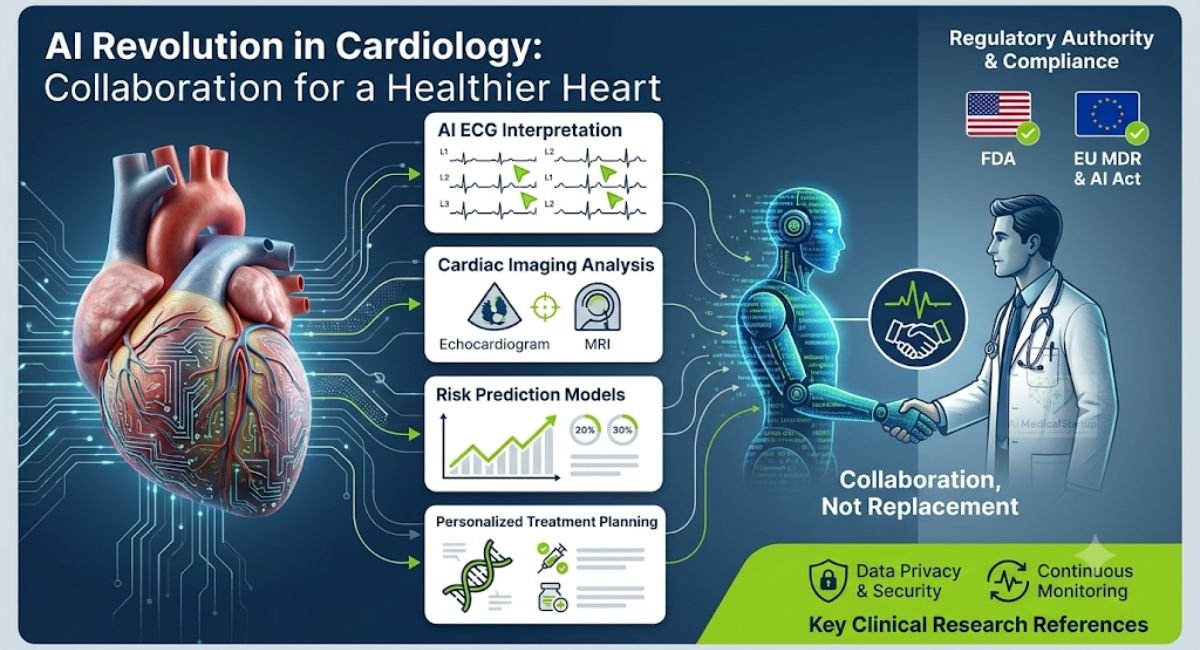
AI in Cardiology

In the Heart of the Matter
The human heart beats thousands of times every day, yet some cardiovascular conditions remain difficult to detect before serious complications develop. ARTIFICIAL INTELLIGENCE is beginning to change that picture. By examining complex CLINICAL INFORMATION, recognizing hidden patterns and supporting faster decisions, AI IN HEALTHCARE and AI FOR DOCTORS are reshaping how healthcare professionals approach CARDIOVASCULAR DISEASE.
From ELECTROCARDIOGRAMS to advanced CARDIAC IMAGING, intelligent algorithms can help CLINICIANS uncover abnormalities that conventional assessments might overlook. However, this technology is not simply about faster diagnoses. It also opens new possibilities for early detection, INDIVIDUALIZED TREATMENT and more efficient cardiovascular care. Let’s explore how these systems work and where they are making a meaningful clinical difference.
AI’s Impact in HEALTHCARE Is Transformative, Especially in CARDIOLOGY
CARDIOLOGY generates enormous quantities of CLINICAL INFORMATION. Every patient assessment may involve an ELECTROCARDIOGRAM, ECHOCARDIOGRAM, blood biomarkers, IMAGING RESULTS and a detailed medical history. Interpreting these different sources together can be challenging, particularly when subtle abnormalities appear across several tests. ARTIFICIAL INTELLIGENCE IN CARDIOLOGY helps organize this complexity through advanced CARDIOVASCULAR DATA ANALYSIS and MEDICAL DATA PATTERN RECOGNITION. These capabilities allow CLINICIANS to investigate relationships that might otherwise remain hidden within extensive datasets.
The AMERICAN HEART ASSOCIATION (AHA) recognizes applications across CARDIOVASCULAR IMAGING, ELECTROCARDIOGRAPHY, hospital monitoring, WEARABLE DEVICES and ELECTRONIC HEALTH RECORDS. Its 2024 scientific statement also emphasizes that widespread adoption still requires stronger evidence of improved PATIENT OUTCOMES. This distinction matters because technical performance alone does not guarantee better treatment. Nevertheless, AI IN CARDIOVASCULAR MEDICINE—supported by advanced AI PLATFORMS IN HEALTHCARE and robust HEALTHCARE AI AGENTS—is creating opportunities for earlier diagnosis and more informed CLINICAL DECISIONS.
Triad of AI in CARDIOLOGY and HEALTHCARE: MACHINE LEARNING (ML), AI, and DEEP LEARNING (DL)
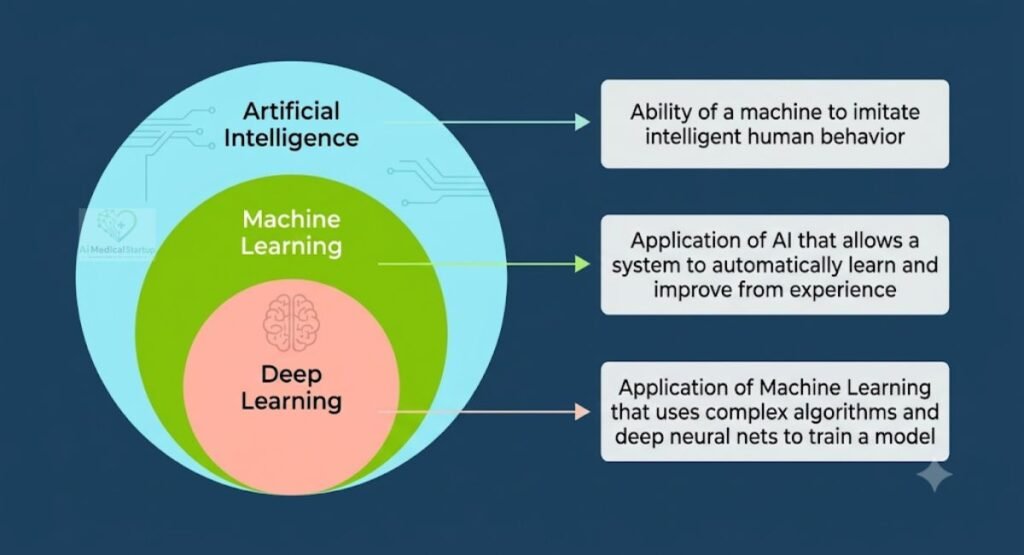
Understanding modern cardiac technology starts with three interconnected concepts: ARTIFICIAL INTELLIGENCE (AI), MACHINE LEARNING (ML) and DEEP LEARNING (DL). Although people sometimes use these terms interchangeably, they describe different levels of computational intelligence. Together, they support AI-DRIVEN MEDICAL DIAGNOSTICS, IMAGE RECOGNITION and PREDICTIVE ANALYSIS. Their applications range from identifying irregular heart rhythms to evaluating complex CARDIOVASCULAR IMAGING.
In practical terms, these technologies help computers learn from CLINICAL INFORMATION rather than simply follow fixed instructions. Their effectiveness depends on suitable MEDICAL DATASETS, reliable annotations and appropriate validation. For example, a cardiac algorithm trained on thousands of properly interpreted ECG recordings may recognize abnormalities across new patient recordings. However, poor data quality or unrepresentative training populations can undermine its reliability, making advanced AI PLATFORMS IN HEALTHCARE essential for oversight.
ARTIFICIAL INTELLIGENCE
ARTIFICIAL INTELLIGENCE (AI) describes computer systems designed to perform tasks associated with human intelligence, including reasoning, learning and recognizing patterns. In cardiology, these systems can examine CLINICAL INFORMATION and support diagnostic decisions. Their applications include AI-ASSISTED DIAGNOSIS, CLINICAL DECISION SUPPORT SYSTEMS and personalized cardiovascular assessment. Rather than replacing CLINICAL JUDGMENT, they provide another analytical perspective that helps AI FOR DOCTORS and healthcare professionals interpret increasingly complicated patient information.
AI IN CARDIOLOGY VS AUTOMATISATION
Traditional automation follows predetermined instructions, such as automatically flagging a heart rate above a specified threshold. By comparison, AI can learn complex relationships from previously collected CLINICAL INFORMATION. AI IN CLINICAL PRACTICE therefore extends beyond repetitive task execution. A trained model might recognize combinations of ECG features associated with a particular CARDIAC CONDITION, even when individual measurements appear relatively ordinary. Nevertheless, CLINICIANS must evaluate its findings before making important diagnostic and treatment decisions.
MACHINE LEARNING (ML)
MACHINE LEARNING (ML) is a branch of AI that enables algorithms to identify relationships within data and improve their performance through training. MACHINE LEARNING IN CARDIOLOGY can analyze patient characteristics, laboratory measurements, ECG recordings and imaging findings to identify clinically relevant patterns. For example, a model may estimate cardiovascular risk by examining age, BLOOD PRESSURE READING, cholesterol levels and previous diagnoses. Its predictions can support CARDIAC RISK STRATIFICATION, although appropriate validation remains essential.
DEEP LEARNING (DL)
DEEP LEARNING (DL) uses multilayered computational structures called NEURAL NETWORKS to identify complicated relationships within large datasets. These systems are particularly useful when analyzing images and electrical signals. In cardiology, DEEP LEARNING IN HEALTHCARE supports ECG CLASSIFICATION, echocardiographic measurements and cardiac imaging analysis. A DEEP NEURAL NETWORK can examine subtle waveform characteristics across multiple ECG LEADS, helping identify potential cardiac rhythm abnormalities and structural heart conditions.
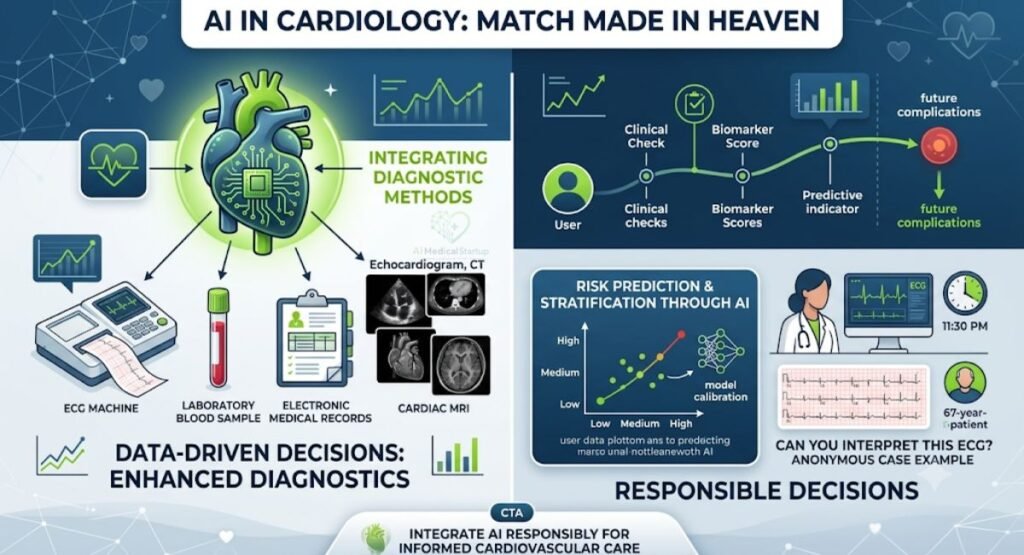
AI and CARDIOLOGY: Match Made in Heaven
CARDIOVASCULAR MEDICINE relies on several diagnostic methods that generate different types of information. AI can help bring these findings together, creating a more comprehensive picture of an individual’s CARDIOVASCULAR HEALTH. Through AI-POWERED CARDIAC DIAGNOSTICS, CLINICIANS can examine ECG RECORDINGS, LABORATORY RESULTS and IMAGING INFORMATION with greater analytical support. This approach strengthens PERSONALIZED CARDIOVASCULAR CARE by helping PHYSICIANS consider multiple clinical factors instead of relying on isolated measurements.
However, the real value comes from applying these insights to appropriate CLINICAL PATHWAYS. CARDIOVASCULAR DISEASE DETECTION requires more than recognizing an unusual pattern; CLINICIANS must establish whether that finding has DIAGNOSTIC SIGNIFICANCE. AI can assist with EARLY DETECTION OF HEART DISEASE, but CLINICAL EXAMINATION and confirmatory investigations remain essential. When integrated responsibly, these systems can support more informed decisions throughout CARDIOVASCULAR CARE.
DATA-DRIVEN DECISIONS: Enhanced DIAGNOSTICS
CLINICAL DIAGNOSIS becomes more complicated when several CARDIOVASCULAR CONDITIONS produce overlapping symptoms. AI can examine MEDICAL RECORDS, PATIENT MEDICAL HISTORY and LABORATORY MEASUREMENTS alongside DIAGNOSTIC IMAGING to identify relationships across different sources. In particular, CARDIAC IMAGING ANALYSIS can support the interpretation of ECHOCARDIOGRAMS, CARDIAC CT SCANS and CARDIAC MRI EXAMINATIONS. These applications may help CLINICIANS detect STRUCTURAL ABNORMALITIES, assess VENTRICULAR FUNCTION and investigate possible CORONARY DISEASE.
RISK PREDICTION and STRATIFICATION Through AI
Some CARDIOVASCULAR CONDITIONS develop silently before producing noticeable symptoms. AI-BASED PREDICTIVE MODELS can evaluate CLINICAL CHARACTERISTICS, BIOMARKERS and previous diagnoses to estimate an individual’s likelihood of experiencing future complications. This supports CARDIOVASCULAR RISK PREDICTION and RISK STRATIFICATION, particularly when CLINICIANS need to identify patients who may benefit from closer monitoring. However, a prediction is not a diagnosis. Its usefulness depends on MODEL CALIBRATION, POPULATION CHARACTERISTICS and whether subsequent interventions actually improve CLINICAL OUTCOMES.
Can You Interpret This ECG?
Imagine a 67-year-old man arriving at an EMERGENCY DEPARTMENT at 11:30 PM with persistent CHEST PAIN lasting two hours. His initial ELECTROCARDIOGRAM (ECG) shows potentially concerning changes, but the findings require careful assessment. Could AI-BASED ECG INTERPRETATION help identify a possible CORONARY EMERGENCY? Advanced ALGORITHMS can examine ECG TRACINGS and recognize suspicious ELECTRICAL PATTERNS. Nevertheless, CLINICIANS must combine these findings with symptoms, examination, SERIAL ECGS and CARDIAC BIOMARKERS before deciding on urgent management.
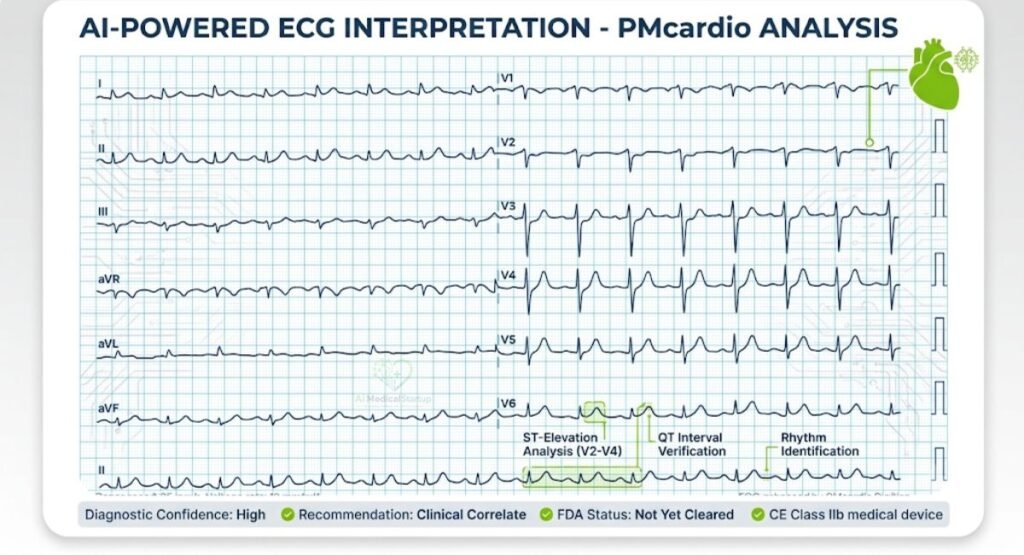
AI-POWERED ECG Interpretation
The ECG remains one of cardiology’s most accessible diagnostic tools. It records ELECTRICAL ACTIVITY through electrodes placed on the patient’s body, producing waveforms that CLINICIANS interpret to assess CARDIAC FUNCTION. Traditional 12-LEAD ECG interpretation requires considerable CLINICAL EXPERIENCE because different conditions can produce overlapping abnormalities. Modern AUTOMATED ECG ANALYSIS uses algorithms to examine these recordings rapidly, potentially identifying MYOCARDIAL INFARCTION, HEART BLOCKS, ARRHYTHMIAS and other abnormalities.
Unlike simple threshold-based software, advanced ECG MODELS can examine relationships across multiple WAVEFORM CHARACTERISTICS. DIGITAL ECG WAVEFORM ANALYSIS can also convert printed ECG images into machine-readable signals, making previously inaccessible recordings available for COMPUTATIONAL ANALYSIS. These developments improve opportunities for MYOCARDIAL INFARCTION DETECTION, RHYTHM ASSESSMENT and other diagnostic applications. Still, an AI-generated interpretation should complement clinical assessment rather than replace it.
A 2026 systematic review published in CARDIOLOGY DISCOVERY examined 88 studies of AI-enhanced ECG analysis for acute MYOCARDIAL INFARCTION. Only 33 studies, representing 37.5% of the total, performed EXTERNAL VALIDATION. The authors highlighted important gaps in GENERALIZABILITY and REAL-WORLD CLINICAL EVIDENCE. This finding demonstrates why impressive laboratory results must undergo rigorous clinical evaluation before widespread adoption.
Introducing PMCARDIO: AI-Powered Precision in Cardiology
One example of commercial ECG analysis technology is PMCARDIO FROM POWERFUL MEDICAL. Its developer reports that an earlier DEEP-LEARNING MODEL used 931,344 standard 12-LEAD ECGs from 172,750 patients to identify 38 diagnostic categories. The company’s current public product information lists 36 core diagnostics, illustrating why published product specifications should always be checked against their latest versions.
The Future of AI in CARDIOLOGY: The Key Is Collaboration, Not Replacement
The future of AI in CARDIOLOGY depends on combining computational capabilities with clinical expertise. Algorithms can process extensive information quickly, but they cannot independently understand every patient’s circumstances. Cardiologists and other HEALTHCARE PROFESSIONALS must interpret AI-generated findings within the wider clinical picture. Effective AI and cardiologist collaboration can support faster assessments, more consistent investigations and better-informed CLINICAL DECISION-MAKING.
REGULATORY OVERSIGHT will also shape adoption across international healthcare systems. In the United States, the FDA maintains an evolving list of authorized AI-ENABLED MEDICAL DEVICES, including cardiovascular technologies. In Europe, medical device requirements under the MDR operate alongside the developing AI ACT framework. The EU‘s current implementation timeline places relevant high-risk obligations for AI embedded in regulated products on 2 August 2028. These frameworks reinforce the importance of safety, accountability and ongoing monitoring.
The Strengths and Limitations of AI in MEDICAL DATA ANALYSIS
AI offers substantial analytical advantages, but its limitations deserve equal attention. A model may perform impressively during development yet struggle when exposed to different patient populations or unfamiliar clinical conditions. Unbiased data sources, representative training populations and rigorous EXTERNAL VALIDATION are therefore essential. Other concerns include algorithmic transparency, cybersecurity, patient privacy and accountability when automated recommendations influence treatment. Ultimately, DIAGNOSTIC ACCURACY must translate into meaningful CLINICAL OUTCOMES rather than impressive statistics alone.
| Clinical Area | Potential AI Contribution | Important Limitation |
|---|---|---|
| ECG interpretation | Identifying rhythm abnormalities and ischemic patterns | False positives and missed diagnoses |
| CARDIAC IMAGING | Supporting image measurements and disease classification | Image quality and population bias |
| Risk assessment | Estimating cardiovascular event probability | Calibration and generalizability |
| Patient monitoring | Identifying concerning changes in physiological signals | Alert fatigue and data reliability |
| Treatment planning | Supporting individualized clinical decisions | Requires physician oversight |
Strategic Partnership With the Cardiovascular Center in Aalst
Collaboration between technology developers and clinical institutions can improve the quality of medical AI development. Powerful Medical describes its partnership with the Cardiovascular Center in Aalst as an important part of PMCARDIO‘s development. According to the company’s account, the collaboration provided clinical expertise and access to additional ECG recordings, including rare diagnoses from historical archives.
An especially interesting development involves MEDICAL IMAGE DIGITIZATION. Older ECG records often exist as printed documents or scanned images rather than digital signals. Converting these records into usable waveforms can expand research datasets and support the study of uncommon cardiac conditions. However, digitization quality must be checked carefully because distorted signals can introduce misleading patterns into subsequent analyses.
Concluding Thoughts
The relationship between cardiology and AI is evolving from experimental research into practical clinical applications. From EARLY INTERVENTION to PERSONALIZED TREATMENT PLANNING, intelligent systems offer new ways to support cardiovascular diagnosis and management. Their greatest contribution will come when HUMAN EXPERTISE guides technological innovation. The objective is not to hand over medical decisions to machines but to make cardiovascular care more informed, consistent and accessible.
FAQs About AI in CARDIOLOGY
AI in CARDIOLOGY refers to computational technologies that analyze CARDIOVASCULAR INFORMATION to support diagnosis, RISK ASSESSMENT and CLINICAL MANAGEMENT. These tools can examine ECGS, CARDIAC IMAGES and PATIENT RECORDS, working alongside AI PLATFORMS IN HEALTHCARE to streamline workflows.
Yes. Certain validated systems can identify patterns associated with ARRHYTHMIAS, reduced EJECTION FRACTION and MYOCARDIAL INFARCTION. However, performance varies by condition and intended use. CLINICIANS must confirm findings through appropriate investigations.
No. AI can support diagnostic interpretation and CLINICAL WORKFLOWS, but it cannot replace comprehensive PATIENT ASSESSMENT, professional accountability or individualized MEDICAL JUDGMENT.
Regulatory status varies by product and intended use. The FDA authorizes relevant devices for the US MARKET, while European devices must meet applicable EU MEDICAL DEVICE REQUIREMENTS. A CE MARK does not automatically establish FDA CLEARANCE.
AI models can analyze multiple patient characteristics and CLINICAL MEASUREMENTS to identify patterns associated with future CARDIOVASCULAR EVENTS. Their predictions can help CLINICIANS decide who may require additional assessment or monitoring.
Reliability depends on the algorithm, training data, CLINICAL VALIDATION and intended application. Even highly accurate models can produce incorrect results. Appropriate CLINICAL OVERSIGHT remains essential.
Key Research References
The article draws on clinical and regulatory sources, including:
- 01 AMERICAN HEART ASSOCIATION – AI IN HEART DISEASE
- 02 AMERICAN COLLEGE OF CARDIOLOGY – CLINICAL APPLICATIONS OF AI IN CARDIOVASCULAR MEDICINE
- 03 FDA – AI-ENABLED MEDICAL DEVICES
- 04 EUROPEAN COMMISSION – AI ACT
- 05 PMCARDIO – AI ECG INTERPRETATION
- 06 2026 SYSTEMATIC REVIEW – AI-ENHANCED ECG AND MYOCARDIAL INFARCTION DETECTION
MEDICAL EDITORIAL NOTE:
PMCARDIO‘s diagnostic capabilities and REGULATORY STATUS are attributed to its manufacturer. Its CE-MARKED EU/UK status should not be confused with FDA CLEARANCE in the UNITED STATES.

Dr. Kanza Sarfraz, M.B.B.S., is a medical doctor and graduate of Allama Iqbal Medical College, Lahore. She brings nearly seven years of clinical experience across tertiary-care hospitals, medical headquarters, and healthcare facilities in both the public and private sectors. Her clinical experience provides a practical perspective on healthcare delivery, emerging medical technologies, and the evolving role of artificial intelligence in medicine.