
Congress Must Solve Healthcare’s Harsh Math

When The Election Ends, Congress Must Solve Healthcare’s Harsh Math
Healthcare reform is easy to promise during an election. Delivering affordable care is much harder. Across the United States, families face rising medical bills while employers struggle with rising employer-sponsored insurance premiums and hospitals manage hospital revenue and operating losses.
This American healthcare affordability crisis demands more than campaign slogans—it requires practical solutions that improve clinical outcomes while controlling U.S. healthcare expenditure. The central challenge is healthcare cost reduction without sacrificing access, quality, or patient safety.
To achieve long-term sustainability, Congress must examine how medical services are delivered to improve healthcare delivery efficiency, how medicines are priced, and how generative AI in healthcare and patient-facing generative AI can support preventive healthcare and chronic disease management.
Although the United States is the primary focus, the UK and EU offer useful lessons in cost control, universal healthcare coverage, and coordinated care through comprehensive healthcare policy reform.
Summary
Healthcare affordability depends on more than insurance coverage. The UNITED STATES spends heavily on medical care, yet many households still struggle with deductibles, prescription costs, and unexpected bills. Rising employer-sponsored health insurance premiums also put pressure on workers and businesses. Effective healthcare policy reform must address prices, administrative waste, and avoidable medical complications rather than treating every expense as unavoidable.
Improves health through prevention, affordable GLP-1 medications, and responsible generative AI in healthcare.
Encourages competition and better insurance choices to strengthen healthcare market competition and support coordinated care.
Neither approach guarantees immediate savings. However, together they could improve healthcare delivery efficiency while helping patients receive appropriate treatment earlier to achieve optimal clinical outcomes across the U.S. healthcare ecosystem.
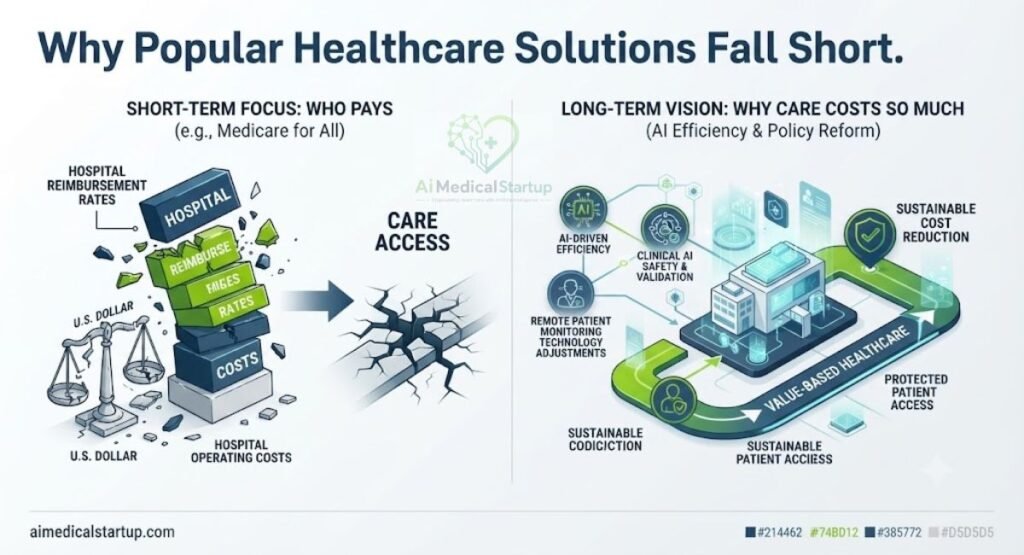
Why Popular Healthcare Solutions Fall Short
Popular proposals often focus on who pays rather than why care costs so much. MEDICARE FOR ALL could expand coverage, depending on its design and funding. However, MEDICARE REIMBURSEMENT RATES are generally lower than many commercial hospital payment rates. A sudden shift could create financial pressure for some hospitals unless policymakers adjust funding and address differences in HOSPITAL OPERATING COSTS.
Conversely, poorly designed HEALTHCARE PRICE CAPS or rigid HEALTHCARE SPENDING CAPS may discourage crucial investment or distort service delivery across the U.S. healthcare system.
The real challenge is improving healthcare delivery efficiency while protecting patient access and driving broader healthcare policy reform.
Will the U.S. Congress pass major healthcare spending caps before the upcoming election cycle concludes?
Thank you for voting! Results update in real-time.
Two Ways To Improve The Economics
The scale of the problem makes small fixes insufficient. According to the CENTERS FOR MEDICARE & MEDICAID SERVICES (CMS), U.S. HEALTHCARE EXPENDITURE reached $5.3 TRILLION in 2024, representing 18% of gross domestic product. Hospital care, physician services, and prescription medicines all contribute to this enormous bill.
CONGRESS needs reforms that address both the cost of treatment and the conditions that make treatment necessary. The first route focuses on PREVENTIVE HEALTHCARE and effective CHRONIC DISEASE MANAGEMENT. The second promotes HEALTHCARE MARKET COMPETITION, better insurance choices, and more HEALTHCARE DELIVERY EFFICIENCY. For US policymakers, the goal is LOWER-COST, HIGHER-QUALITY HEALTHCARE. UK and EU systems offer useful comparisons, but their funding models differ. Their experiences can inform policy without suggesting that one country’s solution will work everywhere.
1. Reducing Costs By Improving Health
Preventing disease can spare patients years of suffering and reduce the need for expensive hospital treatment. Effective CHRONIC DISEASE PREVENTION and CHRONIC DISEASE MANAGEMENT can help control DIABETES AND HYPERTENSION MANAGEMENT and OBESITY-RELATED ILLNESSES. Better access to primary care, regular screening, and medication support may reduce AVOIDABLE MEDICAL COMPLICATIONS, including PREVENTION OF HEART ATTACKS AND STROKES and PREVENTION OF KIDNEY FAILURE. However, prevention programmes also cost money, so policymakers must measure their long-term CLINICAL OUTCOMES and actual HEALTHCARE COST-EFFECTIVENESS.
Affordable GLP-1 Medications
Modern GLP-1 MEDICATIONS have changed obesity treatment, offering many eligible patients meaningful weight loss and metabolic benefits. SEMAGLUTIDE AND TIRZEPATIDE WEIGHT LOSS regimens can support weight management when combined with appropriate dietary changes and physical activity. Yet high prices can restrict access, making affordable weight-loss medications an important policy goal.
CONGRESS could encourage price competition and review insurance coverage. However, COMPOUNDED GLP-1 MEDICATIONS are not FDA-APPROVED WEIGHT-LOSS MEDICATIONS substitutes, and federal COMPOUNDED MEDICATION REGULATIONS under the FOOD, DRUG, AND COSMETIC ACT restrict copies of commercially available drugs during or outside FDA DRUG SHORTAGE EXEMPTIONS.
Generative AI for Chronic Disease Control
A patient with hypertension might measure their blood pressure at home but struggle to interpret weeks of readings. GENERATIVE AI IN HEALTHCARE could help summarize these measurements, identify concerning patterns, and alert clinicians when further review is appropriate. Connected blood pressure monitoring and blood glucose monitoring systems could support REMOTE PATIENT MONITORING TECHNOLOGY and EARLY INTERVENTION FOR CHRONIC CONDITIONS.
Still, PATIENT-FACING GENERATIVE AI must not independently change prescriptions without appropriate clinical oversight. Developers and healthcare providers need rigorous clinical AI safety and validation, privacy protections, and evidence that these systems improve outcomes rather than simply add another layer of cost.
2. Lowering Costs Through Greater Competition & Improved Care
More choices can improve value when consumers have clear information and genuine alternatives. In the UNITED STATES, INDIVIDUAL COVERAGE HEALTH REIMBURSEMENT ARRANGEMENTS (ICHRAs) allow eligible employers to reimburse workers for INDIVIDUAL HEALTH INSURANCE MARKETS and certain OUT-OF-POCKET HEALTHCARE EXPENSES. This EMPLOYER-FUNDED INDIVIDUAL HEALTH COVERAGE approach can expand choice beyond traditional EMPLOYER-SPONSORED HEALTH INSURANCE. However, workers still need help comparing premiums, deductibles, provider networks, and coverage limits.
CONGRESS could strengthen HEALTHCARE PRICE TRANSPARENCY by encouraging clear INSURANCE PLAN CLINICAL OUTCOME COMPARISONS of total costs. Better COORDINATED CARE, stronger HEALTHCARE INSURANCE COMPETITION, and VALUE-BASED HEALTHCARE contracts may reward CAPITATED PHYSICIAN GROUPS for keeping patients healthier rather than delivering more services. HEALTH SAVINGS ACCOUNTS (HSAs) may also help eligible Americans manage certain TAX-ADVANTAGED HEALTHCARE SAVINGS ACCOUNTS expenses. Yet competition alone cannot solve every problem, especially where rural communities have few providers or patients cannot afford coverage.
| Healthcare Challenge | Potential Solution | Important Consideration |
|---|---|---|
| High medicine prices | Negotiation and competition | Preserve access to effective treatment |
| Chronic disease complications | Prevention and remote monitoring | Measure actual clinical benefits |
| Limited insurance choice | ICHRAs and individual plans | Compare total costs and coverage |
| Fragmented treatment | Coordinated care | Protect continuity and quality |

FAQs about Healthcare’s Harsh Math
Healthcare reform after elections requires more than political promises. Policymakers must examine whether proposed changes improve access, reduce unnecessary spending, and protect patients. The following answers address common questions about MEDICAL CARE AFFORDABILITY, healthcare technology, and practical policy options.
For readers in the USA, UK, and EU, the central lesson is that healthcare systems need sustainable funding and measurable results. Effective HEALTHCARE COST-EFFECTIVENESS depends on local regulations, patient needs, and how well each reform works in practice.
Why are healthcare costs so high in the United States?
The US faces high medical prices, substantial administrative expenses, expensive treatments, and growing demand for healthcare services. CMS reported $5.3 TRILLION in national healthcare spending during 2024. Improving healthcare delivery efficiency may help control spending, but reforms must also protect access to necessary treatment.
Can Medicare for All reduce healthcare costs?
MEDICARE FOR ALL could change insurance administration, coverage, and payment rates. Its overall effect would depend on programme design, taxes, provider reimbursement, and how patients use services. Expanding UNIVERSAL HEALTHCARE COVERAGE does not automatically guarantee lower total expenditure or eliminate PATIENT WAITING TIMES FOR MEDICAL CARE.
Can generative AI make healthcare more affordable?
Potentially. AI-powered chronic disease management could support REMOTE PATIENT MONITORING TECHNOLOGY, earlier clinical intervention, and better communication between patients and healthcare professionals. However, savings depend on implementation costs, reliable technology, and demonstrated improvements in CLINICAL OUTCOMES.
How can Congress make GLP-1 medications more affordable?
CONGRESS could examine insurance coverage, medicine pricing, competition, and access for eligible patients. Any changes involving FDA-approved weight-loss medications or COMPOUNDED MEDICATION REGULATIONS must follow applicable law. Lower prices are valuable, but treatment decisions should also consider safety, suitability, and long-term health benefits.
What can the UK and EU learn from US healthcare reform?
The US, UK, and EU have different insurance arrangements, public funding systems, and regulatory frameworks. Comparing their experiences can reveal opportunities to improve PREVENTIVE HEALTHCARE, digital health, and resource allocation. Ultimately, HEALTHCARE ACCESS AND AFFORDABILITY require policies suited to each country’s needs rather than a single universal formula.
Conclusion
When the election ends, CONGRESS must move from promises to practical action. The AMERICAN HEALTHCARE AFFORDABILITY CRISIS will not disappear through HEALTHCARE PRICE CAPS alone or technology adoption without evidence. AFFORDABLE WEIGHT-LOSS MEDICATIONS, responsible GENERATIVE AI IN HEALTHCARE, and stronger HEALTHCARE INSURANCE COMPETITION offer useful opportunities, but each requires careful evaluation.
The real measure of successful CONGRESS HEALTHCARE REFORM is straightforward: can patients obtain effective care without facing unmanageable costs? By prioritizing prevention, transparency, and measurable outcomes, policymakers can work toward a healthcare system that serves patients more sustainably. Consult with Our Doctors for Healthcare Advice to learn more about navigating modern care options.




Dr. Kanza Sarfraz, M.B.B.S., is a medical doctor and graduate of Allama Iqbal Medical College, Lahore. She brings nearly seven years of clinical experience across tertiary-care hospitals, medical headquarters, and healthcare facilities in both the public and private sectors. Her clinical experience provides a practical perspective on healthcare delivery, emerging medical technologies, and the evolving role of artificial intelligence in medicine.