Osteosarcoma Treatment 2026: 4 Emerging Therapies to Watch

Osteosarcoma Treatment on the Brink of Change: 4 Emerging Therapies to Watch in 2026
Osteosarcoma remains one of the most challenging osteosarcoma bone cancer types to treat, especially when the disease returns as relapsed osteosarcoma, refractory osteosarcoma, or spreads as metastatic osteosarcoma directly to the lungs. Although surgery and osteosarcoma chemotherapy have improved historical osteosarcoma survival outcomes, patients facing advanced osteosarcoma treatment pathways still encounter limited options.
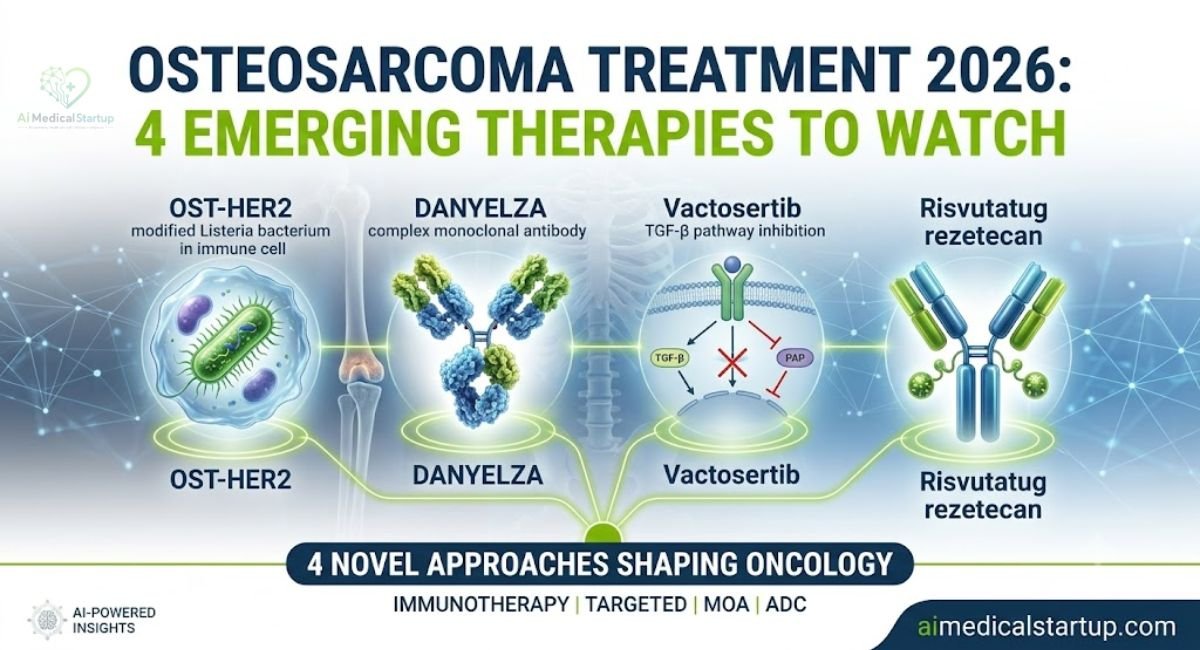
However, new research across the osteosarcoma drug pipeline is beginning to change this picture. Several emerging osteosarcoma therapies are actively exploring immune activation, targeted osteosarcoma therapy drug delivery, and modification of key tumor microenvironment signaling pathways. Among the most closely watched candidates evaluating new osteosarcoma treatment options are OST-HER2, DANYELZA, Vactosertib, and Risvutatug rezetecan. Each approaches the disease from a distinct biological angle, and their clinical findings could help address critical osteosarcoma unmet medical needs across the USA, UK, and Europe.
Osteosarcoma Treatment on the Brink of Change: 4 Emerging Therapies Target the Biggest Gaps in Relapsed Disease
For decades, osteosarcoma bone cancer treatment has relied on surgery and multi-agent osteosarcoma chemotherapy. The standard approach often combines Methotrexate, Doxorubicin, and Cisplatin, commonly known as MAP chemotherapy. Surgeons remove the primary tumor whenever possible. However, treatment becomes more complicated when cancer returns or spreads. The National Comprehensive Cancer Network (NCCN) approach and specialist sarcoma guidance consider disease location, previous treatment, and whether surgeons can remove metastatic lesions. To explore broader therapeutic frameworks, researchers frequently cross-reference clinical protocols with modern osteosarcoma treatment options.
The greatest challenge involves relapsed osteosarcoma and refractory osteosarcoma, where existing drugs may produce limited responses. Doctors may consider Ifosfamide, Etoposide, Regorafenib, Sorafenib, or Everolimus in selected settings. Radium-223 dichloride has also been investigated in bone sarcoma research. Meanwhile, Levoleucovorin (KHAPZORY) helps protect patients from high-dose methotrexate toxicity rather than directly attacking cancer. In Europe, Mifamurtide (MEPACT) has a specific indication for selected patients with resected, non-metastatic disease.
The Next Generation of Osteosarcoma Treatments: Promising Candidates to Watch
The osteosarcoma drug pipeline now includes several approaches beyond conventional chemotherapy. Researchers are investigating osteosarcoma immunotherapy, targeted osteosarcoma therapy, and antibody-based treatments that attack specific tumor markers. Inspired by breakthroughs in AI in drug discovery, these osteosarcoma clinical trials explore whether different mechanisms can improve responses in advanced osteosarcoma treatment. The four candidates below represent distinct strategies, although their clinical maturity and available evidence vary considerably.
| Investigational Therapy | Main Approach | Development Focus |
|---|---|---|
| OST-HER2 | Listeria-based immunotherapy | HER2-directed immune activation |
| DANYELZA | GD2 monoclonal antibody | Investigational osteosarcoma application |
| Vactosertib | TGF-β pathway inhibition | Tumor microenvironment modulation |
| Risvutatug rezetecan | B7-H3-targeted ADC | Targeted cytotoxic drug delivery |

OS Therapies’ OST-HER2
Among the leading emerging osteosarcoma therapies, OST-HER2 uses a live-attenuated Listeria monocytogenes platform to stimulate an immune response against cancer. Developed by OS Therapies, the candidate delivers tumor-associated antigens to Antigen-presenting cells (APCs). This process activates innate and adaptive immunity, encouraging HER2-specific T cells to recognize HER2-expressing cancers. The approach aims to target microscopic residual disease that conventional imaging may not detect. It therefore offers a different strategy for Osteosarcoma metastasis prevention and Pulmonary recurrence of osteosarcoma.
The most notable clinical update came on October 6, 2026. The company’s Phase IIb clinical trial reported a three-year Overall survival (OS) rate of 72.7%, compared with 45.8% in a combined historical control group. The reported P-value was 0.0006. However, the study enrolled only 41 patients and used historical rather than randomized controls. This distinction matters when interpreting the results. OS Therapies is pursuing regulatory discussions in the USA, UK, and Europe, but OST-HER2 remains investigational rather than an approved treatment.
SERB Pharmaceutical’s DANYELZA
DANYELZA, also known as Naxitamab-gqgk, is a fully humanized GD2 monoclonal antibody developed to recognize GD2 on cancer cells. It can trigger Antibody-dependent cellular cytotoxicity, allowing immune cells to attack antibody-coated tumor cells. The FDA approved DANYELZA with granulocyte-macrophage colony-stimulating factor for selected patients with relapsed or refractory high-risk neuroblastoma involving bone or bone marrow. Its established indication is neuroblastoma, not osteosarcoma.
Nevertheless, researchers have explored GD2 as a potential target in osteosarcoma. An earlier study involving 39 patients evaluated naxitamab in recurrent osteosarcoma. It reported a 36% 12-month progression-free survival (PFS) / event-free survival rate, below the predefined 40% target. A subgroup with stronger GD2 expression showed encouraging findings, although the numbers were small. These results explain the scientific interest but do not establish clinical effectiveness. SERB Pharmaceutical acquired Y-mAbs Therapeutics in 2025, adding DANYELZA to its oncology portfolio. Further evidence is necessary before considering it an established advanced osteosarcoma treatment.

MedPacto’s Vactosertib
Vactosertib, also called TEW-7197, is an investigational TGF-β1 signaling inhibitor developed by MedPacto. It targets the signaling activity of Transforming growth factor beta, a pathway that can encourage cancer progression and suppress immune responses. In some tumors, TGF-β promotes Tumor-associated fibroblasts and excessive Extracellular matrix deposition. These changes can create a protective environment around cancer cells. By blocking this pathway, vactosertib may reduce Tumor immune suppression and improve antitumor activity.
Its preliminary results have attracted attention. In a Phase I study, 13 patients enrolled and 11 were evaluable for response. The reported Objective response rate (ORR) was 36.4%, including one complete response and three partial responses. Median Progression-free survival (PFS) was 1.9 months, while median overall survival reached 6.8 months. These early findings require confirmation. The ongoing Phase I/II study is assessing safety and dosing in adolescents and adults with recurrent or refractory disease. The FDA has also granted Fast Track and Rare Pediatric Disease designations.
GSK’s Risvutatug rezetecan
Risvutatug rezetecan, also known as GSK5764227 or HS-20093, is an investigational Antibody-drug conjugate (ADC) developed by GSK and Hansoh Pharma. It targets the B7-H3 protein, which is expressed in several solid tumors, including osteosarcoma. After binding to cancer cells, the antibody delivers a Cytotoxic payload designed to damage tumor DNA. Its topoisomerase I inhibitor payload offers a targeted delivery approach rather than relying solely on conventional chemotherapy, aligning with innovations studied in AI in drug discovery.
A major development arrived on October 26, 2026, when the randomized Phase III clinical trial ARTEMIS-011 met its primary endpoint. Among 122 heavily pretreated patients in China, median progression-free survival reached 5.5 months with risvutatug rezetecan versus 1.4 months with chemotherapy. The treatment reduced the risk of progression or death by 67% (hazard ratio 0.33). However, Grade 3 or higher treatment-related adverse events occurred in 93% of patients receiving the ADC. These findings are encouraging, but regulatory approval and further international evidence remain important next steps.
The Road Ahead for Osteosarcoma Treatment
The future of Osteosarcoma Treatment on the Brink of Change depends on whether these investigational approaches can deliver durable benefits. OST-HER2 focuses on immune activation, while DANYELZA explores GD2 targeting. Vactosertib addresses the tumor microenvironment, and risvutatug rezetecan delivers a cytotoxic drug through B7-H3 targeting. Together, these approaches illustrate how Osteosarcoma therapeutic development is moving beyond traditional chemotherapy. However, researchers must establish which patients benefit and whether these treatments improve long-term survival.
Regulatory progress will also influence access. The US Food and Drug Administration (FDA) may consider an Accelerated Approval pathway when appropriate evidence supports earlier access. Its Fast Track Designation (FTD), Orphan Drug Designation (ODD), Breakthrough Therapy Designation (BTD), Regenerative Medicine Advanced Therapy (RMAT), and Rare Pediatric Disease Designation (RPDD) programmes offer different development incentives. In Europe, the European Medicines Agency (EMA) and its Committee for Advanced Therapies (CAT) assess relevant applications. A Conditional Marketing Authorisation Application (CMAA) may also support earlier access when its requirements are met. None of these designations guarantees approval. Discover more about standard osteosarcoma treatment options as clinical standards evolve globally.
FAQs about Osteosarcoma Treatment
Explore expert insights and common clinical questions regarding modern osteosarcoma treatment options, clinical trials, and emerging drug pipelines.
Current osteosarcoma treatment options include surgery, chemotherapy, and selected targeted approaches. Researchers are investigating OST-HER2, DANYELZA, Vactosertib, and risvutatug rezetecan. However, these candidates remain investigational for osteosarcoma.
Some patients achieve long-term disease control when doctors can completely remove recurrent tumors, particularly isolated lung metastases. Outcomes depend on tumor location, disease burden, and previous treatment.
Early research into HER2-targeted immunotherapy and cell-based cancer vaccines offers potential, but evidence remains limited. Researchers also leverage insights from AI in drug discovery to evaluate efficacy patterns.
Doctors may consider osteosarcoma chemotherapy, targeted drugs, or osteosarcoma clinical trials depending on individual circumstances and prior treatment resistance.
Recent findings suggest progress, particularly for relapsed osteosarcoma and refractory osteosarcoma. Nevertheless, larger studies must confirm improvements in osteosarcoma survival outcomes before these experimental therapies become routine care.
The osteosarcoma treatment market reflects substantial osteosarcoma unmet medical needs, particularly for patients with metastatic osteosarcoma. Future research may combine multimodal osteosarcoma treatment with targeted drugs and immune-based approaches. Meanwhile, osteosarcoma chemotherapy remains central to current care, especially in pediatric osteosarcoma treatment. Researchers must establish the safety, effectiveness, and long-term benefits of new osteosarcoma medications before changing clinical practice.
References and Further Reading
For readers seeking reliable clinical information, the following resources provide additional details about current treatment standards and emerging research.
- National Cancer Institute – Osteosarcoma Treatment
- OS Therapies – OST-HER2 Three-Year Survival Results
- FDA – DANYELZA Prescribing Information
- Journal for ImmunoTherapy of Cancer – Vactosertib Clinical Findings
- GSK – Risvutatug Rezetecan Phase III Results
- DailyMed – KHAPZORY Prescribing Information
Medical Disclaimer
This article provides educational information and does not replace professional medical advice. Treatment decisions should be made with a qualified oncology team. Investigational therapies are not established osteosarcoma treatments unless specifically authorized for that indication.


Dr. Kanza Sarfraz, M.B.B.S., is a medical doctor and graduate of Allama Iqbal Medical College, Lahore. She brings nearly seven years of clinical experience across tertiary-care hospitals, medical headquarters, and healthcare facilities in both the public and private sectors. Her clinical experience provides a practical perspective on healthcare delivery, emerging medical technologies, and the evolving role of artificial intelligence in medicine.