top-8-companies-most-exposed-to-patent-cliff

Top 8 Big Pharma Companies Facing the Patent Cliff

PHARMACEUTICAL MARKET INTELLIGENCE • 2026–2030

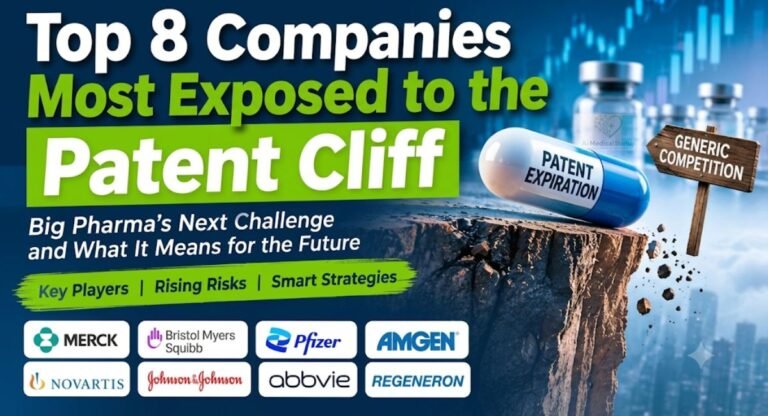
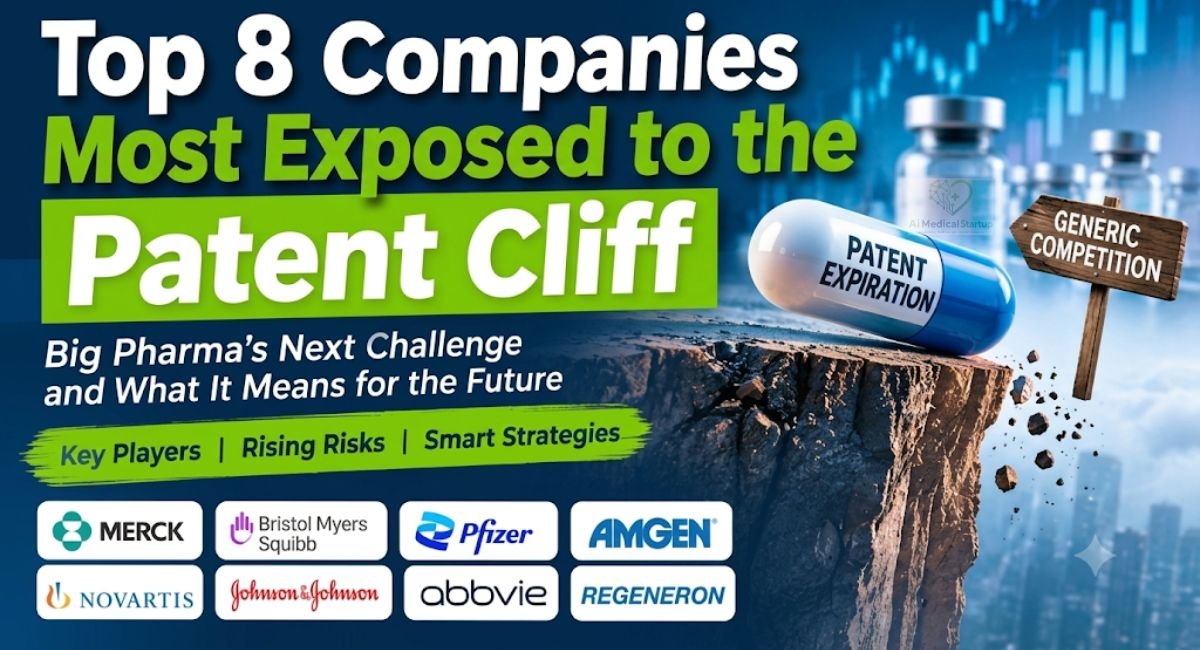
Top 8 Companies Most Exposed to the Patent Cliff: Big Pharma’s $300 Billion Challenge

The pharmaceutical industry is approaching one of its most consequential commercial transitions. Between 2026 and 2030, several blockbuster medicines will face patent expirations, generic competition, or biosimilar entry. For major drug makers, the challenge extends beyond losing market exclusivity. They must replace billions in established revenue while developing medicines through AI in drug discovery that can sustain future growth.

The pharmaceutical patent cliff is particularly important for companies that depend heavily on a handful of successful treatments. Merck & Co., Bristol Myers Squibb (BMS), and Pfizer face significant exposure, while AbbVie and Novartis are already demonstrating how portfolio transitions can soften the impact alongside healthcare technology innovation.

However, patent expiration does not automatically mean immediate revenue collapse. Litigation, regulatory exclusivity, settlement agreements, and new formulations can change the commercial timeline. Let’s examine the eight pharmaceutical giants, their most exposed medicines, and the strategies they are using to protect their future.
$300B+ Revenue at Risk
2026–2030 Transition Window
Top 8 Exposed Pharma Giants

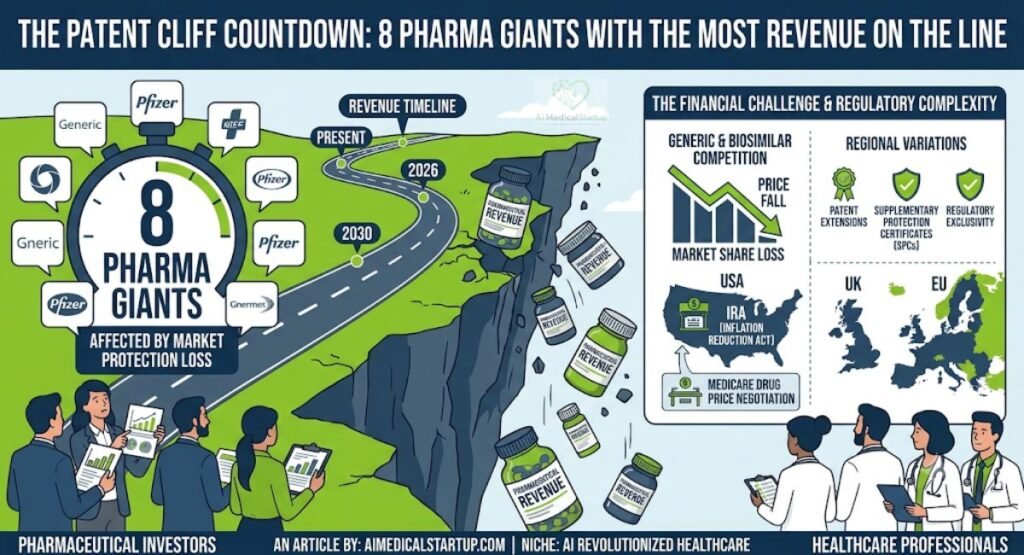
The Patent Cliff Countdown: 8 Pharma Giants With the Most Revenue on the Line

A pharmaceutical patent cliff occurs when a medicine loses its legal market protection and competing manufacturers can enter. Once generic drug competition or biosimilar competition begins, prices can fall quickly. The original manufacturer may lose substantial market share even when the medicine remains clinically important.

The financial consequences vary across the USA, UK, and EU because patent extensions, supplementary protection certificates (SPCs), and regulatory exclusivity follow different rules. Moreover, the Inflation Reduction Act (IRA) introduces Medicare drug price negotiation before some products face generic entry. These overlapping pressures make the coming patent expiry timeline particularly important for pharmaceutical investors and healthcare professionals.

the-patent-cliff-countdown-8-pharma-giants-with-the-most-revenue-on-the-line

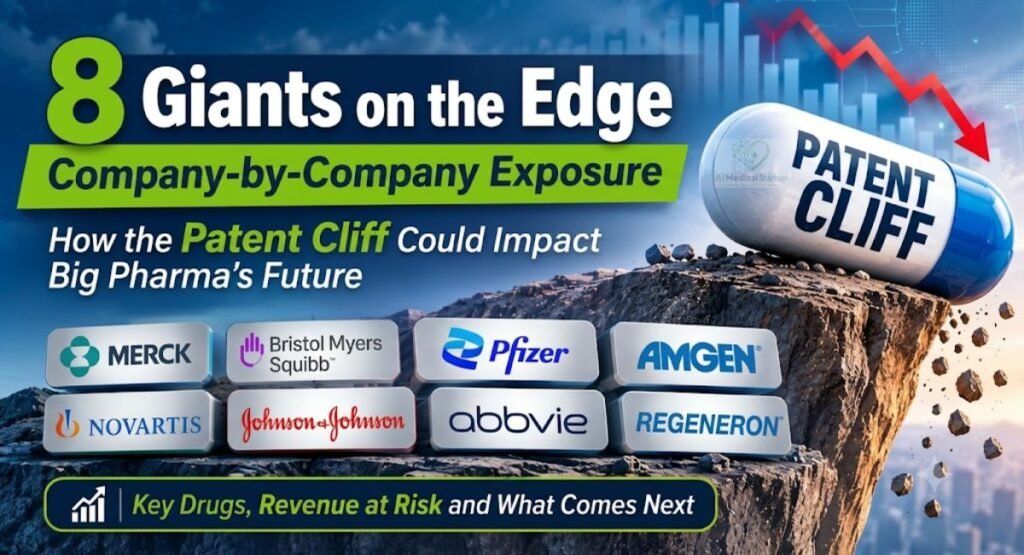
8 Giants on the Edge: Company-by-Company Exposure

Not every pharmaceutical company faces the same level of pharmaceutical revenue exposure. Some depend heavily on one blockbuster medicine, while others have several products approaching loss of exclusivity (LOE). The difference matters because a company with a diversified portfolio can absorb declining sales more easily.

To understand the coming pharmaceutical patent cliff, we must examine individual product revenues, patent protection, commercial competition, and replacement medicines. The following companies illustrate different approaches to managing revenue erosion and maintaining long-term growth.

SC KEYTRUDA • QUARTERLY SALES

Quarterly Sales of SC KEYTRUDA in USD Millions, with its Share of KEYTRUDA Family Sales

Revenue ($M) & Family Share (%)
Hover or tap any quarter to inspect live metrics.
Q3 2026 SHARE OF FAMILY 9.7% up from 0.1% in Q3 2025
Q3 2025 TO Q3 2026 166× revenue growth, from $5M to $830M
ONCOLOGY • PATENT CLIFF EXPOSURE

Merck & Co.: KEYTRUDA, the $31 Billion Question

Merck & Co. faces considerable exposure because KEYTRUDA (pembrolizumab) has become the foundation of its oncology franchise. The medicine generated approximately $31.68 billion in combined KEYTRUDA and KEYTRUDA QLEX sales during 2025. It treats numerous cancers, including lung cancer, melanoma, and bladder cancer.

Its US compound patent expires in December 2028, although additional patent claims and litigation may influence actual market entry. Merck is developing KEYTRUDA QLEX, a subcutaneous formulation, to improve administration convenience and protect its commercial position. Meanwhile, WINREVAIR, WELIREG, and its broader oncology drug pipeline offer additional growth opportunities. The central question is whether these revenue replacement strategies can offset potential losses from its largest medicine.

CARDIOVASCULAR • ONCOLOGY • DOUBLE CLIFF

Bristol Myers Squibb: ELIQUIS and OPDIVO, a Double Cliff

Bristol Myers Squibb (BMS) faces a challenging combination of cardiovascular and oncology exposure. ELIQUIS (apixaban) generated approximately $14.4 billion in 2025 global sales, while OPDIVO (nivolumab) contributed around $10 billion.

European generic competition for ELIQUIS began in 2026, while US settlements permit certain generic manufacturers to launch from April 2028. OPDIVO also faces future exclusivity pressure, with estimated minimum dates of 2028 in the USA and 2030 in the EU. Its newer formulation, OPDIVO QVANTIG, offers another lifecycle-management opportunity. BMS is also expanding through CAMZYOS, REBLOZYL, BREYANZI, and COBENFY, alongside radiopharmaceuticals and other next-generation treatments.

CARDIOVASCULAR • ONCOLOGY • IMMUNOLOGY • VACCINES

Pfizer: Five Franchises, One Rolling Cliff

Pfizer faces a broader patent cliff exposure across cardiovascular medicine, oncology, immunology, and vaccines. Its established products include ELIQUIS, IBRANCE, XTANDI, and XELJANZ. Pfizer's 2025 annual report identifies several US patent expirations between 2026 and 2027 for these products, although actual generic entry depends on settlements and remaining patent rights.

The company is investing heavily in replacement opportunities following its Seagen acquisition, which expanded its antibody-drug conjugates (ADCs) portfolio through medicines such as ADCETRIS, PADCEV, and TUKYSA. Its wider portfolio also includes PREVNAR 20, ABRYSVO, and VYNDAMAX. Pfizer must scale these growth opportunities quickly enough to manage declining legacy-product revenue.

BIOLOGICS • BIOSIMILARS • PATENT EXPOSURE

Amgen: ENBREL, PROLIA/XGEVA and OTEZLA Under Pressure

Amgen faces established-product pressure from several directions. ENBREL generated approximately $2.23 billion in 2025 sales, while XGEVA contributed around $2.08 billion and OTEZLA approximately $2.27 billion. PROLIA and XGEVA contain denosumab and now face increasing biosimilar competition following important US patent expirations in 2025. ENBREL also faces long-term patent and pricing pressure, while OTEZLA is affected by Medicare price negotiations. However, Amgen has meaningful growth opportunities through REPATHA, TEZSPIRE, and EVENITY. Its own biosimilar portfolio, including AMJEVITA and PAVBLU, provides an additional commercial advantage.

PORTFOLIO DIVERSIFICATION • GENERIC COMPETITION

Novartis: ENTRESTO, PROMACTA and TASIGNA, Already Over the Edge

Novartis demonstrates what happens when major products have already entered the generic competition phase. ENTRESTO generated $7.75 billion in 2025 sales, while PROMACTA contributed $1.64 billion and TASIGNA approximately $1.10 billion. US generic competition for these medicines began during 2025, creating substantial commercial pressure.

However, Novartis has developed a strong replacement portfolio. KISQALI generated $4.78 billion, KESIMPTA contributed $4.43 billion, and COSENTYX reached $6.67 billion in 2025 . PLUVICTO, SCEMBLIX, and LEQVIO also support its growth strategy. This pharmaceutical portfolio diversification helps Novartis manage established-product erosion while investing in innovative treatments.

LOSS OF EXCLUSIVITY • 2025 – 2031

Estimated Loss-of-Exclusivity Milestones for the Flagship Products

Tap any milestone node to inspect details
IMMUNOLOGY • ONCOLOGY • BIOSIMILARS

Johnson & Johnson: STELARA’s Fall and the Growth Franchises Behind It

Johnson & Johnson (J&J) has already experienced substantial biosimilar competition against STELARA. Its sales declined 41.3% to approximately $6.08 billion in 2025 following US biosimilar launches. Meanwhile, DARZALEX generated $14.35 billion, making it a major contributor to the company's oncology business.

TREMFYA also delivered impressive growth, reaching approximately $5.16 billion. Other important medicines include IMBRUVICA, CARVYKTI, TECVAYLI, TALVEY, RYBREVANT, and LAZCLUZE. These treatments strengthen J&J's oncology and immunology portfolio. Its experience shows how a diversified pharmaceutical business can absorb substantial losses from an established blockbuster while expanding newer therapeutic franchises.

IMMUNOLOGY • LIFECYCLE MANAGEMENT • BIOSIMILARS

AbbVie: SKYRIZI and RINVOQ, the Cliff Survivors

AbbVie offers an important example of successful drug lifecycle management following a major patent expiration. HUMIRA lost US exclusivity in January 2023, allowing biosimilar manufacturers to compete in its market. Its global sales declined to approximately $4.54 billion in 2025 from $14.40 billion in 2023.

However, SKYRIZI generated $17.56 billion and RINVOQ contributed $8.30 billion during 2025 . Together, these newer immunology medicines have become powerful growth drivers. AbbVie is also investing in neuroscience and oncology to reduce future dependence on individual products. Nevertheless, the company must protect the long-term commercial position of its replacement medicines as their own patent-expiry dates approach.

OPHTHALMOLOGY • FORMULATION INNOVATION • BIOSIMILARS

Regeneron: EYLEA and the Race to EYLEA HD

Regeneron faces increasing competition in ophthalmology following the loss of important US exclusivity protection for EYLEA. The medicine treats retinal conditions such as wet age-related macular degeneration and diabetic macular edema. Biosimilar competition from products such as PAVBLU has contributed to declining sales. Regeneron's response is EYLEA HD, a higher-dose formulation designed to offer longer treatment intervals.

Its US sales reached approximately $1.6 billion in 2025, increasing 36% year over year . Meanwhile, VABYSMO provides additional branded competition. Regeneron's broader portfolio includes DUPIXENT and LIBTAYO, helping reduce dependence on ophthalmology revenue. The company must now balance formulation innovation with growing competition across retinal treatments.

8-giants-on-the-edge-patent-cliff

The Verdict: Who Is Ready for the FALL?

The TOP 8 COMPANIES most exposed to the PATENT CLIFF face different financial challenges. MERCK must manage its dependence on KEYTRUDA[cite: 1], while BMS faces overlapping pressure from ELIQUIS and OPDIVO[cite: 1]. PFIZER must navigate several upcoming exclusivity expirations. AMGEN and REGENERON face biosimilar competition across established franchises. Meanwhile, NOVARTIS, J&J and ABBVIE demonstrate how newer medicines can support a commercial transition. Their experiences show why PHARMACEUTICAL ACQUISITIONS, INNOVATION and effective PATENT CLIFF STRATEGY matter.

MERCK High Exposure
Major Exposure: KEYTRUDA[cite: 1]
Replacement Strategy: KEYTRUDA QLEX & ONCOLOGY PIPELINE
BMS High Exposure
Major Exposure: ELIQUIS & OPDIVO[cite: 1]
Replacement Strategy: New ONCOLOGY & CARDIOVASCULAR PRODUCTS
PFIZER Moderate Exposure
Major Exposure: Multiple established franchises
Replacement Strategy: SEAGEN PORTFOLIO & PIPELINE
AMGEN High Exposure
Major Exposure: PROLIA, XGEVA & ENBREL
Replacement Strategy: REPATHA & newer BIOLOGICS
NOVARTIS Transitioning
Major Exposure: ENTRESTO & established brands
Replacement Strategy: KISQALI & PLUVICTO
J&J Transitioning
Major Exposure: STELARA
Replacement Strategy: TREMFYA & DARZALEX
ABBVIE High Exposure
Major Exposure: HUMIRA
Replacement Strategy: SKYRIZI & RINVOQ
REGENERON Moderate Exposure
Major Exposure: EYLEA
Replacement Strategy: EYLEA HD & DUPIXENT

Ultimately, the next PHARMACEUTICAL PATENT CLIFF will reward companies that prepare early. Strong PHARMACEUTICAL R&D INVESTMENT, effective acquisitions and NEXT-GENERATION THERAPIES can protect long-term competitiveness. However, companies must also manage pricing negotiations, PATENT LITIGATION and changing regulatory requirements. The FDA and EUROPEAN MEDICINES AGENCY (EMA) influence different aspects of medicine approval and market access, making regional planning essential. For the BIG PHARMA companies, the challenge is clear: replacing established BLOCKBUSTER REVENUE requires more than another successful launch. It demands a sustainable INNOVATION STRATEGY.

Top 8 Big Pharma Companies Facing the Patent Cliff

PHARMACEUTICAL MARKET INTELLIGENCE • 2026–2030 Top 8 Companies Most Exposed to the Patent Cliff: Big...

HIBSAGO FDA Approval: New Hope for Chronic Hepatitis B Cure

FDA APPROVAL • CHB BREAKTHROUGH HIBSAGO’s Potential to Reshape the CHB Treatment Landscape How GSK...

MedTech News | Laza Medical, Medtronic, SetPoint Medical

AI Healthcare Insights & Industry Updates MedTech News | Laza Medical, Medtronic, SetPoint...
Dr. Kanza Sarfraz

Dr. Kanza Sarfraz, M.B.B.S., is a medical doctor and graduate of Allama Iqbal Medical College, Lahore. She brings nearly seven years of clinical experience across tertiary-care hospitals, medical headquarters, and healthcare facilities in both the public and private sectors. Her clinical experience provides a practical perspective on healthcare delivery, emerging medical technologies, and the evolving role of artificial intelligence in medicine.

View All Post

Leave a Reply

Your email address will not be published. Required fields are marked *