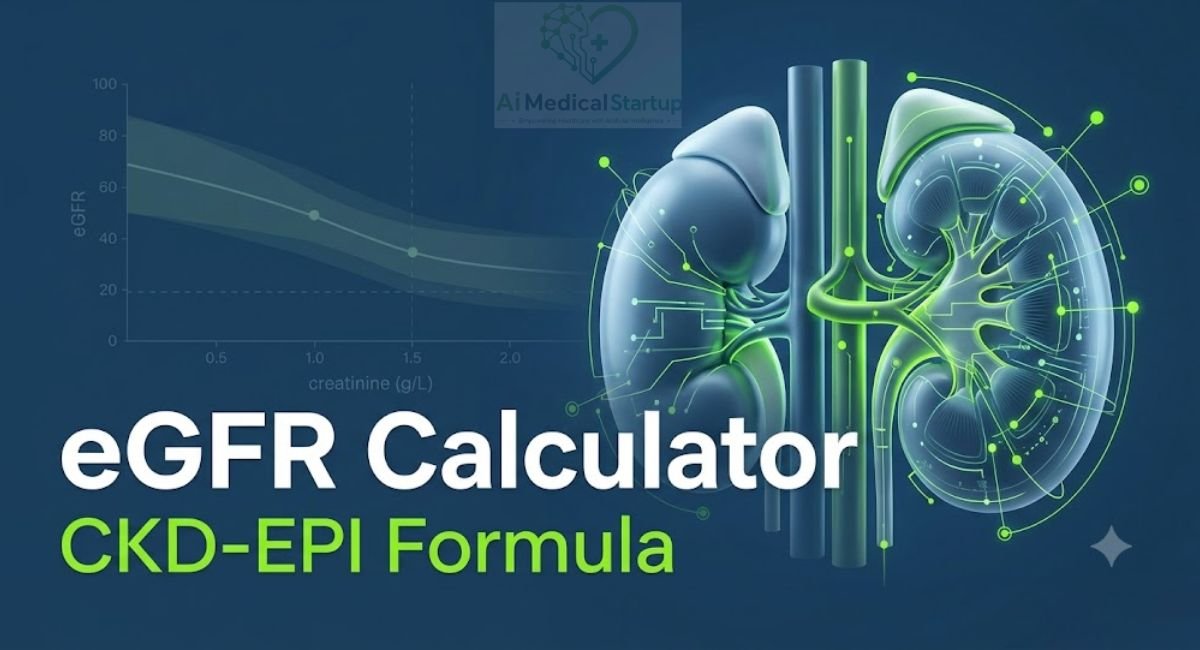
eGFR Calculator

eGFR Calculator
The estimated Glomerular Filtration Rate (eGFR) is widely regarded as the gold-standard metric for assessing renal function and staging Chronic Kidney Disease (CKD).
eGFR Calculator (CKD-EPI)
Estimate kidney function using the race-free CKD-EPI creatinine equation.
How the Calculation Works
Understanding the CKD-EPI Race-Free Equation
The estimated Glomerular Filtration Rate (eGFR) is widely regarded as the gold-standard metric for assessing renal function and staging Chronic Kidney Disease (CKD). CKD-EPI (Chronic Kidney Disease Epidemiology Collaboration) formula refines previous equations by eliminating race coefficients, providing an unbiased, accurate, and standardized measurement of filtration capacity based strictly on serum creatinine, age, and biological sex.
Formula Variables & Parameters
- \(S_{cr}\) Serum creatinine concentration expressed in mg/dL.
- \(\kappa\) (Kappa) Baseline constant set to 0.7 for females and 0.9 for males.
- \(\alpha\) (Alpha) Exponent scaling factor set to -0.241 for females and -0.302 for males.
- Min / Max Piecewise exponential functions accounting for the non-linear relationship between serum creatinine concentration and actual glomerular filtration.
eGFR Distribution & Equation Comparison
Visualizing population eGFR frequency and contrasting the 2021 CKD-EPI vs. Legacy MDRD formulas.
eGFR Equation Comparison
CKD-EPI 2021 (Race-Free)
- Race Coefficient: None (Race-free, clinically equitable)
- Accuracy: Superior accuracy across all eGFR levels (>60 and <60)
- Clinical Standard: Recommended by NKF & ASN Task Force
MDRD Study Equation
- Race Coefficient: Included racial adjustments
- Limitations: Underestimates true GFR in healthy individuals (>60)
- Status: Phased out in modern laboratory reporting
Frequently Asked Questions (FAQs)
Common questions about eGFR, kidney function, and testing
A normal eGFR for adults is 90 mL/min/1.73m² or higher. However, eGFR naturally declines with age. An eGFR consistently between 60 and 89 without kidney damage markers may be typical for older adults, whereas an eGFR below 60 for 3 or more months indicates Chronic Kidney Disease (CKD).
The Task Force established by the National Kidney Foundation (NKF) and the American Society of Nephrology (ASN) recommended removing race from eGFR calculations to improve clinical consistency, eliminate racial bias, and facilitate equitable healthcare delivery without compromising diagnostic accuracy.
Serum Creatinine measures the concentration of a waste product in your bloodstream produced by muscle metabolism. eGFR uses that creatinine level along with age and sex to estimate how many milliliters of blood your kidneys filter every minute, providing a far clearer picture of overall kidney function.
To ensure accurate test results, avoid eating large amounts of cooked red meat or taking creatine supplements within 24 hours of your blood draw, as these can temporarily elevate serum creatinine levels and artificially lower your calculated eGFR.


Dr. Kanza Sarfraz, M.B.B.S., is a medical doctor and graduate of Allama Iqbal Medical College, Lahore. She brings nearly seven years of clinical experience across tertiary-care hospitals, medical headquarters, and healthcare facilities in both the public and private sectors. Her clinical experience provides a practical perspective on healthcare delivery, emerging medical technologies, and the evolving role of artificial intelligence in medicine.